Something clicked today.
I've been heads-down on this adaptation for months — fixing rules, resolving edge cases, playtesting, iterating. Most of that work is granular. You're zoomed in on a single mechanic, a single room, a single edge case. It's hard to see the whole thing from there.
Today I zoomed out, and I saw something I hadn't seen before: the game has a language. Not just rules. A language — a consistent grammar that, once learned, applies everywhere. When a player encounters something new, they don't have to re-read the rules. They already know how it works because it follows the same logic as everything else they've already learned.
Two specific systems crystallized for me. I want to write them down while the clarity is fresh.
The three dice
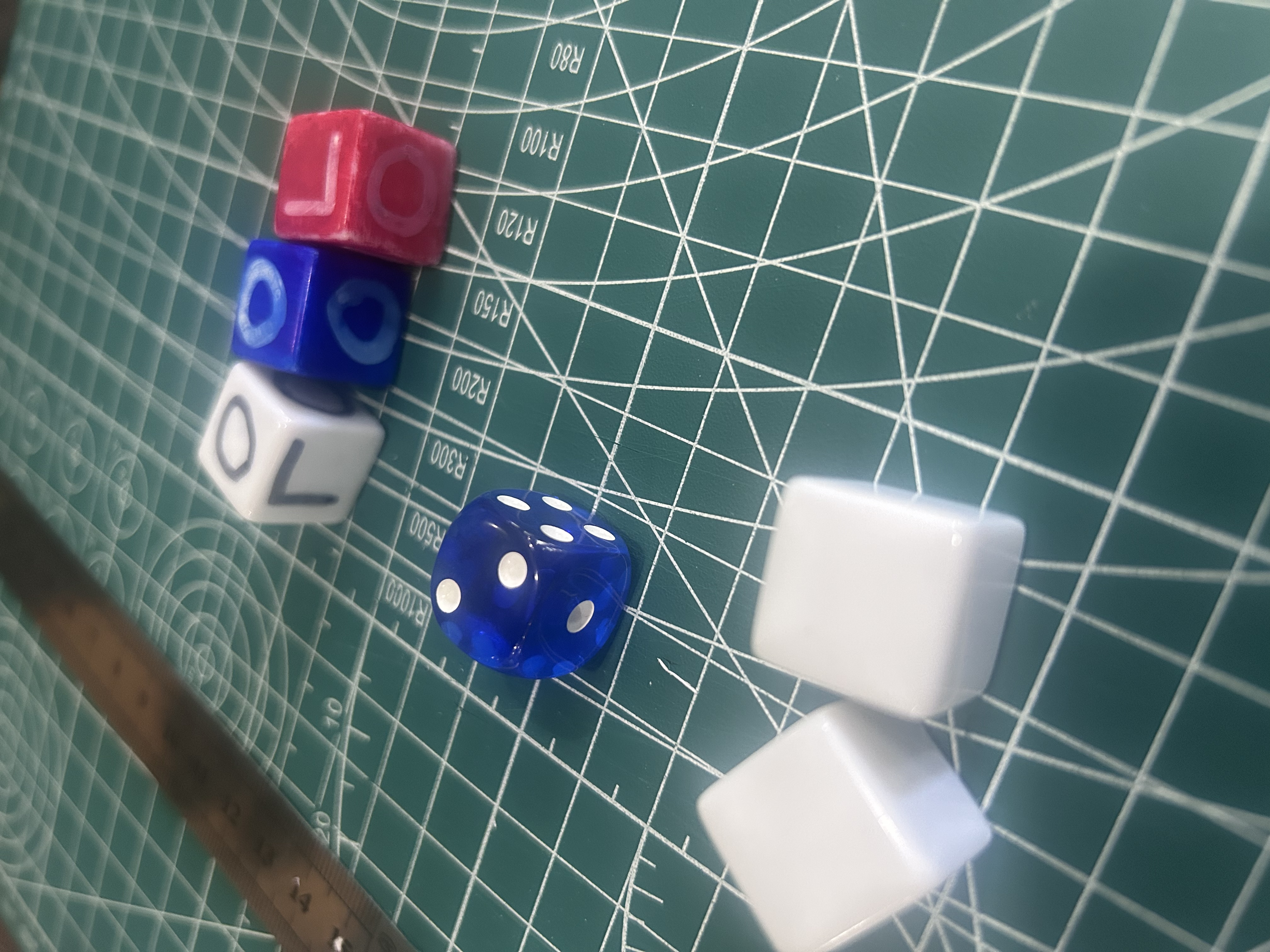
Blue Prince the board game uses three distinct physical dice. Before today, their roles had blurred — the same die was being used for door locks, trunk presence, item spawns, and more. A player couldn't build a mental model because the same object meant different things in different contexts.
Today that got fixed. Each die now has one job and only one job:
The Ivory Die is the most interesting of the three. It occupies a category that nothing else in the game occupies: it resembles a die but functions as a consumable item. That distinctiveness is actually an asset — players handle it differently from the moment they pick it up, because it doesn't behave like a die they roll. It behaves like a coin they spend.
The standard d6 answers: will I get lucky?
The Ivory Die answers: do I have enough left?
Three questions. Three objects. No overlap.
The two card flavors
The game uses several physical card decks — Common Items, Special Items, Dig Results, Trunk Results, and a few others. For a long time these all felt like one thing: "draw a card, see what happens." But there are actually two fundamentally different types of cards in this game, and confusing them creates table confusion.
The distinction matters at the table. A Flavor 1 card resolves and disappears — you never hold it, carry it, or refer to it again. A Flavor 2 card hands you something physical that persists and has its own rules. When a player draws from a deck, they should know immediately which type they're dealing with: does this card give me an effect, or does it give me a thing?
This also means the item cards and token cards live in different mental buckets. You don't "carry" a Running Shoes card through a run the way you carry a Shovel token. The Running Shoes happened to you. The Shovel is with you.
What game language actually means
A rulebook that is only a list of instructions has to be re-read. Every time a player encounters a new situation, they go back to the book to find the specific rule for that specific case. That's not a bad rulebook — it's a reference document. But it's not a language.
A game language is different. When a player learns that OPEN/LOCKED dice only ever answer the lock question, they never have to look up what a die roll means in a new context. They already know. When they learn that Flavor 2 cards always trade for a physical token, they know what to do the moment they draw one they've never seen before. The grammar of the system extends to new situations automatically.
This is what low cognitive load actually looks like in practice. It's not about simplifying mechanics — it's about making the mechanics consistent enough that players can reason about new situations from first principles instead of having to memorize every case.
I'm not saying we're there yet. The game has rough edges and the playtesting hasn't finished. But today I can see the shape of the thing for the first time. The rules aren't a list anymore. They're starting to be a grammar.