It Started as a Board Game
Before Blue Prince was a video game, it was a notebook. Around 2016, solo developer Tonda Ros was working through a handful of board game concepts — one of which combined the architectural language of blueprints with the mechanical concept of card drafting. The player draws cards, chooses a room, lays it down on a grid. That was the idea.
A few months later, Ros was experimenting with Unity and built a first-person room prototype in an afternoon. He recognized something — the two projects belonged together. He deleted his irregular digital rooms and started over with a uniform 10×10 grid so tiles could snap together neatly. The physical game concept became the mechanical skeleton of the video game.
"The mechanical core of Blue Prince comes entirely from the world of tabletop and card games."— Tonda Ros (Dogubomb) · Thinky Games, April 2025
He was also, by his own account, unfamiliar with digital roguelikes at the time. Slay the Spire hadn't been released. The games he was drawing from were Dominion, Ascension, and other tabletop drafting games.
"I was not familiar with roguelikes. Slay the Spire hadn't come out at the time. So my stuff was mostly based on board game stuff."— Tonda Ros · Vice / Waypoint, April 2025
What this means for a physical adaptation: the underlying mechanics were never truly converted from analog to digital. They were always analog. A physical board game adaptation of Blue Prince is closer to a homecoming than a translation.
Designing for Strategic Cohesion
One of the more specific things Ros has said about Blue Prince's design is that he deliberately engineered the room system to resist tier lists — the tendency in strategy games for players to memorize a fixed ranking of options and stop thinking.
"If you get a Nursery, suddenly every Bedroom will give you five more steps. So that changes the evaluation of how you judge the rooms from day to day. If not, then you have your tier list of rooms — you obviously have to take the doors into account, but other than that, you don't have to use too much thinking and strategy. I wanted to include enough strategic cohesion."— Tonda Ros · Vice / Waypoint, April 2025
The mechanism is room synergy: individual rooms that change the value of other rooms in play. A Nursery makes Bedrooms worth more. A Foyer unlocks Hallway doors. A Utility Closet changes what's possible in powered rooms elsewhere on the grid. None of these effects are intrinsically powerful — their value is entirely contextual, shifting from run to run depending on what else got drafted that day.
The result is what Ros calls "strategic cohesion." Not a static hierarchy of good and bad rooms, but a live evaluation problem that changes every time you open a door. He's played 10,000 hours of his own game and still has to think about what he's choosing.
This design principle has direct implications for the physical adaptation. In the board game, the same tension applies: players need a reason to evaluate rooms dynamically rather than defaulting to a fixed path north. The synergy system — rooms that affect other rooms — is one of the key mechanics being carried over faithfully. But it's also adjacent to the open design problem from Session 3: if players have no reason to explore sideways, they won't. Room synergies are part of the answer. A lore/breadcrumb layer may be the other part.
The Community Exists and Is Growing
Blue Prince released in April 2025 to widespread critical acclaim, winning Outstanding Achievement for an Independent Game and Outstanding Achievement in Game Design at the 29th Annual D.I.C.E. Awards. It launched on Switch 2 in March 2026, bringing a new wave of players into the game.
The Blue Prince Discord is active with fans discussing the game's mechanics in detail. When the board game concept comes up — and it does — players engage immediately. Several community members have started their own adaptation attempts, confirming the appetite is real and unsatisfied.
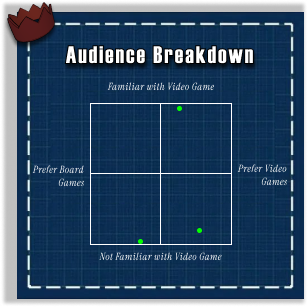
Three sessions. Three players. Three different quadrants.
The game has been playtested by three people so far — each landing in a different quadrant of this matrix. One familiar with the video game who prefers board games. One familiar with the video game who prefers video games. One with no prior Blue Prince experience at all.
All three rated it 4/5 for fun. All three would play again. The addressable audience isn't a single niche — it cuts across both communities.
Nobody Has Built This Yet
As of May 2026, no working physical adaptation of Blue Prince exists. Two efforts are visible in the community:
A multi-contributor "inspired by" adaptation set in a corporate building. Extensive room list, items, and lore across multiple contributors. Has compelling ideas including a vertical floor structure and a keycard clearance system.
No turn structure. No draft procedure. No playtesting. A content list without a game underneath it.
A community member cut and framed the video game's room art in colored card stock, exploring layout possibilities on a table.
No inventory system, no mat, no token infrastructure, no rules layer.
Blue Prince: Board Game is the only project with a working prototype, documented rules, playtested sessions, and a public dev log. Three sessions complete. NPS 7–8. Both players in Session 3 would play again.
"Very similar isn't the same as a Blue Prince board game. I'd love to see one."— Reddit, r/BluePrince · Thread: "Blue Prince board game" · 1 year ago, still unanswered
A year-old Reddit thread asking whether Blue Prince would make a good board game surfaced consistent community appetite — multiple independent requests, comparisons to tile-drafting games like Between Two Castles of Mad King Ludwig, and two separate suggestions for a legacy-style format with sealed packs and progressive tile reveals. One commenter correctly identified that Tonda Ros originally designed it as a board game. Nobody in the thread had built anything. The question remains open in the community.
The closest existing analog in the market is Between Two Castles of Mad King Ludwig — a co-op tile-drafting game with room placement and color-coded effects. It's not Blue Prince. But its existence confirms there's a proven commercial market for exactly this mechanic set.
Where This Adaptation Stands
Blue Prince: Board Game is a non-commercial fan adaptation — solo/2-player co-op, tile-drafting, roguelike run structure, targeting 45 minutes. It has been in active development since early 2026, with all design decisions logged publicly in the dev log.
The design philosophy is faithful-first: every deviation from the video game is documented with justification. The goal is not to simplify Blue Prince into a board game — it's to surface the board game that was always inside it.
"First, as a concept for a physical tabletop game involving drawing cards and drafting rooms. And the second, as a first-person puzzle game set in a large mansion of many doors."— Tonda Ros, describing Blue Prince's dual origin · Thinky Games, April 2025
The project is in active playtesting. If you're interested in following the development, playtesting a session, or getting notified when a stable print-and-play version is available, the signup form is on the About page.