The wind off Lake Michigan was cold, but inside a Chicago row house, surrounded by prototype cardboard tiles and a blue physical service bell, sits the designer who decided to do something the Blue Prince community has been dreaming about since the game launched: turn the digital, ever-shifting rooms of Mt. Holly into a physical board game. C.H. is a UX professional by day — the kind who designs financial interfaces you would likely recognize — but today the table in front of him holds a 5×9 hand drawn grid, a cloth bag full of handmade tiles, and a set of custom-painted lock dice. He agreed to talk through the whole thing: the origin story, the math, the moments of failure, and why a stack of tiles falling over was one of the most important things that's happened to this project.
We'll start at the beginning, because the beginning of this story is unusual. You've mentioned that your entire trajectory as a designer — professionally and now as a game designer — traces back to a single childhood memory. Tell us about the box from California.
My older cousin lived in California — I grew up in Chicago — and at some point when I was around seven, he sent me a paper prototype of a board game he was working on. It was called Skate or Die. And what I remember most is that it was three-dimensional. He had actually built stuff out of cardboard. My memory interprets it as a miniature skate park — a diorama. Ramps, structure, depth. Something you could reach into.
What stayed with me — and I only understand this now, looking back — is that it was completely white. No color. No graphics. Just white paper and white cardboard. A pure paper prototype. No fluff. Just the idea of the thing.
And that philosophy — stripping everything down to the raw idea — carried forward into your professional life?
Completely. The "white paper" approach is a standard UX tactic — you strip away all the visual design, all the fluff, and you focus on the underlying interaction. Does the thing work? I've used it my entire career. I once designed an interface for stock trading — voice controls, AI integration, natural language processing — and the entire thing started on paper. You figure out the logic before you add the color.
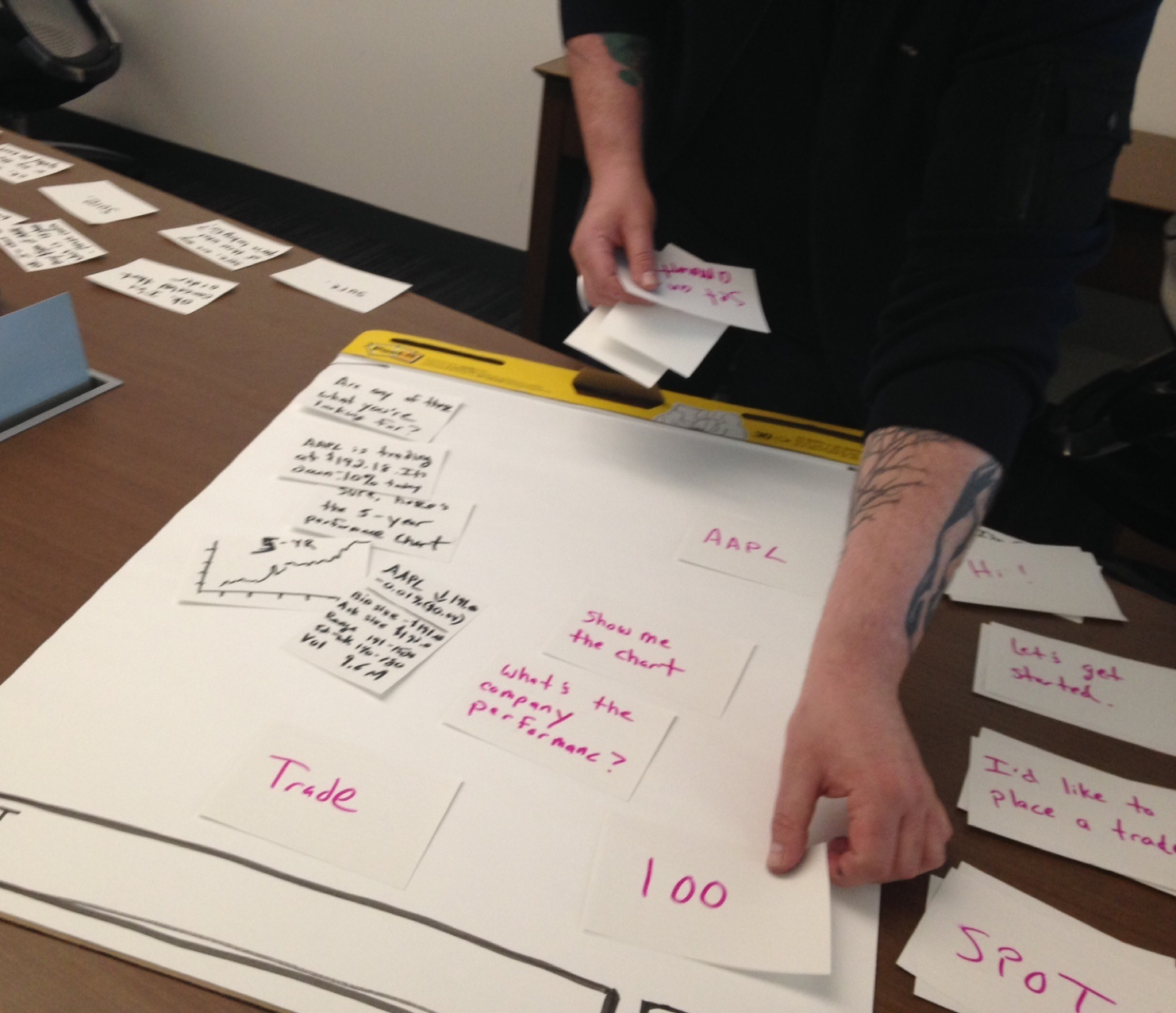
An earlier project. Same method, different problem. Logic before color.
For Blue Prince, I just needed to know how the game mechanics actually worked. Then I tried to mimic that at the table. That's the whole project, really. Strip it down. Find the bones. See if they hold.
"He looked up to that cousin. At seven years old, something about that white cardboard world said: someday I want to build one of these."
— From our pre-interview notesLet's talk about the translation problem. Blue Prince the video game has a sophisticated internal engine — it's managing probability, lock chances, room rarity, all of it invisibly. When you started trying to replicate that at a physical table, what was the first thing that scared you?
The math. Immediately and completely, the math. Tonda Ros and the team at Dogubomb have clearly thought deeply about the probability of their game. The way rooms appear, the way certain rooms stay rare until you're deep into the manor, the sense that the house is revealing itself at the right pace — all of that is tuned. And in the video game, the computer handles all of it invisibly. The player never thinks about it. They just feel it.
At a physical table, the player is the CPU. There's no engine. And I'm not a mathematician — I'm a designer. So I've been using Claude to help me parse the inner mechanics, build probability models, figure out what I'm actually dealing with.
And what does that look like in practice?
Honestly, it's been a crash course in probability. You look at a curve showing the odds of drawing a specific high-rank room when you're only pulling three tiles at a time, and it's brutal. The Rank 9 rooms — the powerful late-game rooms — are almost statistically invisible until you've burned through the bulk of the lower-rank tiles. In the video game, that creates this beautiful sense of the manor slowly revealing its secrets. At a table with a finite tile pool, that same math can just feel broken. Like the game is withholding things you can't reach.
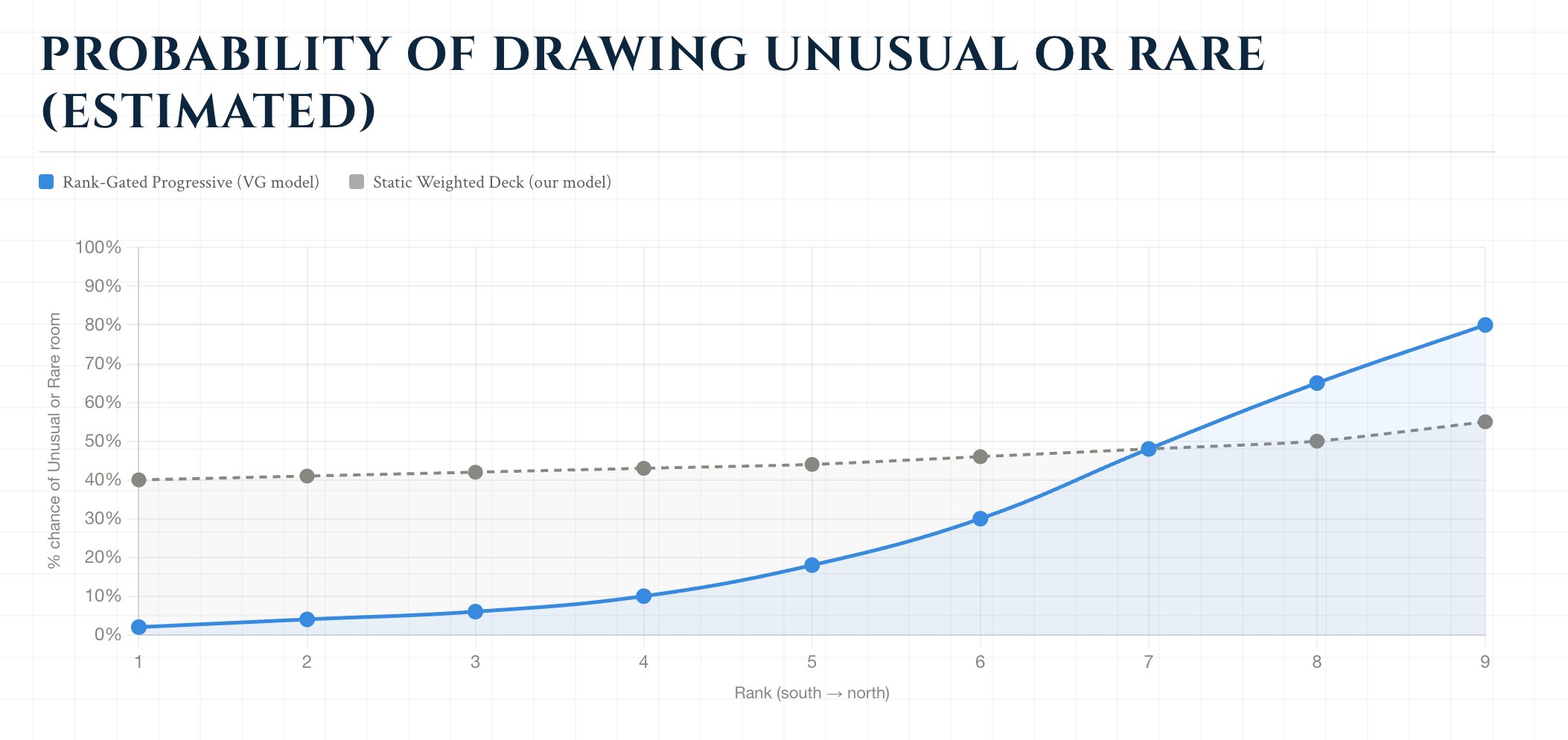
The brutal curve. Blue: the video game's rank-gated model. Grey: the static weighted deck. At Rank 1, a 2% chance of drawing something rare. The math that keeps him up at night. Full model →
Does that keep you up at night?
Literally, yes. The challenge of mimicking the video game's feel — something Tonda and the team have toiled over and fine tuned — is the crux of it. Also, adapting another designer's ideas, systems, and intellectual property puts me in an uncomfortable position morally. So showing respect and honoring the original material is of utmost importance to me while balancing that with the need to design a great tabletop experience.
I have 100 hours in the video game. That doesn't make me an expert, but I have a good sense of how it should feel. I just don't know yet if what I've built delivers that feeling for someone sitting across a table.
Let's talk about the "Holly Spire." Because before any of the probability problems, there was a more immediate, physical one.
The stack. Yes. All 63 core room tiles, printed on 110lb cardstock, stacked on a table. The height is genuinely alarming. It wobbled constantly. During the first solo playtest — before anyone else had touched the game — it fell over. Just completely toppled. And I'm sitting there looking at tiles scattered across the table thinking: this is a design problem that has nothing to do with probability curves.
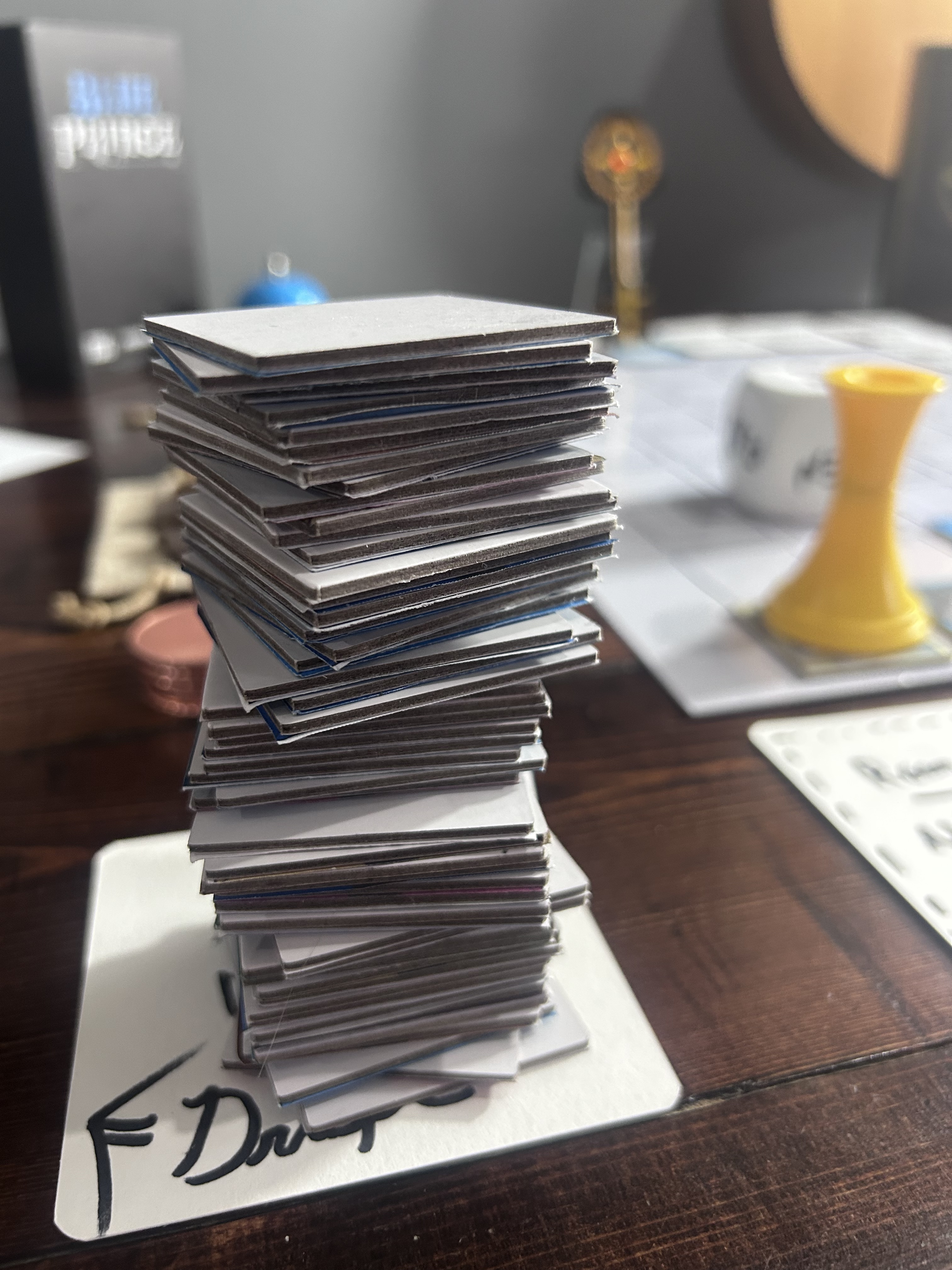
63 tiles. 110lb cardstock. Face-down backs, no way to shuffle without toppling it.
The fix came from outside the project entirely. A large felt drawstring bag from another board game I had lying around. The tiles went in, I shook it up, and drawing three blind felt — honestly, more satisfying than pulling from the top of a stack ever did. There's something right about reaching into a bag and not knowing what you're going to get. It fits the game.
But the AI pushed back on this.
Claude was against it. The argument from that side was mechanical — a stack lets you see how many tiles remain, gives you information. A bag removes all of that. And to an algorithm, that's information loss. But as soon as I playtested in the real world, I realized the bag was the only viable path. The moment of reaching in and pulling three tiles blind doesn't feel like information loss. It feels like opening a door in a house you've never been in before. Which is, not coincidentally, the entire point of the game.
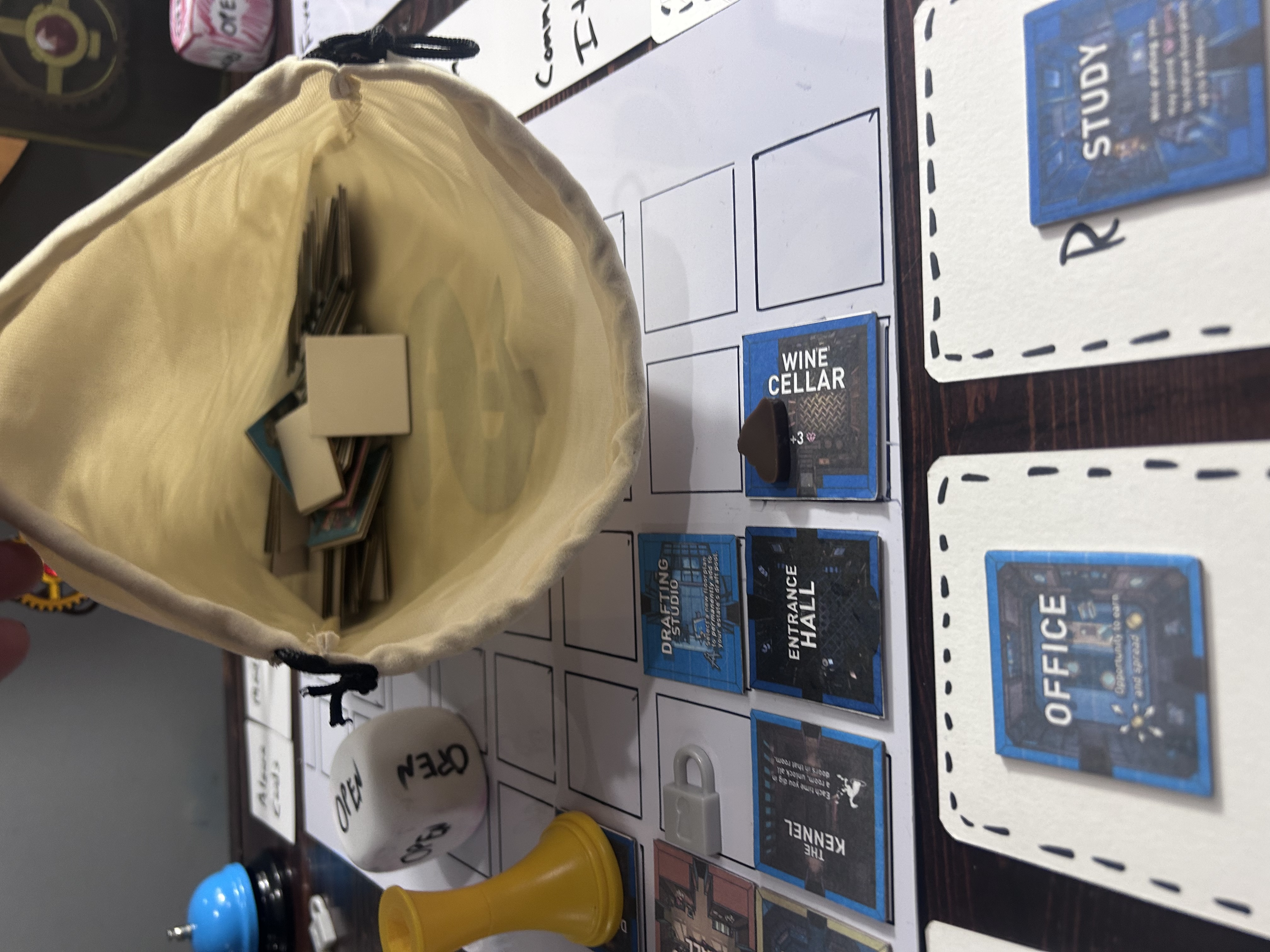
The fix. A drawstring bag borrowed from another game — tiles inside, board below, OPEN die ready.
A bag of identical-back tiles creates a different risk though. A player could theoretically draw the Antechamber — the win condition room — on Turn 1. How does the physical design prevent that?
Not every room lives in the bag. The Antechamber is a fixed position — it sits at Rank 9, Column 3, pre-placed before the first draft, every single run. Same with the Entrance Hall at Rank 1. They're the anchors. The North Star. And a whole category of rooms — Event Additions, Studio Additions, Found Floor Plans — sit outside the bag entirely and only enter when specific conditions are met.
For example, the Sauna and Locker Room sit on the sideline until the Pool tile is drafted. The moment that happens, they go into the bag. The Planetarium doesn't exist in the bag until someone discovers it mid-run. The estate grows around you as you play. Which is — that's the video game. That's the feeling I'm trying to preserve.
There's something philosophically interesting about that fixed Antechamber. In a game defined by chaos and shifting architecture, you've put a permanent destination at the top of the board.
That's exactly it. In the video game, you see the Antechamber on the pause screen map, and something clicks. You think: if I were Room 46, I'd probably be behind the Antechamber. You don't need the game to explain the goal. The map explains it. I wanted that same moment at the physical table — you sit down, you see this grid, and the Antechamber is just sitting there at the top. You know where you're going. Now figure out how to get there.
But getting there isn't the whole game. One of the things Blue Prince does extraordinarily well is make you forget you're trying to get somewhere, because the house keeps handing you reasons to stop and look around. How are you replicating that?
The vague objective. You're given this loose mandate — find Room 46 — but along the way you find so many more mysteries and puzzles that players start creating their own sub-goals. That happens naturally once people learn the rooms. Once you know that drafting Hallway unlocks all the Orange Rooms, you start thinking about that. You start routing for it. You're no longer just pushing north — you're building a strategy around the mansion's systems.
That's what I'm hoping players discover. The rooms have synergies. The house rewards knowledge. And the beautiful thing is I can't teach that. It has to be found.
"The mansion is a giant puzzle box, and the rooms are the tools to solve it. My goal is to find the point where the math disappears and the mystery takes over."
— QQYou design digital products in a highly regulated industry professionally. This project has none of those constraints. Does that feel liberating or terrifying?
Completely liberating. The only constraint I've given myself is: be true to the video game. That's self-imposed, but it's meaningful. Every deviation from the source material has to be justified — I actually log them formally in a design document. But beyond that? No stakeholders. No approvals. The only audience is the Blue Prince fan community, and eventually anyone else who might want to sit down at this table.
And yet you've reached the point where you've admitted: I could keep editing this forever and still not know if it's fun.
That's the inflection point. I could refine the tile backs, polish the reference cards, tune the probability models — for months. And still have no idea whether a stranger sitting down at this table would have a good time. The only way to know is to stop editing and start watching. I'm at the playtest-needed point. The work now happens across the table from other people.
When you finally put this in front of someone else — what are you looking for? What's the one moment that tells you this is working?
I want them to do a run and fail. Then I want to see them immediately want to clear the board and start another run out of pure curiosity. Not because I told them to. Not because there's anything left to explain. Because the house pulled them back in.
That's the curiosity loop. That's what the video game does. You run out of steps two rooms from the Antechamber and you immediately start thinking about what you'd do differently. You don't feel like you lost. You feel like you have information now. That's what I'm building.
Last question. If your cousin — the one who sent you that white Skate or Die prototype — walked into this room right now and saw what's on the table, what do you think he'd say?
I think he'd be genuinely curious. And I think he'd sit down for a run through Mt. Holly.
That's probably the best compliment I could get.
- Grid
- 5×9 board, 45 room positions
- Draft method
- Drawstring bag · 63 core tiles · draw 3, choose 1
- Fixed rooms
- Entrance Hall (Rank 1) · Antechamber (Rank 9) · Room 46
- Starting resources
- 50 Steps · 0 Gems · 0 Keys · 0 Coins
- Lock system
- Custom OPEN/LOCKED d6 · standard d6 for presence and selection
- Legacy features
- Campaign Sheet · Studio Additions · permanent unlocks
- Target play time
- ~45 minutes per run
- Players
- Solo or 2-player co-op