There's a phase in every design project — I don't care what kind — where you stop building and start questioning whether everything you've built belongs there. Not individual pieces. All of it. You look at the full thing and ask: what would survive if I removed everything that isn't completely necessary?
I call this Brutal Simplification. Not because the simplification itself is brutal, but because the act of doing it honestly requires something that feels a little like violence. You have to be willing to cut things you love. Especially things you love. The things you hate are easy to cut — you were already lukewarm. The real test is what you do when the thing on the chopping block is something that made you excited to design in the first place.
Good designers seek elegance. Elegance isn't ornament — it's what remains when everything unnecessary has been removed. The elegant solution is usually also the simpler one, but you can't start there. You have to arrive at it. And arriving at it often requires a period of deliberate, uncomfortable subtraction.
I'm in that period now.
The translation problem
Adapting a video game into a physical board game is fundamentally a translation problem. Not a content problem — a complexity budget problem. The two formats have different tolerances for how much a player can hold in their head and hands at once.
In a video game, complexity is often invisible. Steps from meals, Tomorrow Room carry-forwards, which safes you've opened, lock states on every door — the game holds all of it. You experience none of it as overhead. You don't experience that complexity as complexity — you experience it as richness. The game feels full. The game feels alive.
At a physical table, that same complexity has weight. Every mechanic is something you pick up, put down, reference, or remember. Every card deck is something you shuffle, store, explain to a new player, and find room for on the table. Nothing is invisible. Nothing is free. The richness that felt natural in the video game becomes friction at the table, and friction is the thing that turns a good evening into a long evening.
When I started this adaptation, I built it from a position of fidelity: if it's in the game, it deserves to be here. I still believe that instinct is basically right. But two playtests have shown me that some things I preserved in the name of fidelity are carrying more overhead than they're delivering in experience. That gap — between what something costs at the table and what it gives back — is what Brutal Simplification is for.
The candidate list
Here's what I'm considering cutting. I'm putting it in writing because designers have a way of being vague about hard decisions — we hedge, we say "maybe," we defer. Writing it down forces honesty.
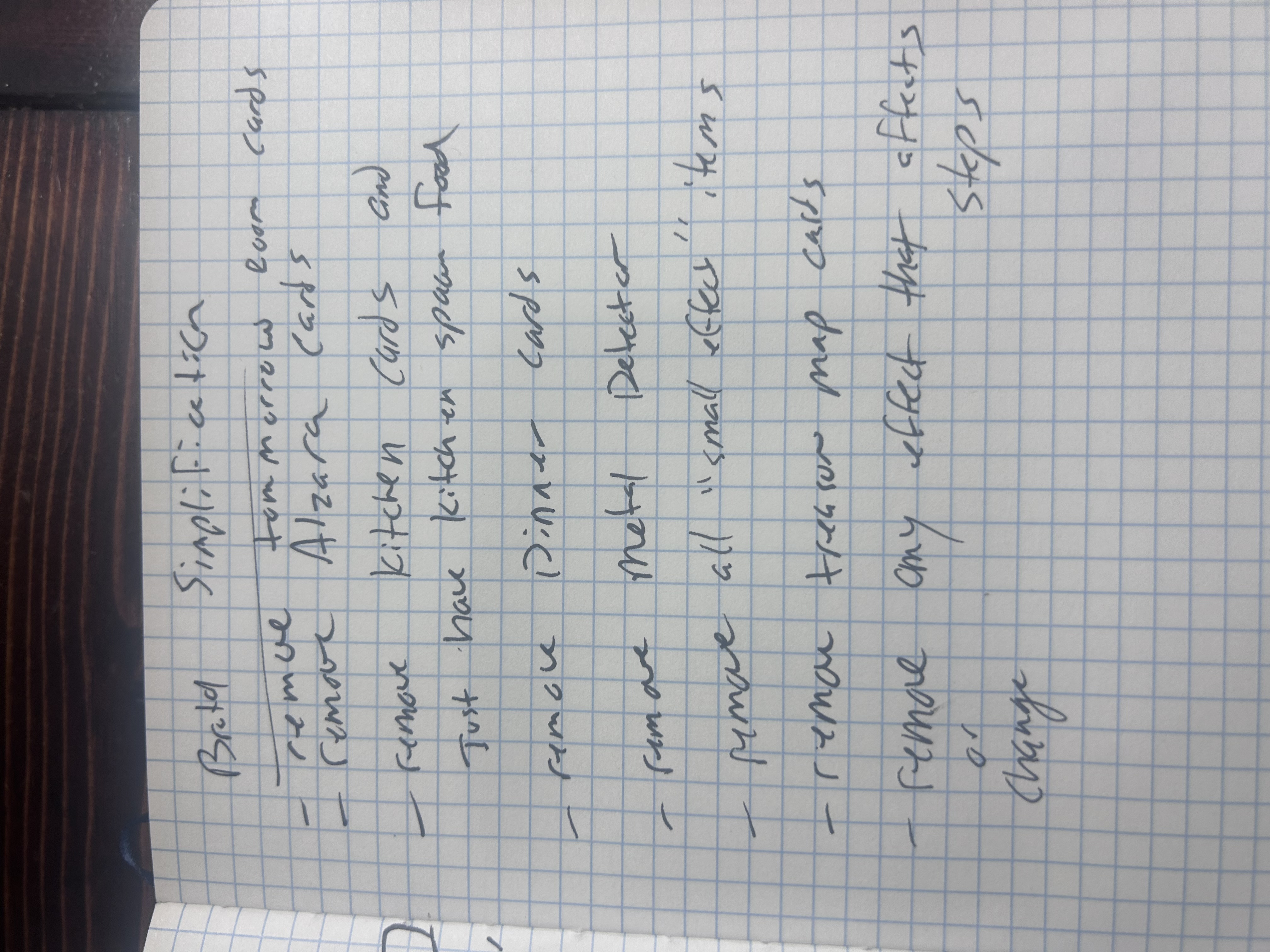
- Tomorrow Room cards — physical card deck tracking between-run effects. The mechanic stays. The cards go. Campaign Sheet handles it.
- Alzara Prophecy cards — 7-card deck, lore-driven, requires its own setup and explanation. Lore content has been an expansion target from the beginning.
- Kitchen cards and Dinner cards — meal selection and dinner tracking. Replace with the Kitchen spawning food tokens directly.
- Metal Detector — item whose mechanical weight doesn't justify the card space.
- Small-effect items — cupcake, running shoes, sleep mask, coupon book, salt shaker, loose coin. Real VG items. Thin at the table.
- Treasure Maps — dedicated card deck for a mechanic that may not be earning its component footprint.
Looking at that list: I think it goes too far. My instinct is that it's right to put everything on it, and also right to walk some of it back after testing. The purpose of listing everything isn't to cut everything. It's to force yourself to make each decision consciously instead of keeping things by default.
Default-keeping is how bloated games happen. You keep something because cutting it feels like admitting the original decision was wrong. But the original decision wasn't wrong — you often need to include something to find out it doesn't belong. That's design. The mistake isn't adding it. The mistake is refusing to remove it once you know.
The Alzara in the room
I want to talk about Alzara specifically, because it's the hardest one on that list and I think it illustrates something true about this phase of design.
Early in this project, I described Alzara as "pure delight." I meant it. The fortune-telling automaton in the Rumpus Room, the sequence of cryptic visions, the slow revelation across multiple days of play — it's one of the most distinctive things in the video game, and it has genuine fandom. I spent real time researching the exact text of each vision. I built seven cards for it. I was excited about it.
Then I watched two players sit down who had never touched the video game. Alzara meant nothing to them. Not nothing bad — just nothing. They interacted with the card, read the text, moved on. The resonance that makes Alzara feel like a discovery in the video game requires that you came in already caring about the world. For a player who didn't, it's seven cards and an explanation.
That's a different kind of loss than cutting a mechanic that doesn't work. Alzara works. It's just lore, and lore belongs to people who already care. In product design terms: it's a feature for power users, not new users. And this game, at this stage, is for new users.
From a practical standpoint: even without Tomorrow Room cards and Alzara, this game still has eight custom card decks. Eight. I don't have a calibrated answer for whether that's the right number. But I do think the right question to ask about each deck is whether it earns its place — whether removing it would make the game noticeably worse for a player experiencing it for the first time.
The thin-translation items
The small-effect items on that list are a different problem. These aren't items I invented — every one of them exists in the video game. But they illustrate something that I keep bumping into in this adaptation: an item's value is partly the medium it lives in.
In the video game, a cupcake costs nothing to exist. It's a pixel. You pick it up, you use it, it's gone. The overhead is zero. As a physical card it needs to be printed, stored, explained, handled, and set aside. If the mechanical effect is small, the card format amplifies its insignificance. It doesn't feel like a small reward. It feels like an afterthought someone bothered to print.
This is the hardest thing about adaptation: you're not translating content. You're translating experience. And the experience of a small item in a video game — frictionless, momentary, slightly pleasant — does not translate to the experience of a small item card at a physical table, which is clunky, forgettable, and slightly annoying to shuffle back in. Same item. Different experience. The thing that was a light touch becomes a flat note.
Where this lands
I don't have answers yet. I have a list, a playtest scheduled for tomorrow, and the specific feeling that I imagine every designer recognizes: the discomfort of sitting in the middle of a decision you know you have to make but haven't made.
Brutal Simplification isn't a one-day decision. You make the list. You sit with it. You play. You see what you miss and what you don't. Then you cut the things you don't miss and find out whether the game is lighter and better, or just lighter.
The designer's job in this phase is to be willing — not eager, not reckless, but genuinely willing — to remove something you built with care. That willingness is the thing that separates a finished game from a design that keeps accreting features until nobody can explain it in under five minutes.
I'm not there yet. But I'm asking the right questions. That's usually how you get there.