After Mike's run and my own solo attempt, I had a feeling the item system was the source of most of the friction I was seeing at the table. Not broken — just carrying more overhead than it was delivering. I needed to go back and look at how the video game actually does it, without the filter of already knowing the design.
So I replayed the game from Day 1 and took handwritten notes on every item I found, every room it came from, and every moment that felt different from how I'd built it on the board. Ten days of notes. The picture that came back surprised me.
What the VG actually does
The video game's item distribution is much broader than what I'd documented. Items appear in the Parlor, Boudoir, Courtyard, Nook, Library, Nursery, Chapel, Patio, and Garage — rooms that in our board game either gave nothing on entry or weren't documented as item rooms at all. It's not that I designed the system wrong. It's that the VG handles item presence invisibly, room by room, day by day, and I'd only captured a fraction of it when building the spawn reference.
The other thing the notes showed: the VG doesn't feel scarce. Items turn up naturally, often in places you didn't expect them. The board game has felt slightly tight by comparison, and now I understand why.
What changed
The Archived Keychain
The Special Key system had a problem I'd been aware of since Mike's playtest. The Music Room's two-roll sequence — first roll to see if a Special Key is granted, second roll to determine which key — was legible in the rules but not at the table. Mike got confused when I handed him the Secret Garden Key. The chain of events that produced it wasn't visible from where he was sitting.
Then I opened four boxes from iam8bit.
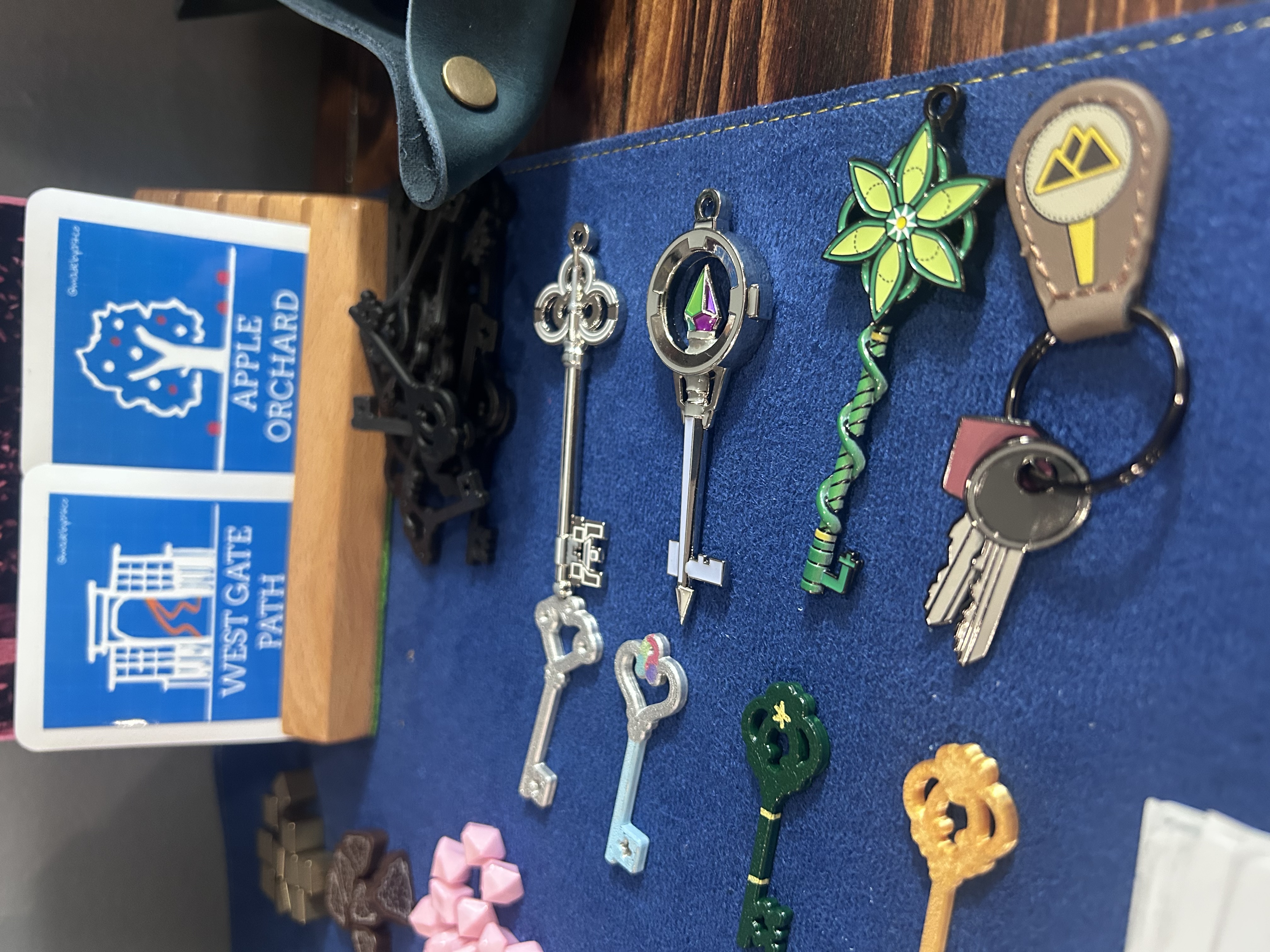
iam8bit sells official Blue Prince merchandise, including replica keychains of all four Special Keys — Secret Garden, Car, Silver, and Prism. They come in small cream-colored boxes stamped CONFIDENTIAL / ARCHIVED KEYCHAIN. Four identical boxes. Four distinct keys inside.
The mechanic the boxes naturally create: each key goes back in its box at setup. Boxes are shuffled face-down. When a player earns a Special Key — from the Music Room, Billiard Room, Locksmith, a dig result, a trunk result — instead of rolling to determine which key they get, they pick a box blind. Open it. That's their key.
This collapses the two-roll sequence into a single physical action with a genuine moment of discovery. The confusion Mike experienced disappears. The player makes a tactile choice, opens a box, holds something. The key is the reward, not a card draw result.
The Secret Garden Key stays in the pool. It's one of four — a 1-in-4 chance per draw. That randomness is intentional. In the VG you don't know when or whether you'll find it. Making it deterministic would let a player just route to the right room and guarantee a win path. The uncertainty is part of the design.
This is logged as Proposed — needs playtesting. The specific question I'm watching for: does drawing a Car Key or Prism Key when you needed the Secret Garden Key feel like a meaningful setback, or just frustrating? The answer will tell me whether the pool needs rebalancing.
The honest version
Most of these changes came from one insight: I'd built the item system from documentation and memory, not from watching the VG carefully. Going back and taking notes room by room, day by day, showed me the gaps. The board game wasn't wrong — it was just working from an incomplete picture.
The trunk change and the new fixed spawns bring the physical experience closer to what the VG actually feels like. The Archived Keychain mechanic takes something that was a rules interaction and turns it into a table moment. The Tomorrow Room card cut removes a component that was adding overhead without adding experience.
None of these changes make the game simpler by making it smaller. They make it simpler by making each interaction clearer.