Lipstick on a Hippo
I had what looked like a high-fidelity project. Tiles in slots, card decks in cases, dice in a box. Then the feedback coming out of Protospiel put me back at pen and grid paper, hand-drawing wireframes for a tile and a rules system I had already designed once.
Going back to wireframes, in my professional experience, is never a good sign. It means there is a fundamental problem in the usability of the system, and no amount of better visual design fixes it. You can’t put lipstick on a hippo.
The feedback took a specific form, and it came from a publisher. Paraphrasing: you could hand-write a small number of cards that prove out each room type — say ten — get the core loop working, and then create the rest.
That is correct. It’s correct the way “write the test first” is correct. Eighty-five finished tiles is production, and production before the loop is proven is how a prototype eats a year. It landed at all because of how Protospiel had gone — not one playtest made it to the end.
After my bruised ego healed, I sat down to take roughly ten tiles, one per room type, write them by hand, and see whether the loop held.
Ten by hand
So: grid paper, a pen, ten tiles, one per room type. Front and back, at size.
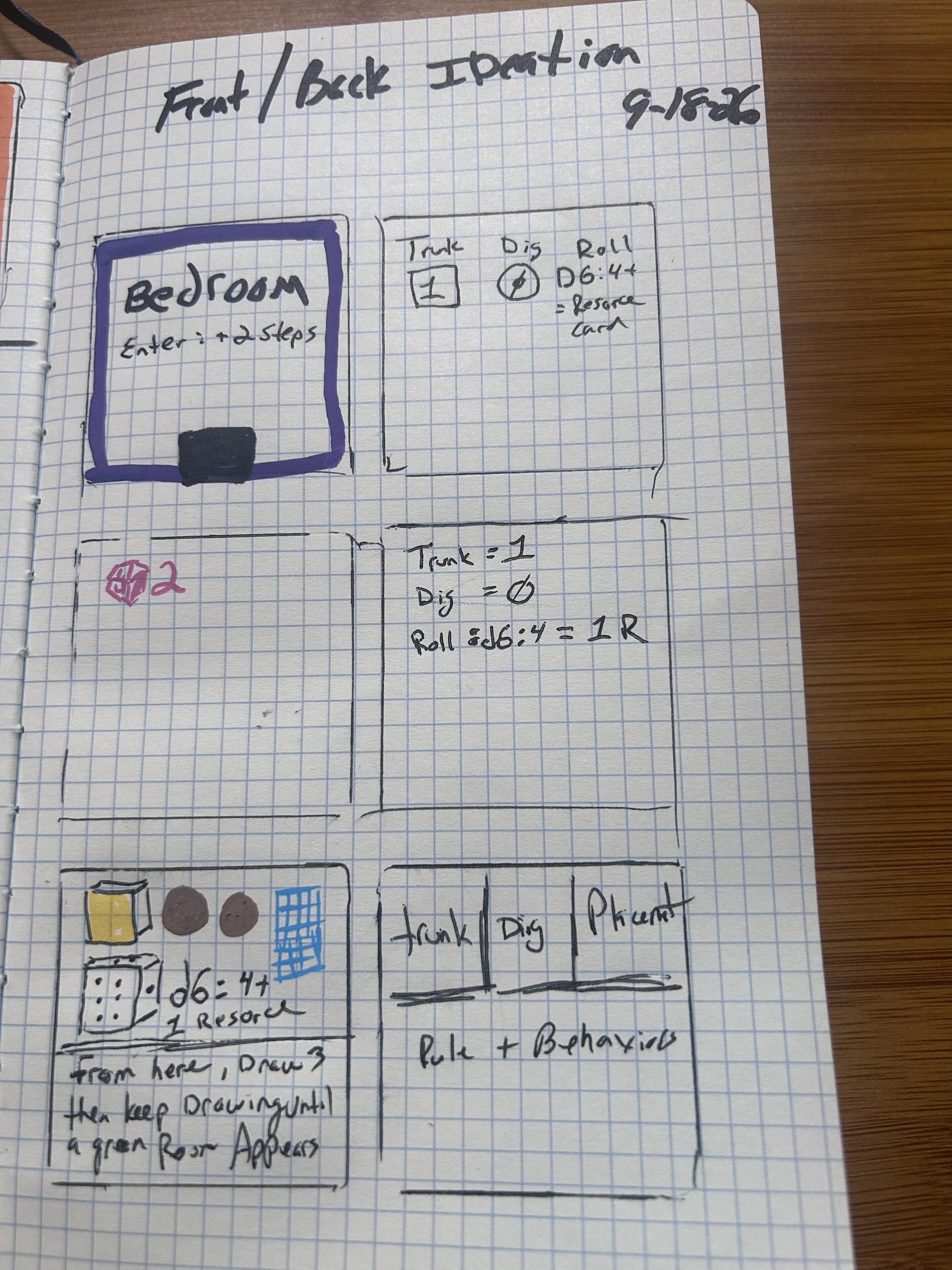
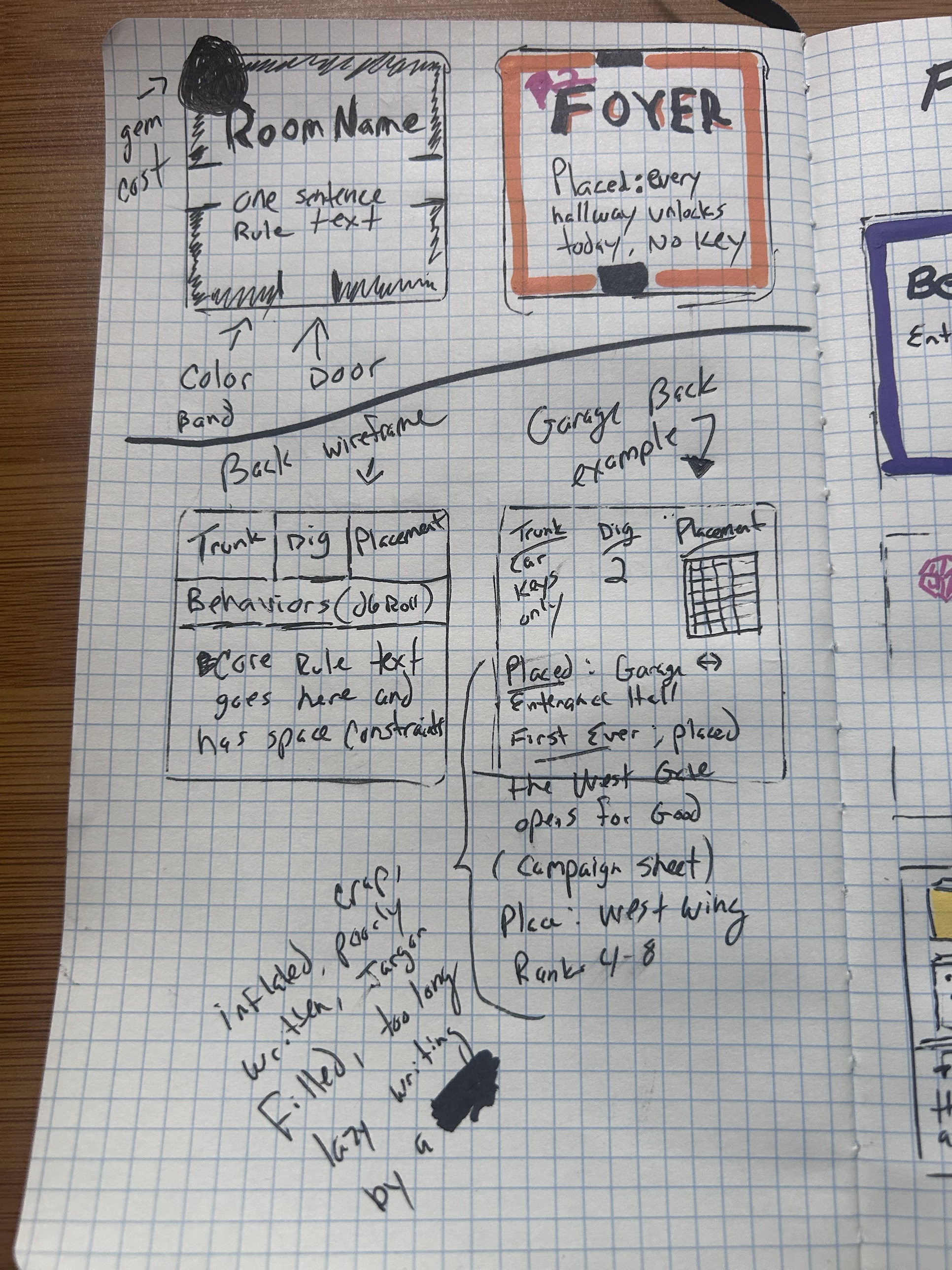
What started as a content exercise became the need to create a whole new tile and rule writing system for the room tiles. Which turned into a content audit for each and every front and back of tile. Which surfaced the need for a systematic layout for the card backs.
Then I drew the Garage back as a worked example and wrote what I thought of it in the margin. Crap. Inflated, poorly written, jargon filled, too long. Lazy writing.
That is what the grid paper is for. On screen the rule text always fits, because I can always make the type smaller. On paper the box is the box. The Garage rule ran past the edge of a hand-drawn square and there was nowhere for it to go.
The tile system design surfaced two models which were content placement questions and labeling consistency needs.
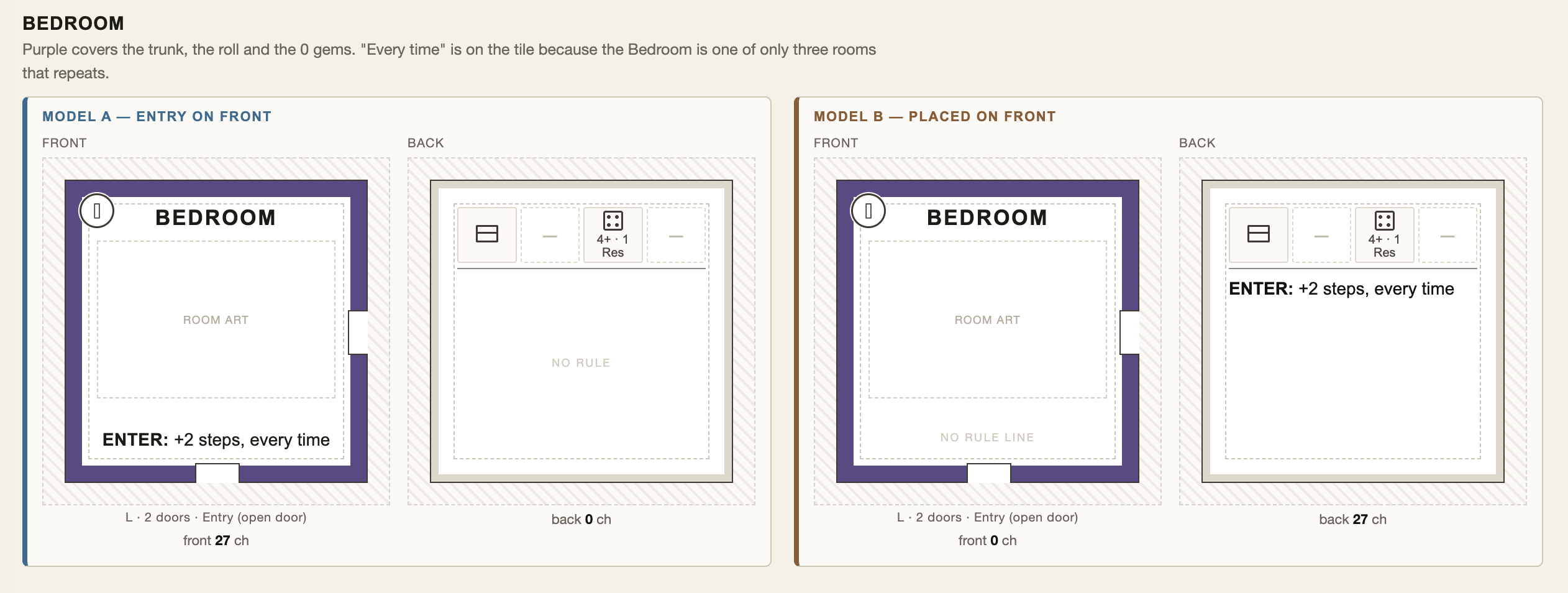
The labels were half a system
Seven labels, all of them answering one question: when does this fire. Then 28 of the 85 backs turned out to carry rules with no label at all, because about a fifth of what a room does isn’t a firing time. “Counts as a bedroom” is a standing fact. “Studio addition” is a note about the bag. “Furnace also placed” is a condition. One vocabulary doing three jobs, and the third job had no words at all.
The fix was a form, not more words. Four fixed slots across the top of the back — Trunk, Dig, Roll, Placement — with prose underneath. Once the slots take the structural lines, 54 of the 85 backs have no prose left on them. It was never a writing problem. It was a layout problem.
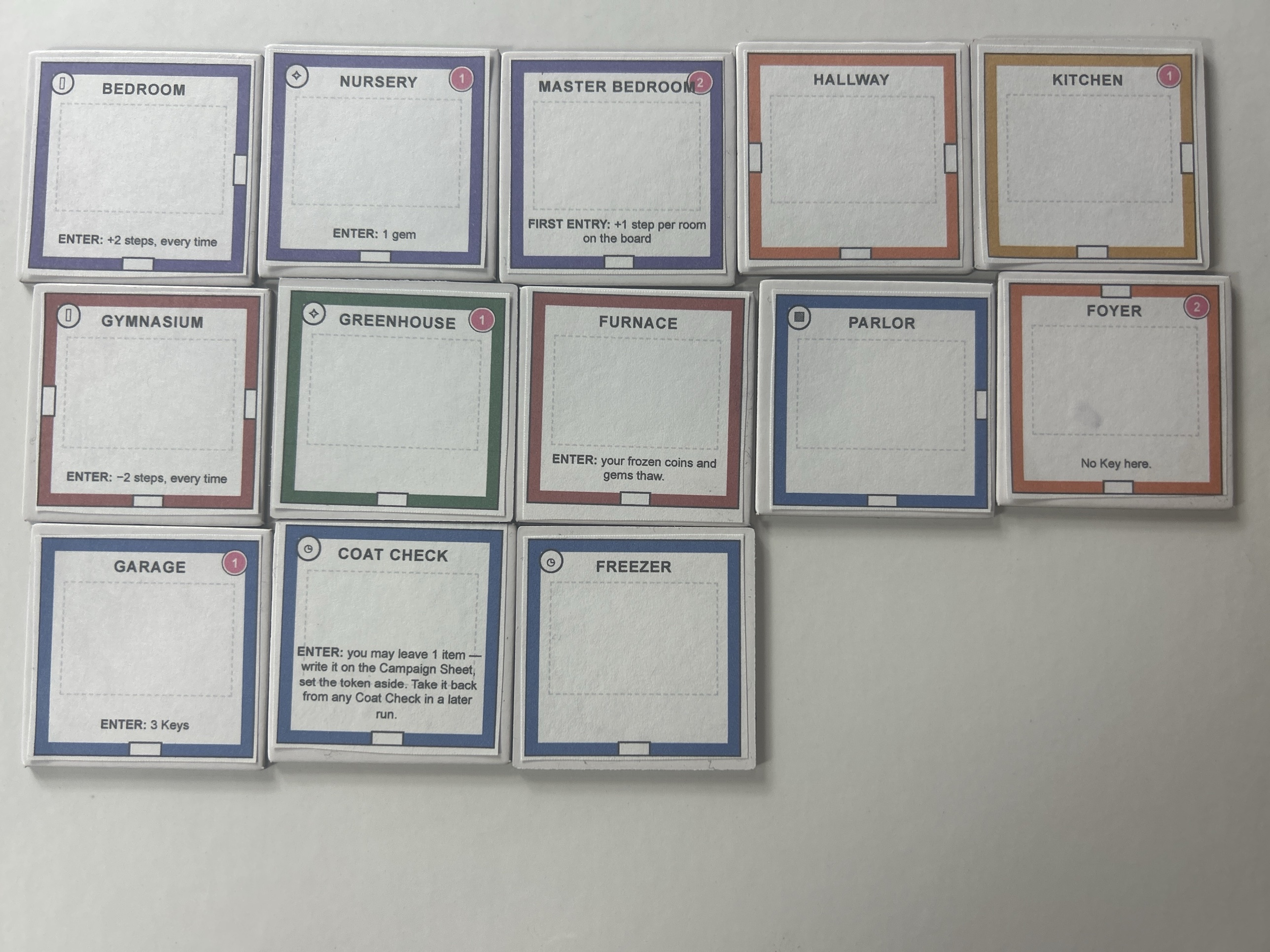
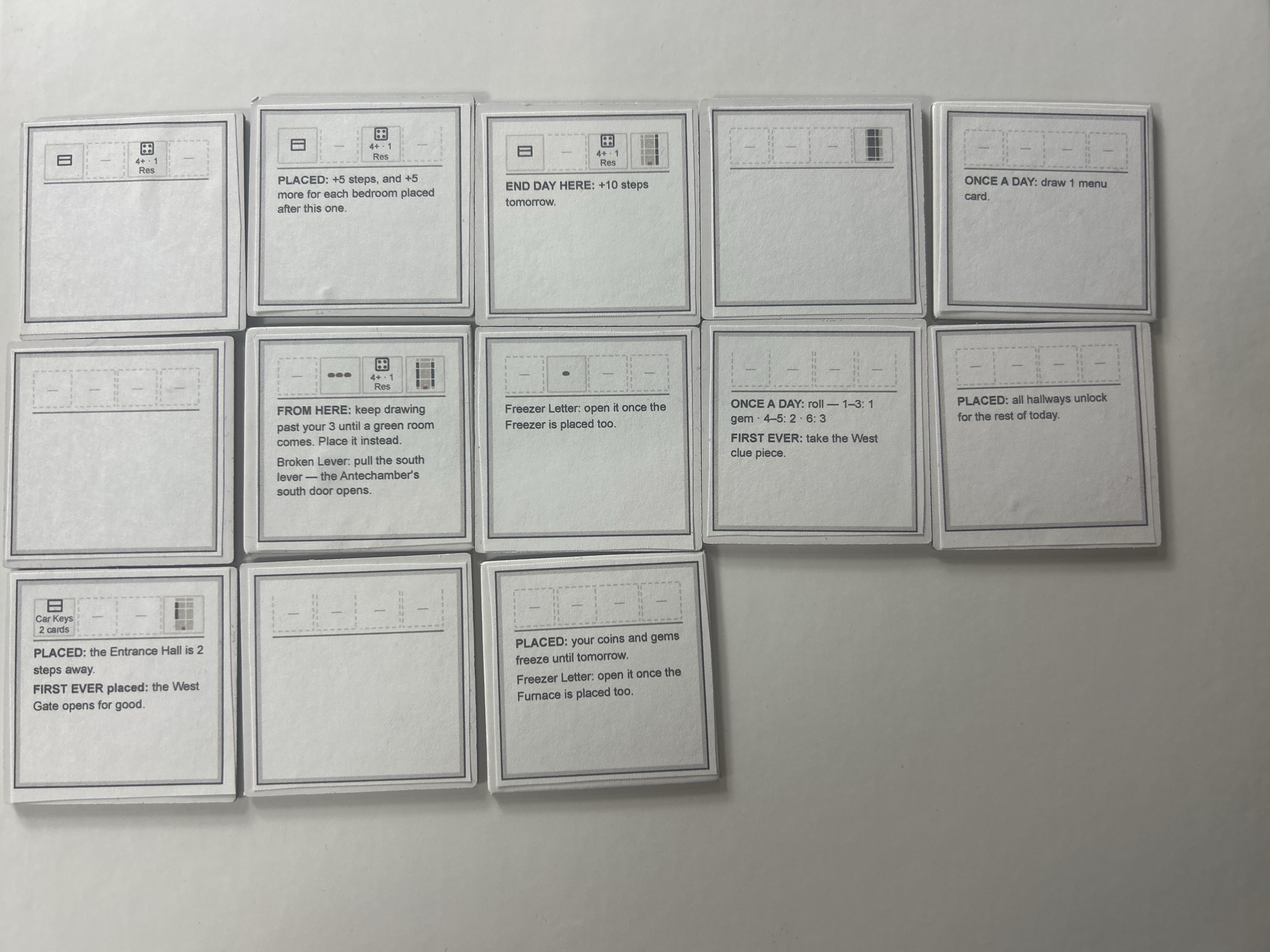
Two models, drawn and printed
Model A puts entry effects on the front. Model B puts placement effects there. Both written from scratch for the face they sit on, because the first attempt had quietly loaded the comparison by moving back-length sentences onto B’s front.
Blank fronts tied at six each. Four of the eleven tiles came out identical under both models — Parlor, Hallway, Kitchen, Greenhouse — because their rules are FIRST EVER, ONCE A DAY and FROM HERE, which neither model reaches. A third of the test set doesn’t care about the decision at all.
Model A won on one argument. Placement rules are conditions, and conditions need words. Entry effects are transactions, and transactions are short.
Then the print answered a question nobody had asked. Layout and legibility were mostly fine. What it showed instead was the empty ones. An empty front reads as deliberate. An empty back reads as an unfilled form — four outlined boxes with a dash in each doesn’t say “none,” it says somebody forgot.
Eighteen systems, one tile
Mt. Holly is a mansion that I’m learning has an entire city’s worth of systems running through its halls.
Here is what has to fit on a square smaller than a coaster. Eighteen separate systems. The median room touches five of them at once. The worst three — Greenhouse, Garage, Secret Garden — touch nine.
| 1 | Colour taxonomy — six colours, six rule sets | 85 |
| 2 | Room shape and doorways | 85 |
| 3 | Timing labels — PLACED · ENTER · FIRST ENTRY · ONCE A DAY · FIRST EVER · FROM HERE · END DAY HERE | 69 |
| 4 | Gem cost | 32 |
| 5 | The video game’s subtype icons | 30 |
| 6 | Item roll (d6, 4+) | 18 |
| 7 | Dig tokens | 16 |
| 8 | Placement restrictions | 16 |
| 9 | Card decks drawn from a tile | 15 |
| 10 | Trunks | 13 |
| 11 | Campaign Sheet tracking | 12 |
| 12 | Tomorrow / next-run carry | 9 |
| 13 | Safe rooms | 6 |
| 14 | Clue pieces and the red letter chain | 6 |
| 15 | Special keys and the Keychain | 6 |
| 16 | Once-a-day state — no marker designed | 5 |
| 17 | Spreads — tokens onto other rooms | 4 |
| 18 | The lever / Antechamber chain | 4 |
And it has to do that for a room a player looks at for about nine seconds before deciding whether to spend a gem on it. That’s the job.
Ten tiles do not reduce that to ten tiles’ worth of decisions. The median room touches five systems, and to write one tile honestly you have to have settled those five for every room that shares them. The sample doesn’t isolate. It tells you which decisions you have been postponing, all at once, in a pile.
The numbers, as evidence
Every one of these was computed from the room file, not estimated. This is what it looks like when you measure whether eighteen systems fit.
- 94% of rooms carry a printed rule. Median 54 characters, 75th percentile 142, longest 334.
- At a 104-character budget, 56 of 85 fit and 29 don’t.
- A text pass on those 29 took them from 4,750 characters to 2,610 — a 45% cut with no rule removed. 26 of them fit afterwards. It is a proposal sheet and it has not been applied to the data.
- The Office went 128 to 63 by deleting a sentence that repeated the line above it. The Conference Room went 187 to 76.
- The character budget was first handed to me as 29 characters a line, from type metrics. Measured off a rendered page it’s 18.
- The wiki’s room-shape classification agreed with 75 of the 78 door counts already in the file.
And eighteen systems still isn’t doing the whole job.