The reason was on the tiles
Protospiel is a weekend where designers bring unfinished games and play each other's. The visual upgrade over the last two months has been a quiet trap. Things are looking polished. Things are looking complete. But things are anything but complete.
Over three days I could not complete a single playtest. Every session stalled, and the reason was the text on the tiles.
The core design principle of this project is to stay faithful to the video game: match it unless a physical game has a strong reason not to. I held that principle hardest on the tiles. The room art, the room name, the caption, none of it was mine to change. That principle is now the thing most in the way, because fixing what stalled every session means rewriting the text on every tile. I've been silently avoiding admitting that. The principle has to relax where better gameplay needs it to.
What happened at the table
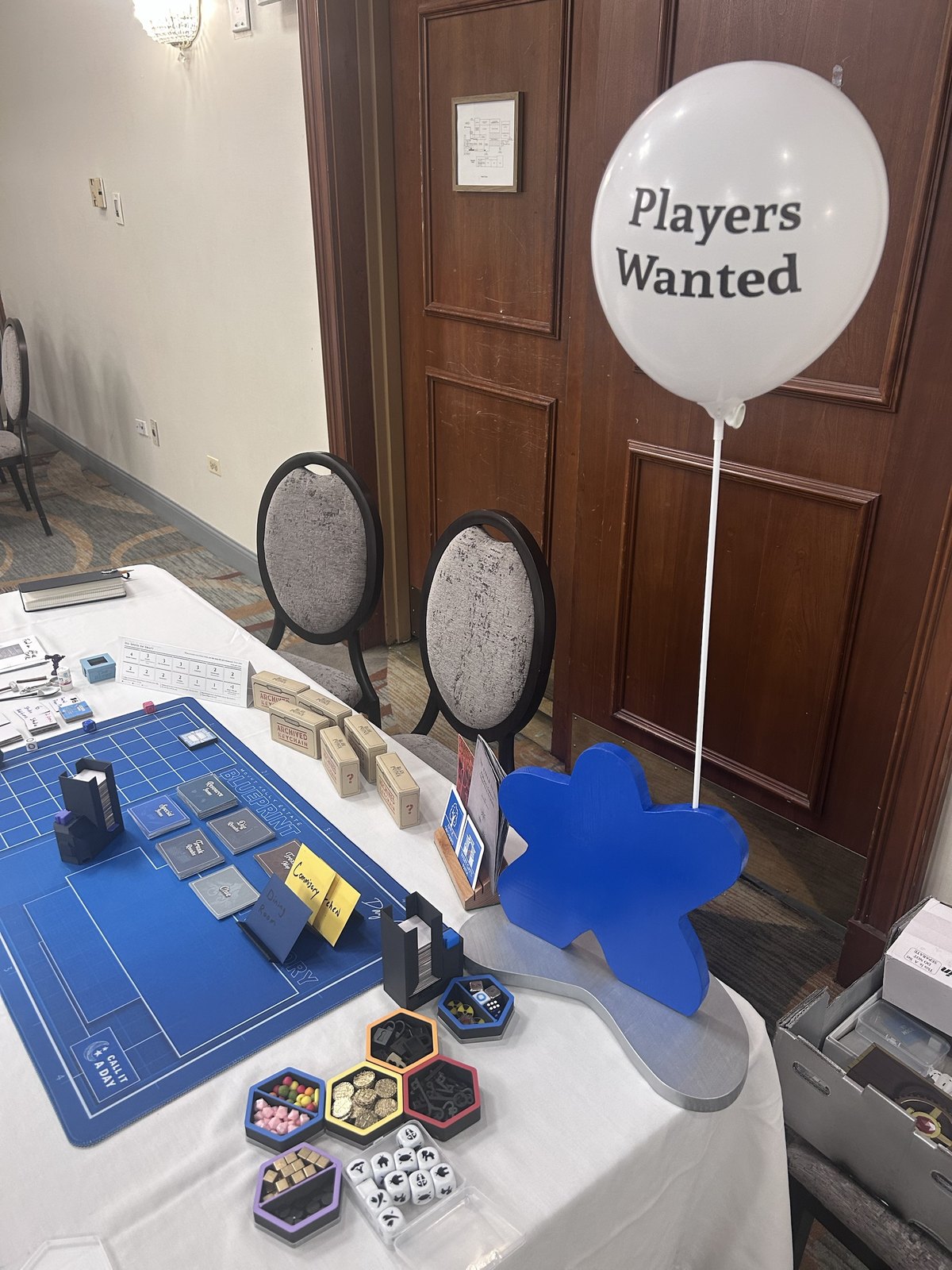
The mat did the recruiting. It's big and blue and you can see it from across the room. A publisher, who was at the event testing his own game, made a beeline for my table with his colleague. The two guys came over with curiosity in their eyes and wanted to know about the game.
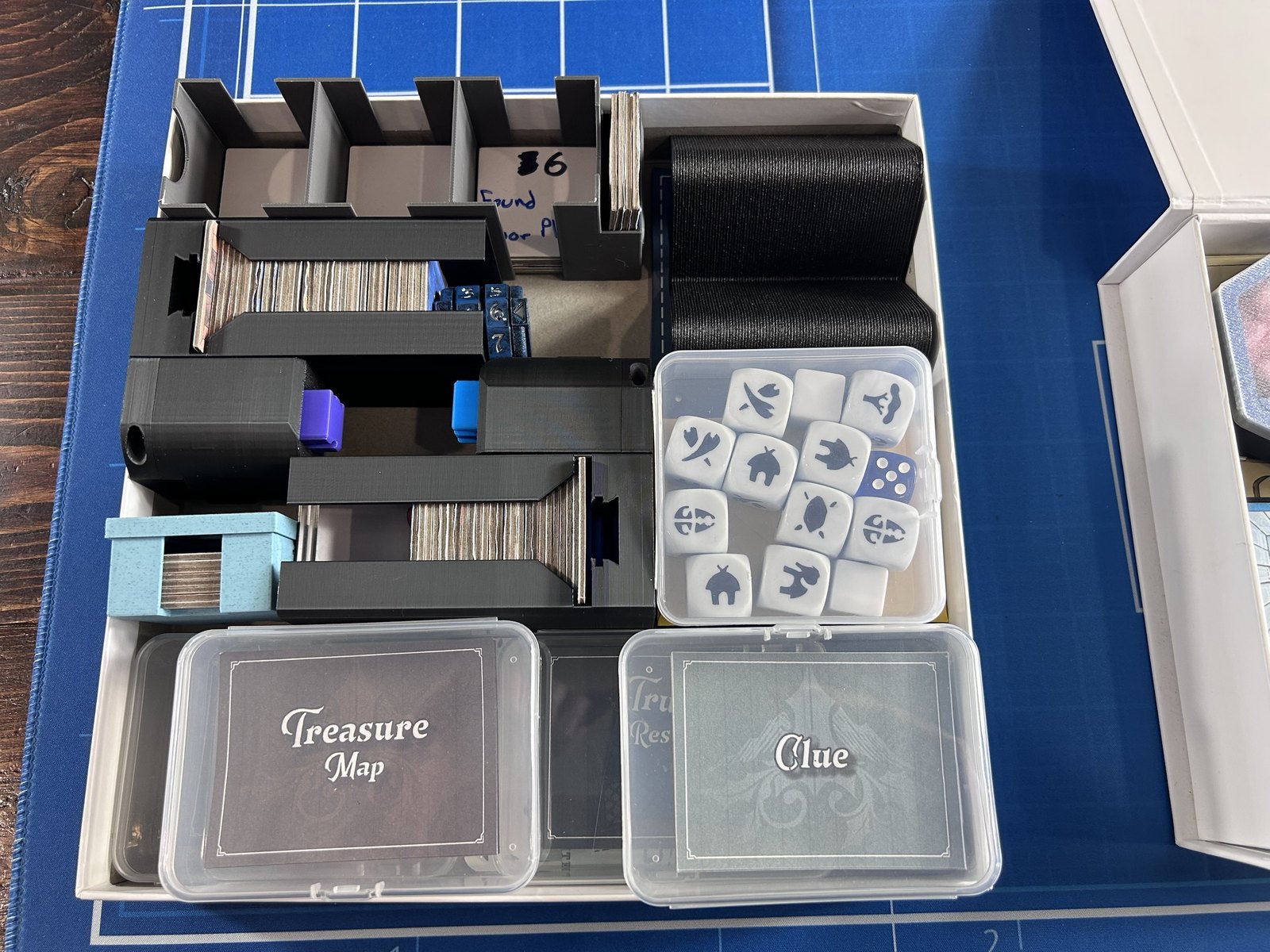
Here is what was on the table, all of it supposed to work together. The mat. Two dealer towers full of tiles. The card decks, the Archived Keychain boxes, the token trays. A strip listing the dig spots by room, added at the last minute and ignored at the table. The room grid, every room's rule on seven printed pages. A five-minute teach script for me. And a reference card at the table with the core loop on it, for whoever was playing.
The publisher got the thirty-second version of what Blue Prince is, and he cut it off there: "familiar with the video game." He knew the designer's name. My read is that he was more familiar than he let on. He sat down, got the five-minute teach, and his session stalled before the second draft.
Every session that weekend stalled the same way. Someone drafts the Closet. The tile says "2 items." They read it, look up, and wait. Two of what, from where? The way the game was supposed to work, you pick the room and then look it up in the room grid, where the rule is written out. Nobody did that. The tile was in their hand, so the tile was the rule. Pete, one of the two who'd come over curious, got stuck and reached for the reference card instead, the one with the core loop on it. The Pool was worse. Its tile says "Adds Locker Room, Sauna and Pump Room to today's Draft Pool," so the player who drafted it went to add three tiles to the dealer towers. You can't. A tower is a shuffled stack with a button on the front. That tower had its own post, Tell Me This Thing Is Not Fun, seven days earlier.
The useful part of the publisher's visit was the conversation. When I mentioned, without showing him, that I was designing tile backs to do more of the work, he said "not necessarily." He thought the step count would get tedious, counting every turn, and that I might want another way to put time pressure on a run; in three sessions with Mike and Chris it never came up as a problem, so that one is in the notes. He suggested I get blank tiles, write on them with a marker, pick about ten rooms, and test just those. And then, after a pause, as a hunch more than a verdict: "there is something here." He meant the gameplay.
Two phrases came from the other players. One was "table distance": the small text on the tiles can't be read from where you sit. The other was "make a room do one thing only," which doesn't mean what it sounds like. He didn't mean cut each room down to a single effect. He meant build a system you can learn, so that all green rooms have a trunk, say, and you learn the color instead of reading every tile. He pointed out that this leans harder on a rulebook.
Between sessions I filled a page headed "IDEAS, mostly to simplify." Most of it was ways to make the game smaller: the Silver Key opens every locked door on the board at once; the Event and Addition rooms fold into rooms you find inside other rooms, the Tunnel in the Secret Passage, the Planetarium in the Observatory, the Sauna and Locker Room in the Pool, the Morning Room in the Kitchen; the Lockpick Kit rolls to see if it works instead of counting down uses; the Secret Passage lets you name a color and draft until it appears, with no gem cost. The last two added something instead: the puzzle rooms hand out a clue card, and you get a clue for every rank you complete. Two of the cuts, it turned out, were already in my files. The Lock Pick card already rolls a die, and rooms found inside other rooms were already logged for five of them.
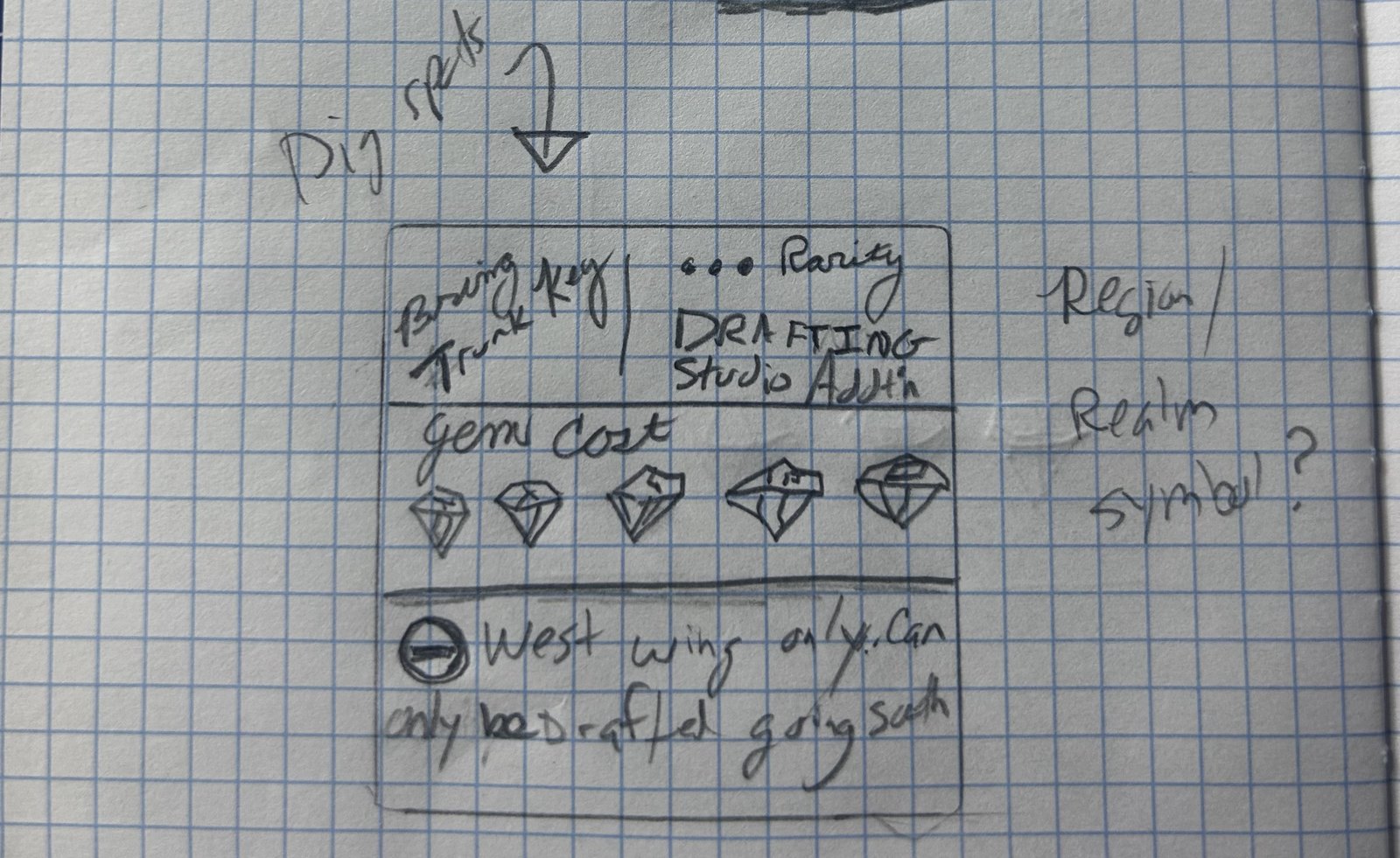
I also sketched what a tile back could carry: placement restriction, gem cost, chess piece, room type, rarity. Two layouts, both carrying exactly that and nothing else. No rule text. The publisher never saw them. That's the version "not necessarily" was answering.
What was actually wrong
On the 17th I sat down with Claude and went through every room in the bag, one row per room, every field with its source written next to it. Sixty-eight rows.
Here is the finding. Every word on every tile front, except one, is the video game's own caption. The exception is the Entrance Hall's "the clock has stopped at 1:30," which I wrote (see The Awkward Teen Phase). In the video game those captions are enough, because the software does everything else: it adds the tiles, counts the steps, opens the trunk. On a table the player does everything else, and the caption is the first and most trusted thing they read. It's in their hand at the moment they decide, and my teach materials had told them to trust it. Nobody had ever written board-game text for the front of a tile.
The publisher stalling is the strongest evidence I have, not the weakest. He knew the video game, so the captions matched what he knew, and what he knew didn't match this game. Familiarity made the captions more believable, not less.
"All tiles are self-explanatory."Definition of done
"Whatever the room says happens the moment you enter."Protospiel teach script, beat 3
"Do what the room says now — it's mandatory and immediate."Protospiel reference card, step 5
"Do not rely on the tile art to determine what draws — refer to this table."Design documentation, section 7, twice
"The reference sheet has every room. Look there first."Protospiel teach script, beat 5
"Unsure what a room does? Check the room reference before asking."Protospiel reference card, sidebar
"Tile art doesn't tell you which system applies — you have to check the table."Item reference
The teach script and the reference card also said "bag" while two towers sat on the mat.
I had designed the fix twice and never built it. The first row in the list of everywhere this game departs from the video game is "Room Tile Visual Redesign," dated May 28, marked high priority. On June 3 I wrote new text for all 88 rooms at twenty characters each. The 110-tile print order went out three weeks later with the video game's captions on it. Counting the glossary and the September room grid, the room text has now been written three separate times. None of them on the tile.
The printed tiles were a learning run, and I knew that going in. They cost $30. The time cost more, since they ship from China. The point isn't that the art shipped wrong. The point is that the tiles are the core of how this game gets played, so rewriting their text is the biggest departure from the source I've made, and it's the one the game needs.
A first count of the captions, which I still need to check myself: of 80 that can be sorted, 31 say the whole rule and are correct; 20 are correct but incomplete, the "2 items" kind; 16 describe something this game cut or changed; 13 have no text at all. 49 of 80 can't be acted on from the front.
The paperwork had drifted the same way. Four different lookup sheets disagreed with each other and with the September rules. The file that was supposed to hold every room's data is loaded by no page on the site; the glossary, the item spawn sheet, the design documentation and four other files each carry their own hand-typed room table, so a fix in one never reached the others. The four printed card decks don't match the files they were printed from, either; I counted them from photos, and the Resource deck alone has 35 cards where the file has 30. The physical decks are the truth now.
The tile is the rule
The decisions from the 17th, in plain words. What's printed on the tile is the rule. The front carries what matters while the tile is on the board. The back carries what you need before you place it: where it's allowed to go, how many dig spots, whether it has a trunk, anything that happens the moment it's placed. During play there is no separate chart to look things up in. The captions go, and I write the text.
The front gets one line under the room name, and that line does one of two things. Either it states the whole effect, so you can act from it alone, or it names the kind of effect and ends with a small flip symbol meaning the full rule is on the back of this tile. A half-line with no symbol, "2 items," is not allowed.
"Table distance" became a design rule. Once a tile is placed, the things you can read from across the mat are its color, its name, its door positions, its gem cost, and at most one icon. The one-line rule is read once, up close, at the draft. Rooms whose effect keeps going after they're placed need an icon that reads from across the table; by my estimate that's about 21 rooms. Rooms that do something "once today" need a marker to show it's been used.
The worry with color rules is that they flatten the house: if every purple room has a trunk, there's nothing to find. Where that landed: the color rule tells you what's always true (there is a trunk); what's inside stays random (the deck); every room's own numbers stay on its tile; and learning the house by heart is what the video game's campaign is, too.
The whole house stays. The publisher's ten rooms is a way to test, not a game to build; shrinking the bag would be "becoming a completely different game." So: ten blank tiles, a marker, one session, before anything is reprinted.
The bag is back. "Towers have a usability problem." Draw three, place one, the other two go straight back in the bag, and the same for the Library's extra draws, the Greenhouse's extras, Study redraws and Ivory Dice redraws. The Drawing Board, which worked on its first try in Session 3, is retired along with the towers.
Why so few trunks. These are estimates, all of them: at a full board that's 11 trunks against somewhere between 15 and 19 Keys of income and roughly 10 locked doors. On paper, a version with 17 trunks put too many gems on the table and too many tokens on the tiles. Keys stay scarce, which is the point. In the video game "you quickly learn NOT to spend your keys stupidly on trunks and wait till you have the sledgehammer. It's a resource management learning for the player, not a flaw." That lesson only works if the hammer shows up, and it does: the Sledge Hammer is 3 of the 22 cards in the Special Items deck, not one.
Smaller calls, one line each. The Rotunda's one-step-per-turn cost to rotate was "completely invented"; turning is free now. The Locksmith sells what the video game's Locksmith sells, at its prices, on a shop card: a Key for 5, three Keys for 12, a special key for 8 once a day, a Lock Pick for 10. That's the first concrete answer to Session 3's question about what coins are for. The Freezer freezes your coins and gems again, as it does in the video game, and the Furnace thaws them. The Music Room gives one Resource card and one Archived Keychain box, once. The Garage gives 3 Keys on entry; placing it opens the West Gate for good, on the Campaign Sheet, while the room itself resets each run. The Study, Office, Boudoir and Drawing Room give 1 gem on entry, once per run, as a stand-in until the safes have their puzzles; the Drafting Studio gives none, because its safe is a model.
The eight "A Clue" cards I printed are fragments of the video game's Antechamber Entry Controls blueprint, one lever per side. They become four pieces, one per lever, one per puzzle room: Parlor, Billiard Room, Gallery, Room 8. The first time you ever enter one, take its piece and keep it; the printed "Return to bottom of pile" is wrong and gets reprinted as "Keep this clue." No puzzle inside those four rooms for now, and Gallery and Room 8 join the bag as ordinary blue rooms to make that work. Which piece lives in which room is not settled. "A clue for every rank you complete," from the ideas page, is dead.
Where the assistant got it wrong
I ran two audit passes on Claude's work from the 17th, and the review table is better for it. The pattern was numbers stated as facts that had never been counted. "About a third of the captions" (the count above is one in five wrong and 49 of 80 unusable). A character limit of 22. "7pt readable." Label dimensions to the millimeter. "Most runs complete one or two ranks." Summary totals typed in rather than computed, in a file that computes its own.
Then the gaps filled in "for completeness": a timing for the Courtyard's Shovel that no source gave; a Campaign Sheet note for the Master Bedroom; a staff notice card for the Security room that was designed once and never built; "dead end" added to the Closet; and a line claiming the tile rewrite "isn't a departure from the video game." It is. That's the point of it.
The worst one was a heading over 23 items that read "I found no deviation row for it," written without opening the file. Six of them were in the file, several marked Locked with the reasoning attached. Two of the day's decisions were made on that false premise: the Library losing its Key, and the Bunk Room's new draw-one-card-take-it-twice. Both overturned rows I had locked on purpose. Both are flagged to be reconfirmed, and until then they aren't decisions.
Smaller: it assumed the Garage persisted across runs (only the West Gate does), and it assumed the Protospiel table was strangers. It wasn't, and that matters for the diagnosis. It also brought its own vocabulary, "stub," "pointer," rooms as "streets," which I sent back. Every row in the review table now has a column saying where each field came from, and the ones marked "mine" are its proposals, not my decisions. There's a post about this sitting in the drawer. Its one line: the model reads the text, not the intent.
Still open
The Great Hall. The video game gives it seven locked doors including the exit; behind the six side doors are two prize rooms, two passages to side exits, and two dead ends, with the east lever in one of the prize rooms. Two versions are written up. In the first, the Silver Key opens every locked door on the board, the Great Hall's six included; that's my Protospiel note, and it's powerful. In the second, the Silver Key opens one locked door free and then you draw until a three- or four-door room appears, while the Great Hall's side doors cost 1 Key each with a die roll for what's behind them. The video game's Silver Key is "used in a very specific moment and you don't even really FEEL the effects. It's very lackluster." I haven't chosen. "Spend 3 Keys" stays as the placeholder.
The 88 front lines exist as proposals in the review table. None are tested, and the character limit will come from a print test, not a spreadsheet. A list of smaller questions sits in the table's open column: whether the Bedroom's +2 repeats on every entry as it does in the video game, the placement rules as a set, what the Maid's Chamber does at all.
The test is the publisher's: ten blank tiles and a marker. The suggested set is Bedroom, Guest Bedroom, Terrace, Hallway, Chapel, Closet, Music Room, Study, Garage and Furnace: two with no line, two with a number only, three that state the whole rule, three that flip to the back. Plus the Locksmith card and the four clue pieces. This time I log what Session 3 didn't: Keys spent on doors versus trunks versus not at all, and how many locked doors players walked around.
New pieces to make: the Locksmith shop card; the four clue pieces reprinted; a marker for a pulled lever; a marker for once-today rooms; three Banana cards reprinted at +3 steps, since the printed ones say +2 and the rule says +3. Then the paperwork, none of it started: one room file that every page reads from, so a fix lands everywhere; the four card files regenerated from the decks that actually exist; about thirty entries for the departures list; the Drawing Board removed from every file that mentions it. The changelog's last entry is September 11, the day before Protospiel.
At Protospiel, a publisher who knew the video game couldn't play it with me sitting next to him.