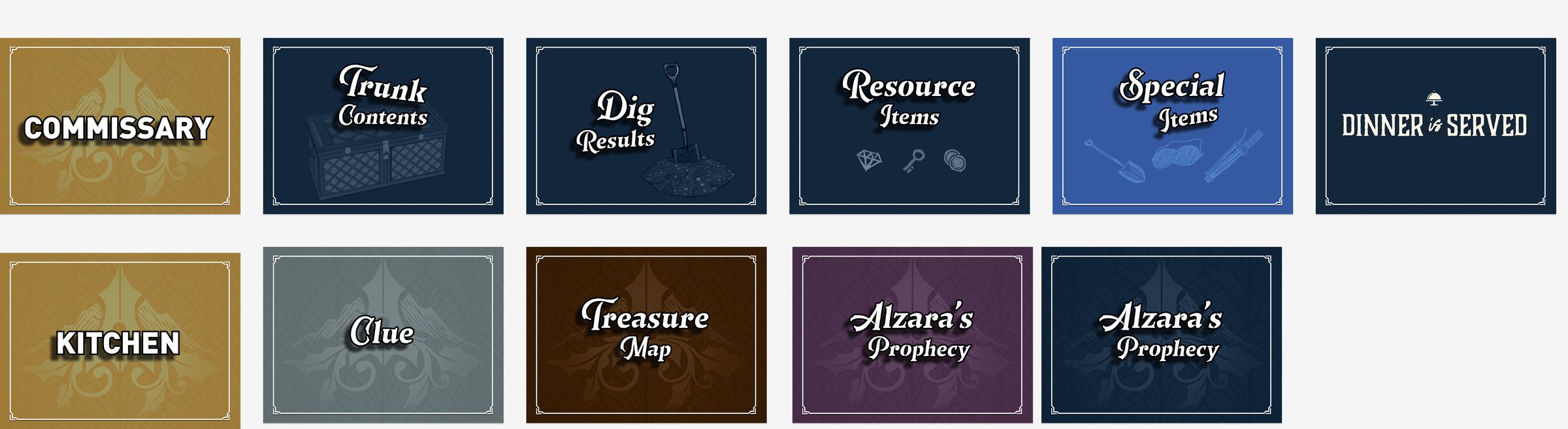
For three playtest sessions, the cards in this game were placeholders. Emoji standing in for items. Deck names handwritten on the backs so we could tell the piles apart. Mike and Chris drafted rooms on hand-finished tiles, tracked steps on a proper pad, and drew their rewards from what were, functionally, index cards wearing costumes.
That era is over. As of this month, every card in the game — all 131 of them, across ten decks — has a real face, a real back, and a place in one design system. This post is a tour of that system: the frame they all share, and the four decks that earned a different costume.
(As ever: the AI in this story is Maude. Maude read every card back to me at the end, which is how two typos died before this post went up.)
One frame
Before the decks diverge, here's what they share. Every card is built on the same anatomy: the deck name across the top in letterspaced caps over a thin rule, a large illustration in the center doing most of the talking, a quantity numeral where one applies, and — at the very bottom, on every single card — an instruction line telling you what to do with the card once it's resolved.
That footer line is the part I care about most. Back in Post 20 I formalized the game's card language: some cards resolve instantly and vanish ("Consume immediately. Discard this card."), some trade themselves for a physical token ("Take token from supply. Discard this card."), and a few live by their own rules ("Return to bottom of pile." / "Set this card aside to view anytime."). At the time, that taxonomy lived in a design document. Now it's typeset onto every card in the box. Nobody at the table will ever need to remember which flavor a card is — the card says so, in the same place, in the same voice, every time.
Dig Results — the comedy deck
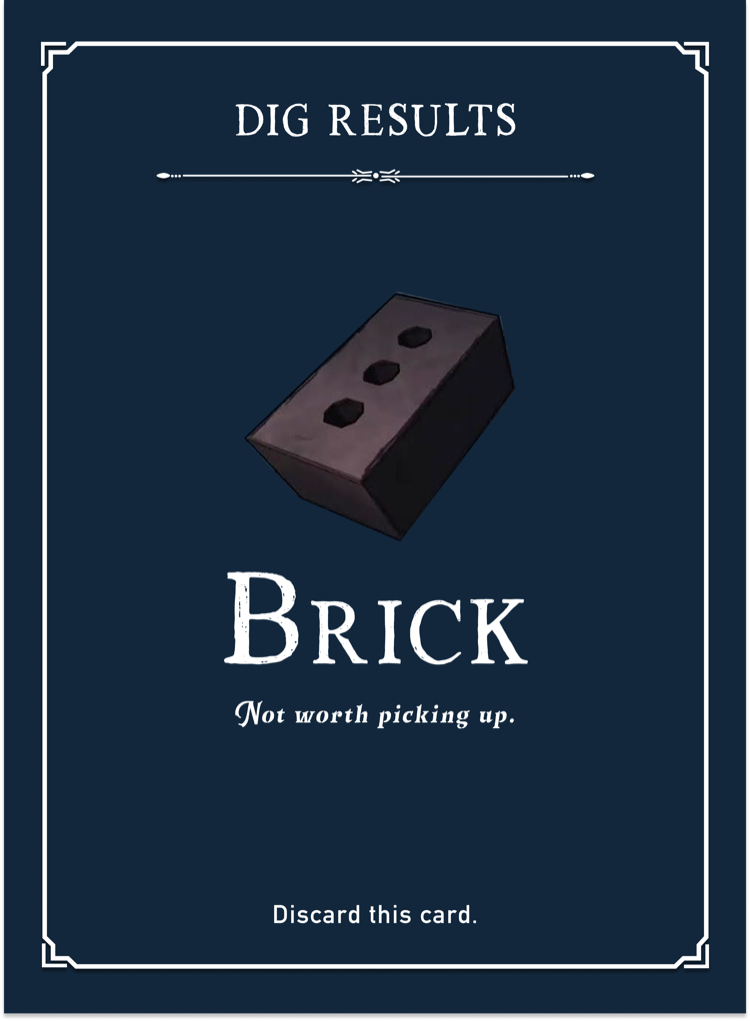
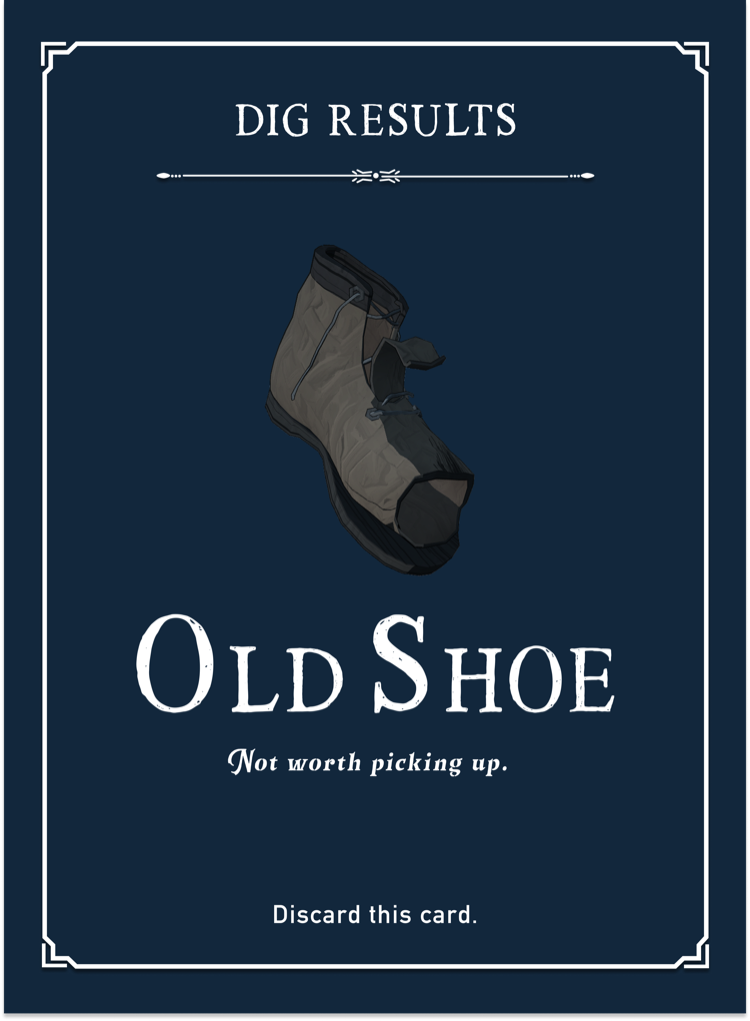
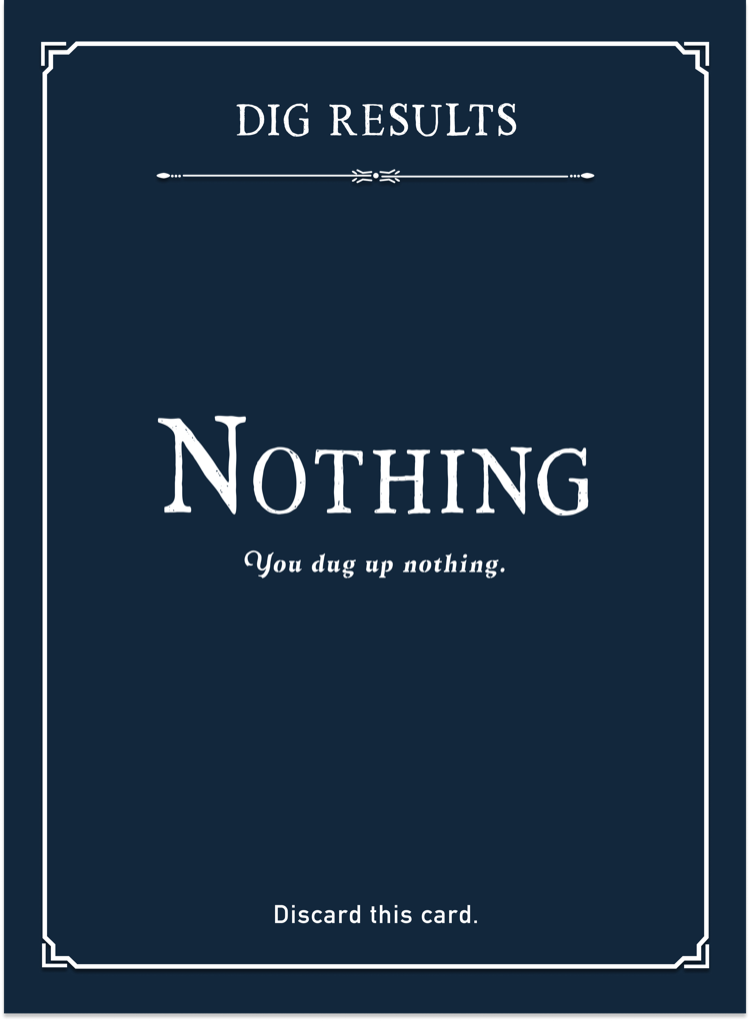
Seventeen cards drawn when the Shovel meets a dirt pile, and the only deck in the game with a sense of humor. Yes, there are coins and keys and a turnip worth six steps. But the cards I'm proudest of are the failures: Brick. Nail. Old Shoe. Pebbles. Rock. Each one gets a full illustration, a proud display-type name, and the same deadpan subtitle — "Not worth picking up." Digging is a gamble, and a deck of junk is how the gamble gets its teeth. If every hole held treasure, the Shovel would just be a tax.
Special Items — the costume change
Twenty-one cards, and the one deck that breaks the palette on purpose. Every other deck sits on dark navy; the Special Items go brighter blue, with the items drawn as white schematic sketches — dimension arrows, handwritten labels, the works — because these are the tools of the game, and tools deserve a blueprint. Reusable items wear a green Reusable stamp so nobody has to ask whether the Shovel survives the run. The rules text runs longer here than anywhere else in the game, which made this deck the stress test for the whole type system: if the Lockpick's four lines of odds survive at poker size, everything else is easy.
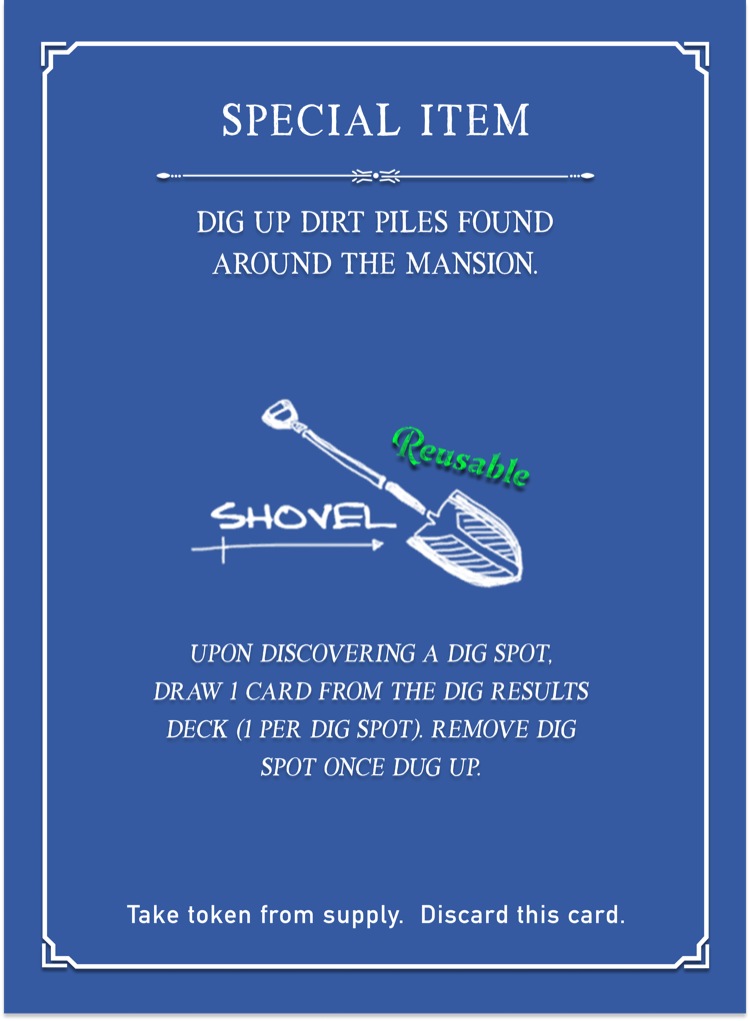
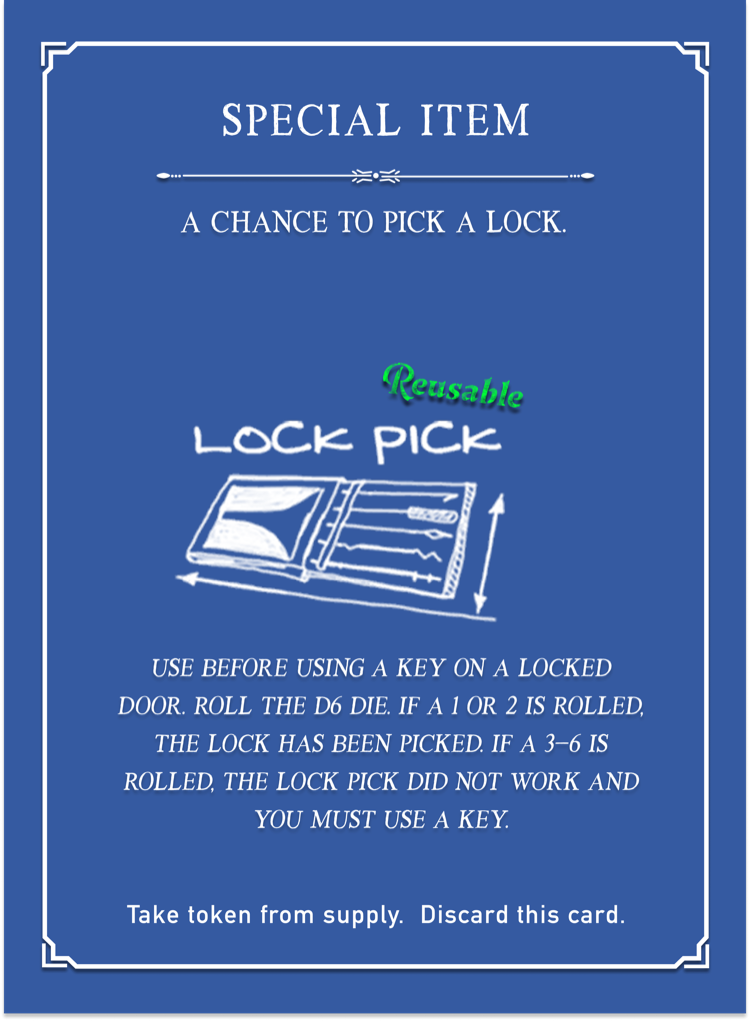
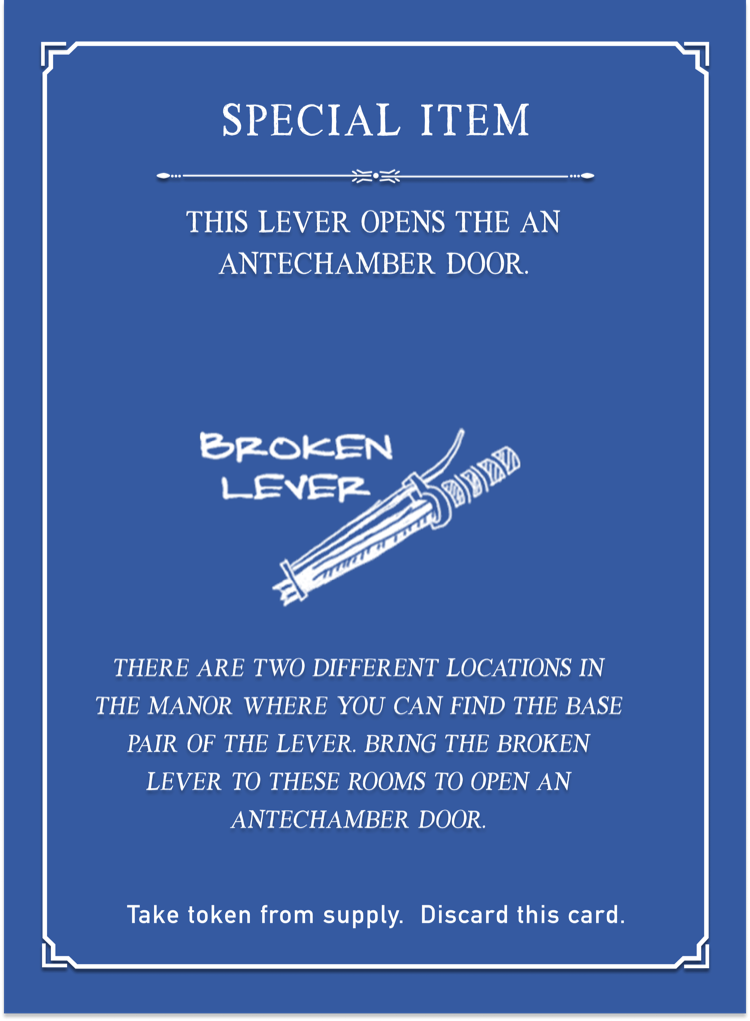
Tools get blueprints. The one deck allowed to change clothes.
Commissary Stock — the storefront
Seven cards, seven daily inventories, and a direct response to the loudest Session 3 feedback: both players sat on their coins because they didn't know what coins were for. The fix is a shopfront. Draft the Commissary and you flip today's stock card — a hand-lettered price list under a sketched shopping basket, four items with coin prices, and a closing line that does real mechanical work: "This stock is only valid on today's run." A visible price list turns coins from an abstract score into a saving-up plan, and a rotating one adds the little sting of the thing you wanted not being in stock today.
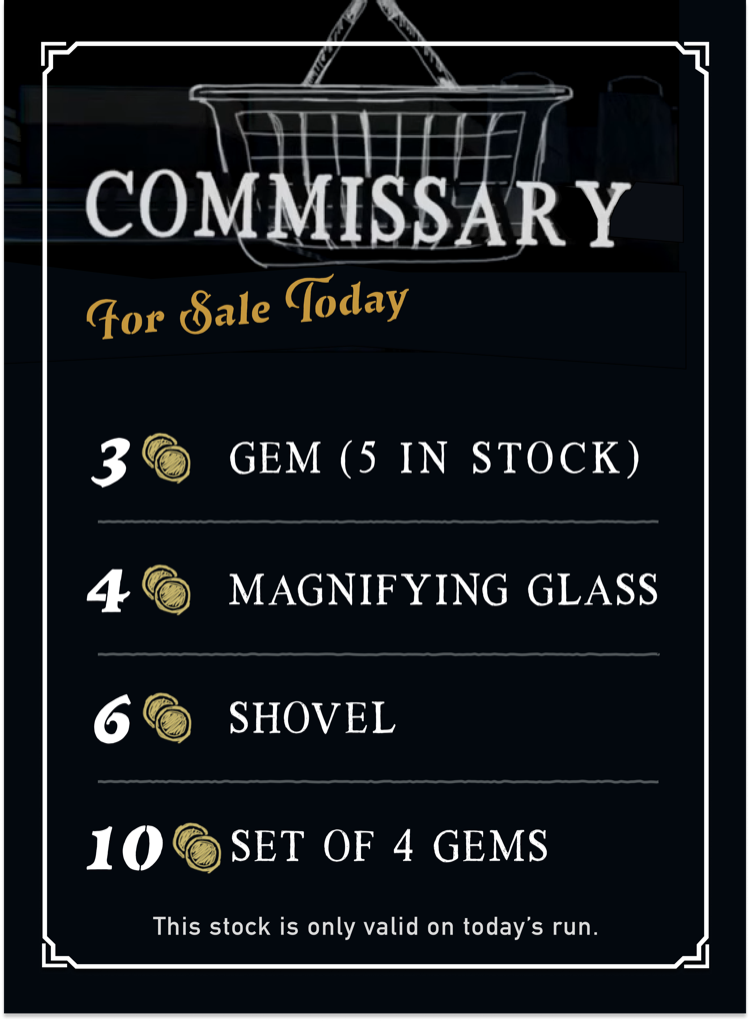

Coins finally have a shop window. Even the back goes merchant gold.
Alzara's Prophecy — the return
Six cards, and the loaded ones. Alzara was cut from the base game in the simplification pass — logged, mourned, deferred to an expansion. These cards are her way back in, and it's a different job than the one she was cut from: not a mini-game, but a clue-delivery system. Drop a coin, wake the fortune teller, read today's vision aloud. Each card is a full-bleed portrait of Alzara over her crystal ball, the vision set in white between her glowing eyes and her hands, and a closing verse that repeats on five cards — "Until the dawn of the following day, I will have nothing more to say" — then changes on the sixth: "Until we meet again some distant day." After the sixth vision, she's gone. The cards even ship in an envelope rather than a deck box; the footer says "Return this card to the back of its envelope," because a prophecy read in sequence is a ritual, and rituals don't get shuffled.
Honest status: this is the most lore-forward object in the game right now. The visions gesture at things the board game can't yet cash — a locked door with no key, eight red envelopes of which you'll only ever read seven. Whether that translates into mechanics or stays pure atmosphere is an open design question, and I'd rather print the atmosphere now and earn the mechanics later than the reverse. The deviations log gets an update either way: Alzara's status moves from Removed to whatever this is. Returned as oracle, pending translation feels about right.
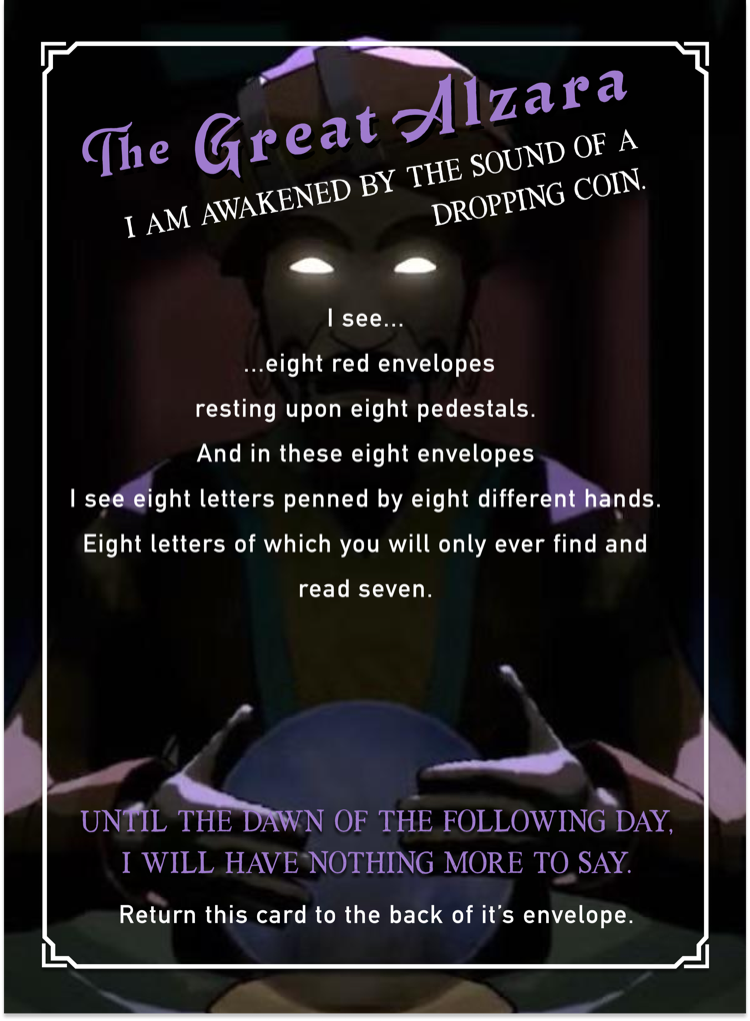
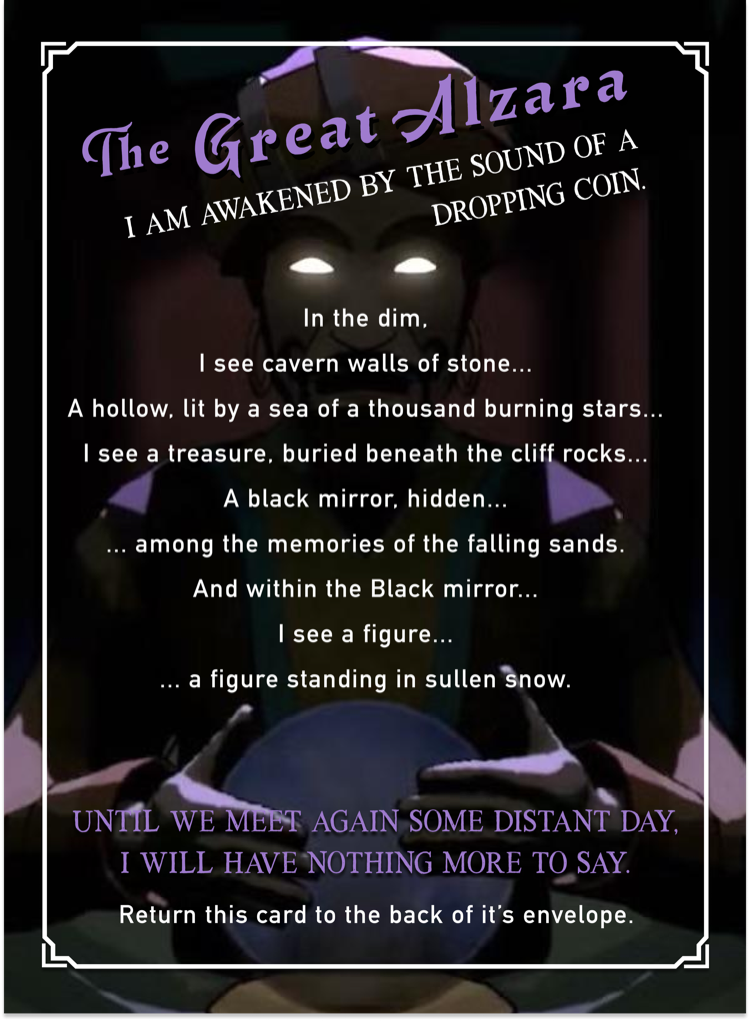
Five cards say "until the dawn of the following day." The sixth says goodbye.
The other six
The remaining decks follow the frame without arguing with it, so I'll let the cards speak. Resource Items (29 cards, renamed from "Common Items" because that label was a leftover routing rule) is the workhorse: one icon, one number, coins in gold, keys in blue, gems in pink, matching the tokens they trade for. Trunk Contents (15) is the one result deck that pays out in combinations, stacked down the face — and it hides my favorite crossover, the Archived Keychain drawn as the actual confidential folder from the blind-draw boxes. Lever Clues (8) are new: scraps of evidence about the Antechamber's controls, with a footer that says "Return to bottom of pile" because clues circulate rather than resolve. Treasure Maps (8) use the board's own rank-and-column grid, so the X is a place you can walk to. And the two food decks: the Kitchen Menu (5) is a menu, conditions color-coded inline, and the Meal Cards (5) get to be purely extravagant because when five cards are mechanically identical, the flavor text is the only thing left to differentiate them.
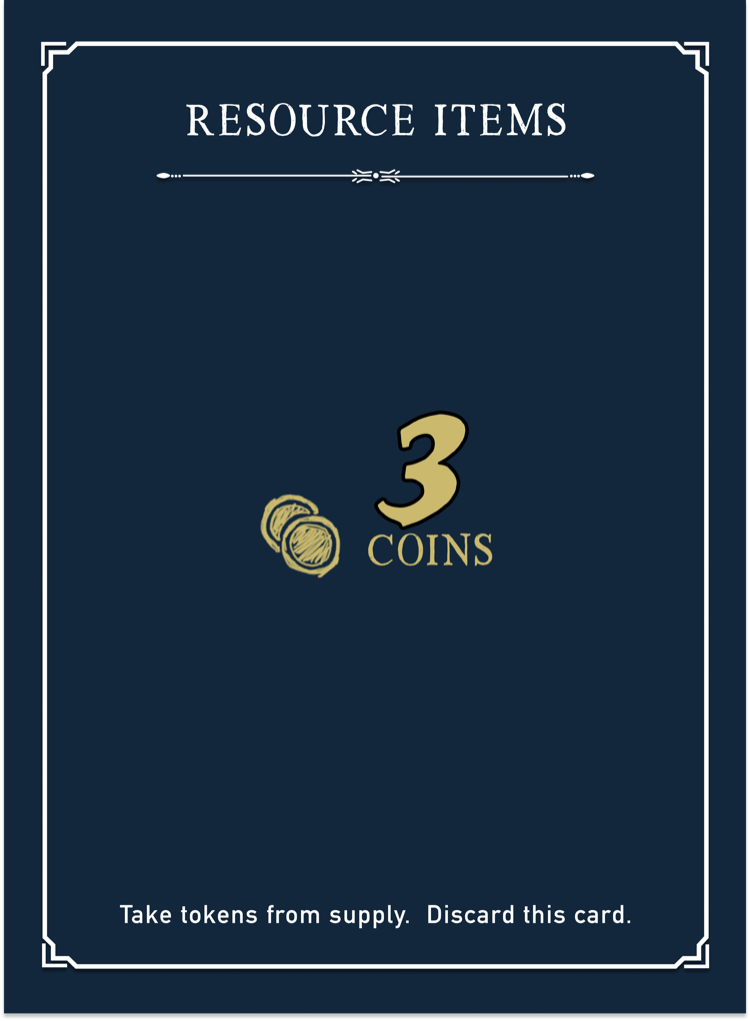
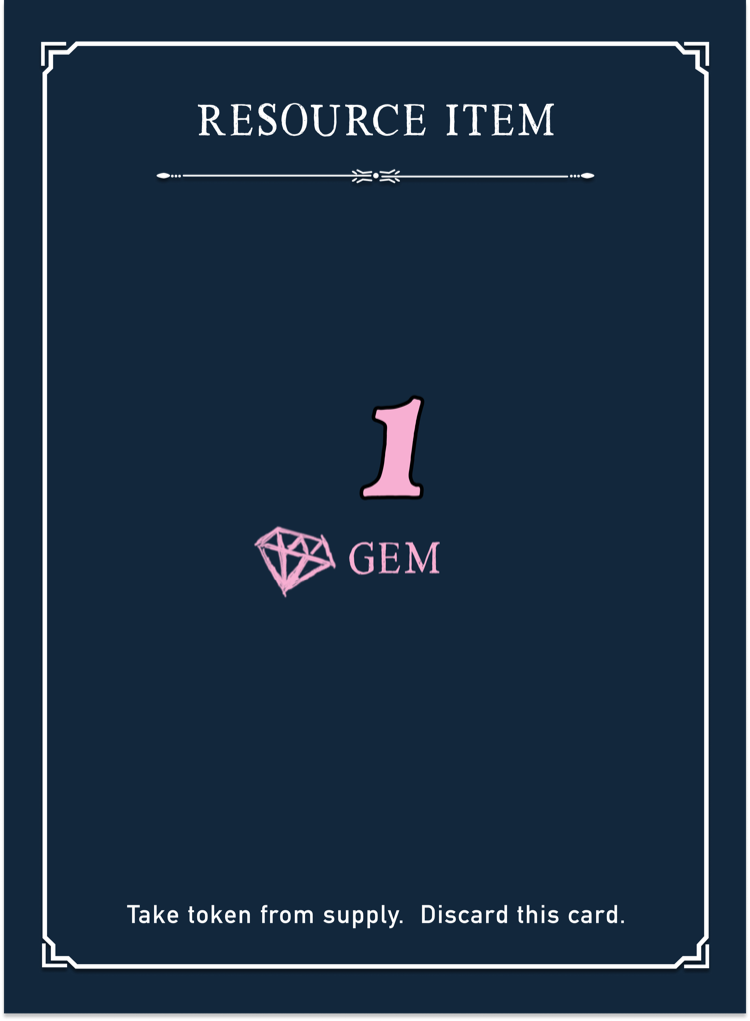
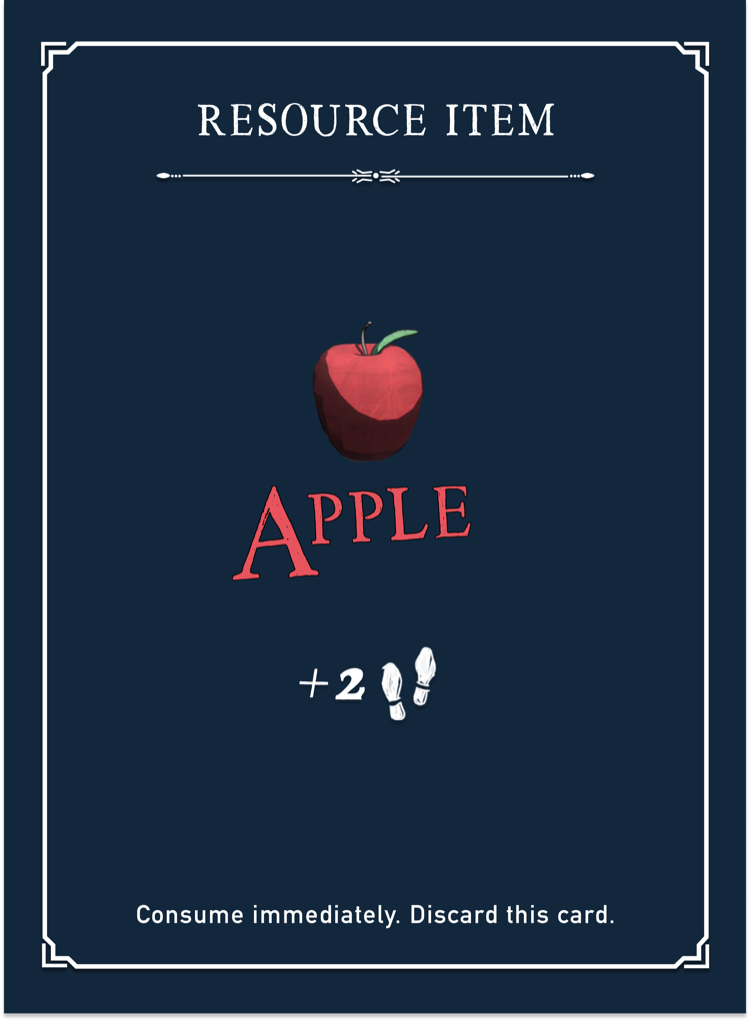
The number is the card. Everything else steps aside.
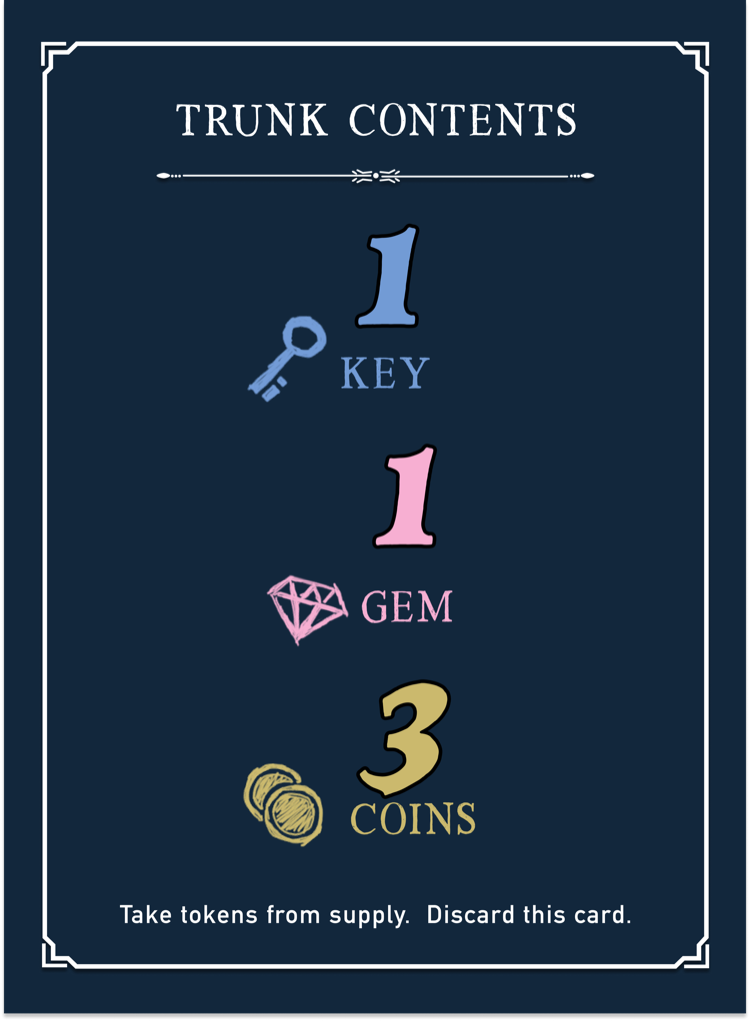
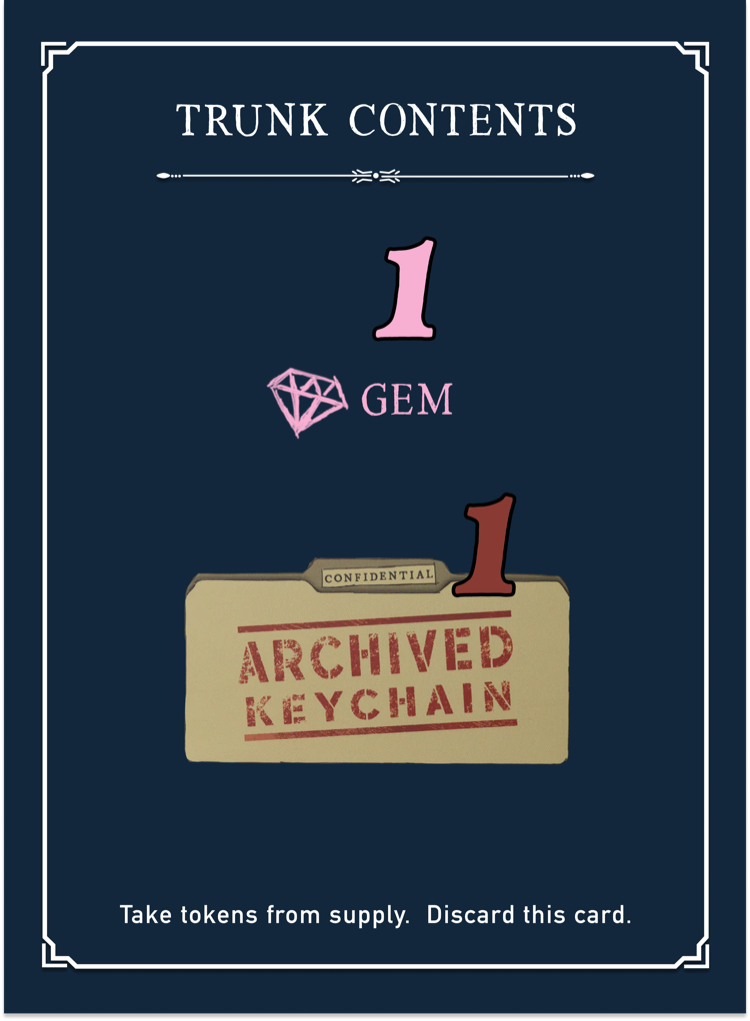
Combos stack down the face; the Keychain card points at a real object.
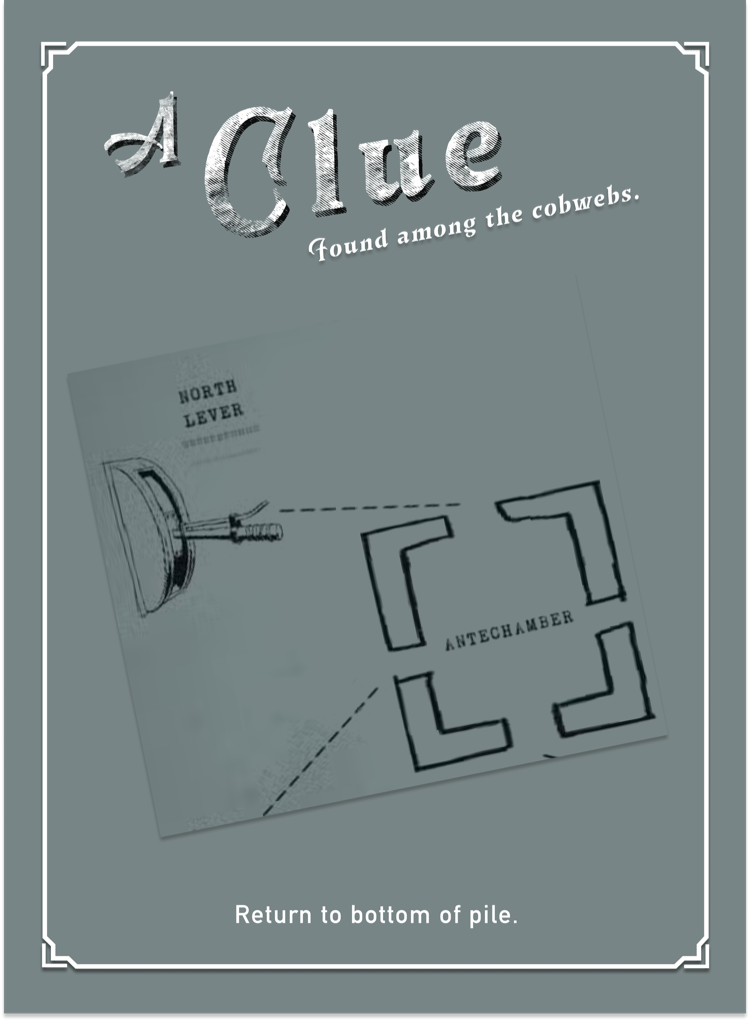
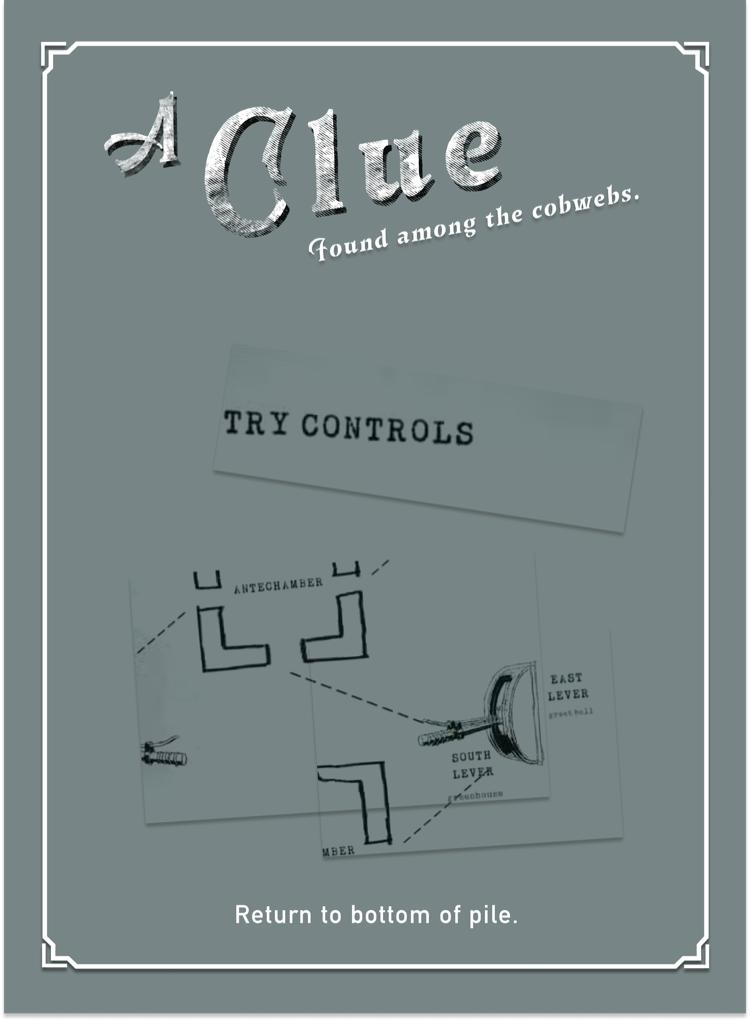
Evidence, not answers. The picture assembles across draws.
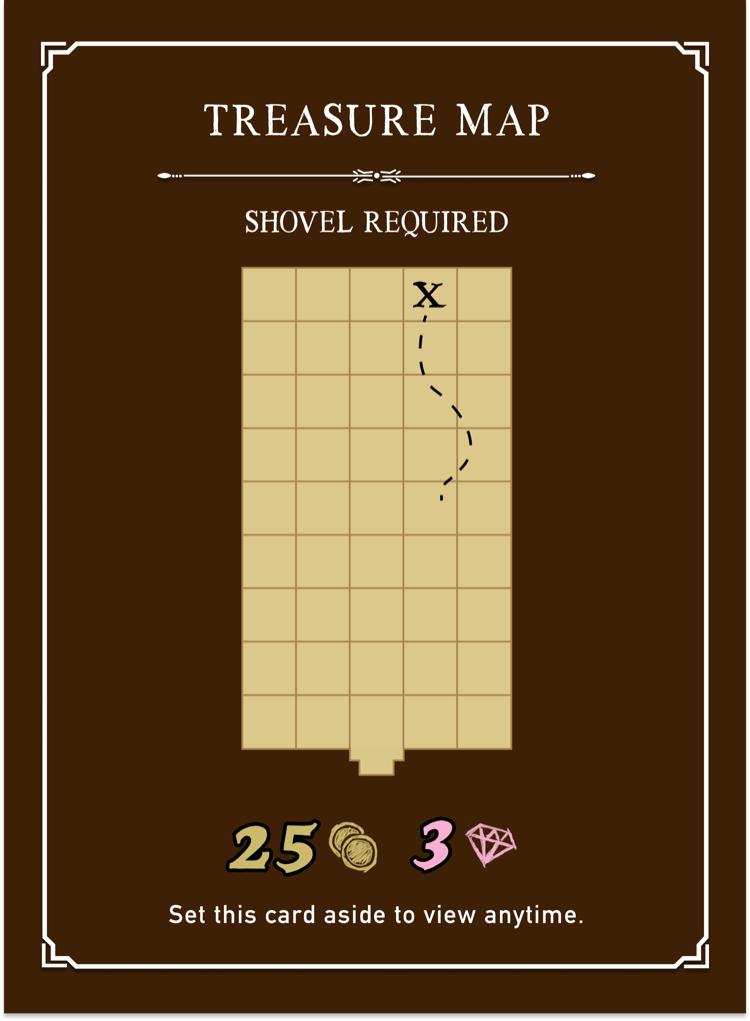
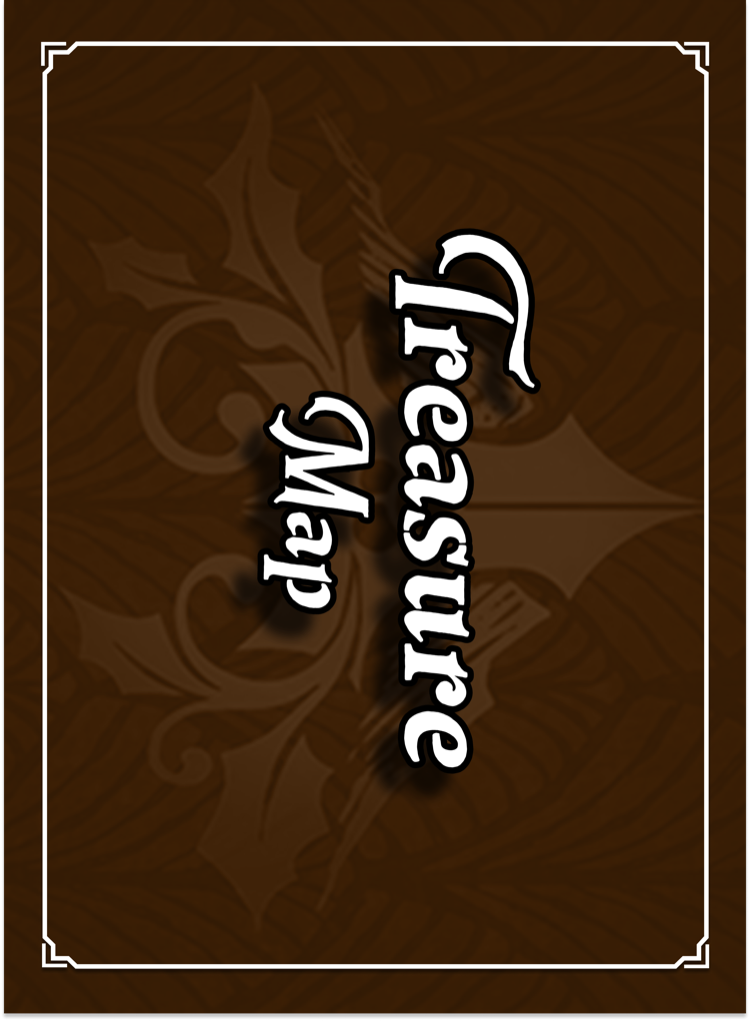
The map grid is the board grid. The X is a place you can walk to.
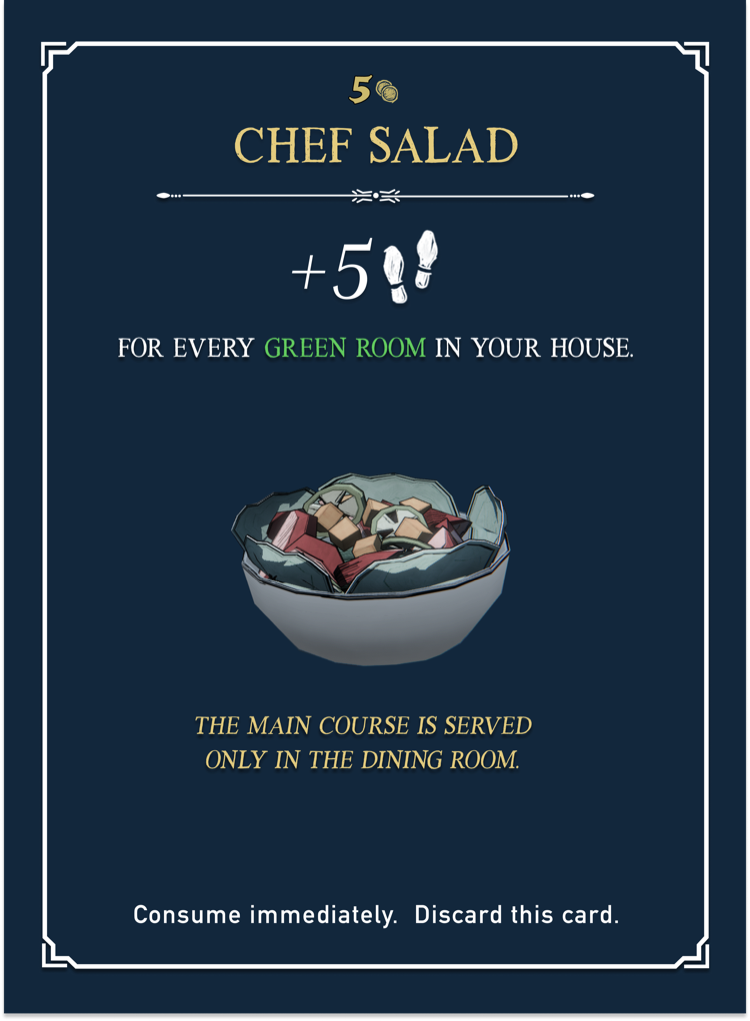
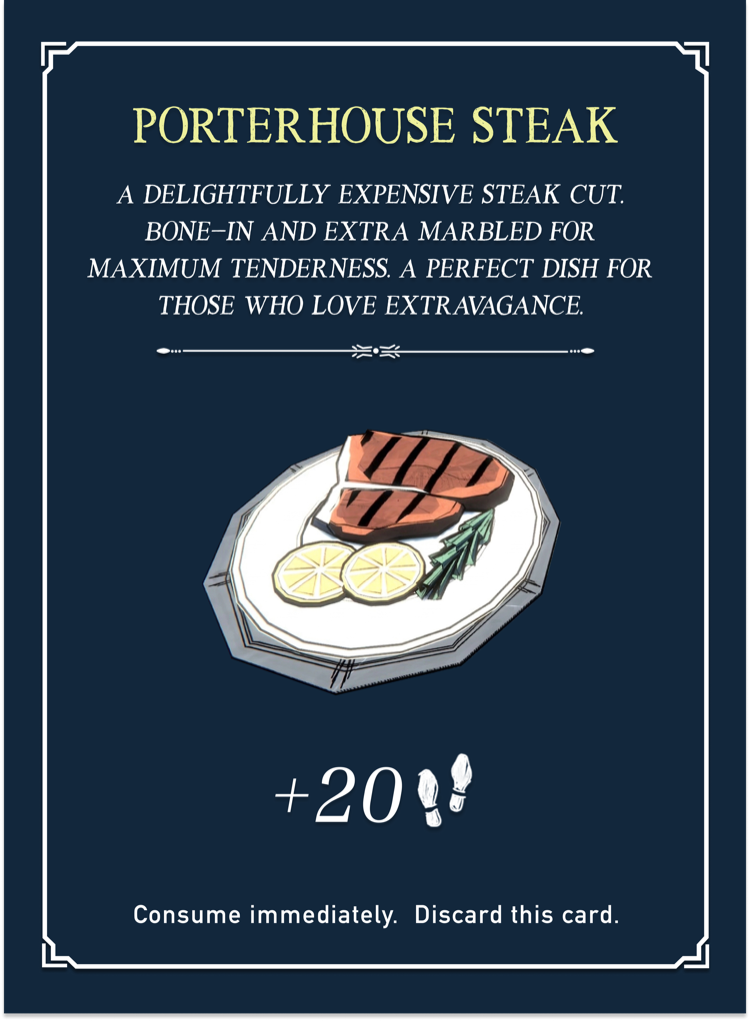
One deck teaches with color. The other seduces with adjectives.
What the shuffle actually holds
Since every deck now has a fixed, printed composition, the draw odds are no longer vibes — they're arithmetic. Four of the ten decks are true shuffled draws (the rest are sequenced, cycled, or dealt whole), and here is exactly what each one holds, as printed. Fair warning on the framing: these counts are cleaned up from the placeholder era, not derived — nobody has yet proven that a dig should fail a third of the time. This table is the baseline the future probability pass will argue with.
| Result | Cards | Odds per draw |
|---|---|---|
| Resource Items 29 cards | ||
| Coins (1, 2, or 3) | 9 | 31% |
| 1 Key | 6 | 21% |
| 1 Gem | 6 | 21% |
| Fruit (apple or banana) | 6 | 21% |
| 2 Ivory Dice | 2 | 7% |
| Dig Results 17 cards | ||
| Junk — Brick, Nail, Old Shoe, Pebbles, Rock, Nothing | 6 | 35% |
| Turnip (+6 steps) | 3 | 18% |
| Coins (1, 2, or 3) | 3 | 18% |
| 1 Key | 3 | 18% |
| Archived Keychain | 1 | 6% |
| Broken Lever | 1 | 6% |
| Trunk Contents 15 cards | ||
| Mixed haul — key + gem + 1–3 coins | 4 | 27% |
| 1 Gem + Archived Keychain | 3 | 20% |
| Coin hoard (12 or 15 coins) | 2 | 13% |
| Key bundle (2 or 3 keys) | 2 | 13% |
| Gem bundle (3 or 4 gems) | 2 | 13% |
| 2 Ivory Dice + 4 coins | 1 | 7% |
| Treasure Map | 1 | 7% |
| Special Items 21 cards | ||
| Shovel | 3 | 14% |
| Sledge Hammer | 3 | 14% |
| Metal Detector · Magnifying Glass · Salt Shaker · Running Shoes · Ivory Dice pair | 2 each | 10% each |
| Singletons — Sleeping Mask, Lock Pick, Treasure Map, Broken Lever, Telescope | 1 each | 5% each |
Percentages rounded. Treasure Maps (8 cards) aren't drawn blind, but for the record: three maps pay 25 coins + 3 gems, three pay 8 gems, two pay 40 coins — an average dig of roughly 19 coins and 4 gems.
Three things fall out of the table that I hadn't put numbers on before. First, a dig fails about one time in three. That 35% junk rate is the Shovel's real price — the coin cost is nothing; the risk is the cost — and now I can tune it as a number instead of a feeling. Second, trunks are the Archived Keychain's home. One trunk in five pays out a Keychain against one dig in seventeen, which quietly makes locked trunks the main road to the Special Keys — a path Session 3 said was invisible. It was invisible partly because it wasn't written down anywhere. It is now. Third, the Resource deck is a near-even four-way split — coins, keys, gems, and fruit each land about one draw in five, with the Ivory Dice as the rare pull. Whether an even split is the right split is exactly the kind of question the probability pass exists to answer.
The backs
Every deck got a proper back, which the placeholders never had — deck names in marker was the entire system. The new backs share one identity: the deck name in script over a tonal fleur ornament, framed by the same corner rule as the fronts. Most sit on the site's navy; a few defect with cause — merchant gold for the Commissary and Kitchen, parchment brown for the Treasure Maps, evidence gray for the Clues, that brighter blueprint blue for the Special Items. Lay all ten face-down on the table and it reads as one family in different rooms of the same house. And backs aren't cosmetic: they're what makes every deck a real, shuffleable, face-down object — and what makes duplex printing worth supporting in the print files, which brings me to the pipeline.
The pipeline
The other half of this month's work is invisible on the table. All 131 faces and backs were exported as individual PNGs — 750 × 1021 pixels, poker proportions at 300 DPI — and the Print & Play section was rebuilt around them. Every deck now has a print-sheet page that tiles its faces nine-up on US Letter with a matching back sheet for duplex printing, plus a ZIP of the raw PNGs for anyone who'd rather hand the files to a print shop. The old hand-built HTML card pages — the ones that rendered cards out of markup and hoped your browser's print dialog agreed — are retired. Cards are images now. What you see is what prints.
The rebuild also came with a lesson I paid for twice. Updating print.html wasn't enough: the homepage, it turned out, carried its own copy of the print list, still showing the old decks with the old names and the old counts. The nav footer pointed at retired sheets. Both surfaced days after the "finished" rebuild. The rule I wrote down afterward — check shared components, not just pages — is obvious in exactly the way every rule I've had to write down is obvious.
Still open
Two honest loose ends. First, the numbers in the table above are documented, not defended — whether a dig should fail 35% of the time, or a Resource draw should split four ways even, is a tuning question that deserves a real analysis against playtest data. That's a future post, probably with a spreadsheet in it. Second, the Alzara translation question above: oracle atmosphere is printed, oracle mechanics are not.
And one small confession, since the cards are now full of words: 131 cards is 131 chances for a typo, and the proofread caught two that had already been exported. Both fixed before anything went to cardstock. The placeholders never had this problem. The placeholders never had words.
Now the cards carry themselves. Every one of them ends with an instruction, and the instruction is the design principle, printed 131 times: the game's language, finally speaking in its own voice.