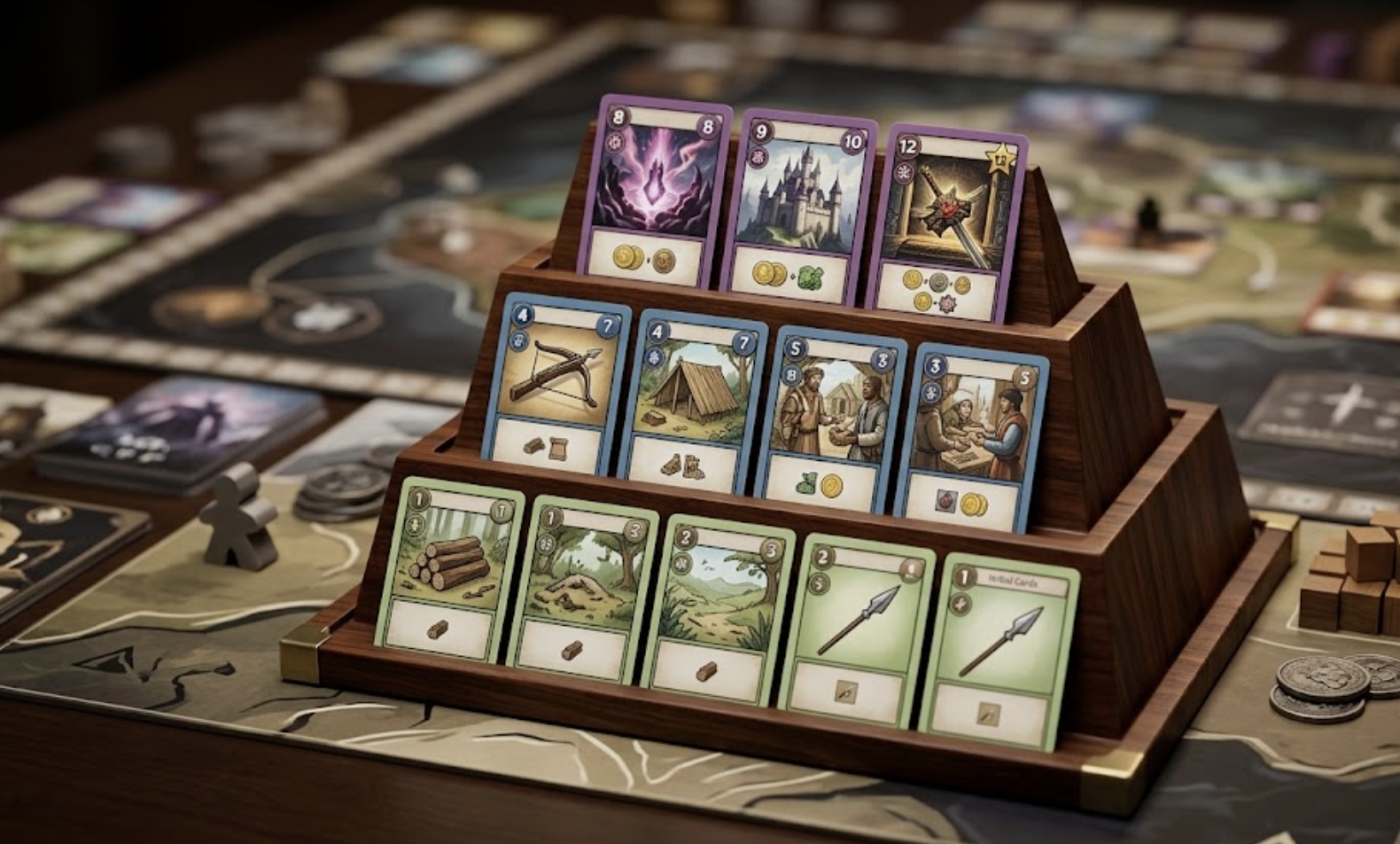
Post 03 was called "The System Underneath." The headline decision: rarity removed. Every Core Room tile goes into one bag. No tiers, no counting, no random exclusion per run. The bag is the deck.
It was the right call at the time. The tiers were producing complexity without drama — you had to count tiles and track pools to get an effect the player couldn't feel. Cutting it simplified setup, eliminated a bookkeeping step, and let playtesting focus on the actual core loop.
But the problem rarity was trying to solve didn't disappear. It just went underground.
The VG's mansion gets harder as you go north. Early ranks feel accessible; late ranks feel dangerous. The drafting pool in the VG is weighted — common rooms dominate early, rare and unusual rooms surface as you push deeper. That escalating tension is part of what makes each run feel like a three-act structure. In a single flat bag, you don't get that. Every rank draws from the same distribution. The manor doesn't breathe.
I've known this for months. The difficulty_curve_comparison page has been sitting in the repo since April — a side-by-side of Model A (our flat bag) and Model B (rank-gated progressive draw). Open question, pending playtesting. I've been waiting for the right frame to reopen it.
That frame just arrived from a German farmer's game designed in 2007.
Uwe Rosenberg
Career at a glance
Born 1970, Aurich, Germany. Co-founder of Lookout Games. Studied statistics at Dortmund — his thesis was on probability distributions in Memory. Designs roughly full-time since the late 1990s. Has four children and by his own account has mostly stopped playing other designers' games, preferring to iterate inward on his own mechanics.
The career arc
Rosenberg's career breaks into three distinct phases, each defined by a different relationship between cards and game feel.
Phase 1 — Card games, social mechanics (1992–2006). His first major success was Bohnanza (1997), a bean-trading card game built on one elegant constraint: you cannot reorder cards in your hand. You play from the front. That forced order — combined with a trading system — produces a game about negotiation, desperation, and social dynamics. Rosenberg didn't design a trading game and add hand order as a feature. He designed hand order as the mechanic and let the trading emerge from the pressure it creates.
Phase 2 — Worker placement, agricultural engine building (2007–2015). Agricola (2007) changed the genre. Players are farmers who must feed their families or face penalties — an anxiety engine embedded in a resource game. It held the #1 spot on BoardGameGeek for nearly two years. Caverna (2013) followed: same structure, more freedom, dwarves instead of farmers, underground rooms instead of fields.
Phase 3 — Spatial puzzles, tile-based farms (2014–present). A Feast for Odin (2016) is Rosenberg at his most ambitious: a Viking-age game where players fill a polyomino board with resources and land tiles, scoring based on coverage. Atiwa (2022) and Hallertau (2020) continue experimenting with cards as upgradeable action spaces — flip a card to reveal new capabilities as the game progresses. The spatial and the systemic merged.
How he works
In a 2016 interview at Spiel, Rosenberg described his process plainly: "The usual approach is to spend more time thinking about mechanisms that encourage play. Once I have a mechanism that gets players going, I quickly start looking for a theme." Mechanism first, then the world that makes the mechanism make sense.
He also described a second approach — playing another designer's game and changing the part he doesn't like until it becomes something new. He noted this is less common now that he has less time to play widely.
His statistics background surfaces in the design. He thinks carefully about probability distributions — what will actually come up, how often, what shape the experience curve takes across a session. This isn't accidental. It's trained.
Known design principles
The deck-switching mechanic in Agricola
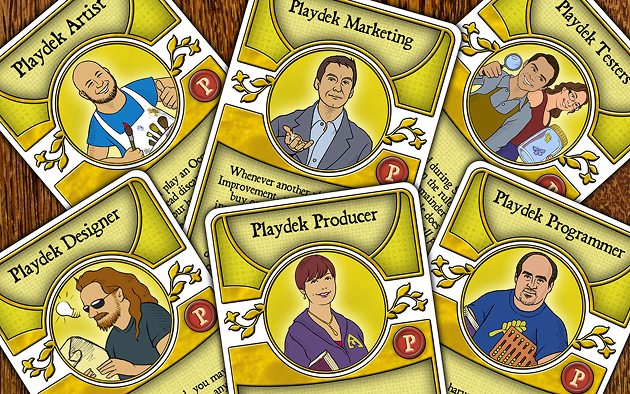
Agricola ships with three card decks: E (Einsteiger — Beginner), I (Interaktiv — Interactive), and K (Komplex — Complex). Each contains a different set of Occupation and Minor Improvement cards. The rulebook encourages players to mix decks and experiment. Aftermarket decks — Z, L, NL, and regional country decks (France, Netherlands, and others) — continue expanding the pool.
The mechanism is elegant in its simplicity: the rules don't change. The board doesn't change. The worker placement structure is identical. But swap the deck at setup and you get a fundamentally different strategic texture. E-deck produces accessible, friendly games. K-deck produces dense, combo-driven games where experienced players can break rules in layered ways. The difficulty curve doesn't live in the rules — it lives in the card pool.
This is the thing that stopped me when I first encountered it. Because it's exactly the shape of the problem we cut in Post 03.
The ghost of Post 03
In April, we cut room rarity because it was "creating complexity without drama." That diagnosis was accurate. The two-tier room deck was bookkeeping overhead in exchange for an effect players couldn't feel.
But Rosenberg's E/I/K system isn't a two-tier deck. It's a replaceable pool. You don't run two pools simultaneously with weighted draw rules. You choose which pool to use at setup and run one clean bag. The complexity is a setup decision, not a session mechanic.
That's the difference. And it means the problem Post 03 was solving — how to make the drafting pool feel different across experience levels and campaign progression — has a solution we haven't tried.
Proposals
Proposal 1 — Base Bag / Advanced Bag (Rosenberg-style swap)
Two curated room pools. Base Bag: current 57-tile flat Active Bag, unchanged. Advanced Bag: same rules, but seeded with a selection of rooms that have higher gem costs, more conditional mechanics, or greater interdependency (Locker Room, Mechanarium, Pump Room, Showroom-adjacent rooms if reintroduced). Player chooses at setup. One bag, one clean draw, same rules. No mid-session switching.
Preserves everything cut in Post 03. No rank-aware draw rules, no rarity tracking, no parallel piles. Just a different bag for a different experience.
Proposal 2 — Campaign unlocks seeded into bag
Start campaign with Base Bag. As players hit milestones (Studio Additions, Days Played thresholds, Room 46 found), permanently add specific room tiles to the bag. The pool expands over the life of the campaign rather than at setup. Legacy-adjacent but non-destructive — tiles are always returnable.
Mirrors the VG's progressive room unlock system more faithfully. The manor literally grows as the player learns it.
Proposal 3 — Hybrid: Base Bag + rank-gated draw for one slot only
Retain the flat Base Bag for Slots 1 and 2. For Slot 3 only, at Ranks 7+, draw from a small curated "deep manor" pool rather than the main bag. One additional pile, one additional draw rule, applied to one slot at late-game ranks only. The manor gets dangerous at the top without changing anything below.
This is Model B from difficulty_curve_comparison.html, minimized. Least disruptive way to introduce rank-aware escalation.
All three are worth testing. None requires changing the rules the playtester reads on their first run. That's the Rosenberg constraint: the complexity lives in the pool, not the procedure.
Post 03 cut the right thing for the right reasons. The flat bag was the correct prototype decision. But a prototype that survives into a publisher conversation needs to answer a question the flat bag defers: does the manor feel harder as you go deeper? Right now, the answer is not reliably yes.
Rosenberg has been answering that question for thirty years with cards. The method translates.