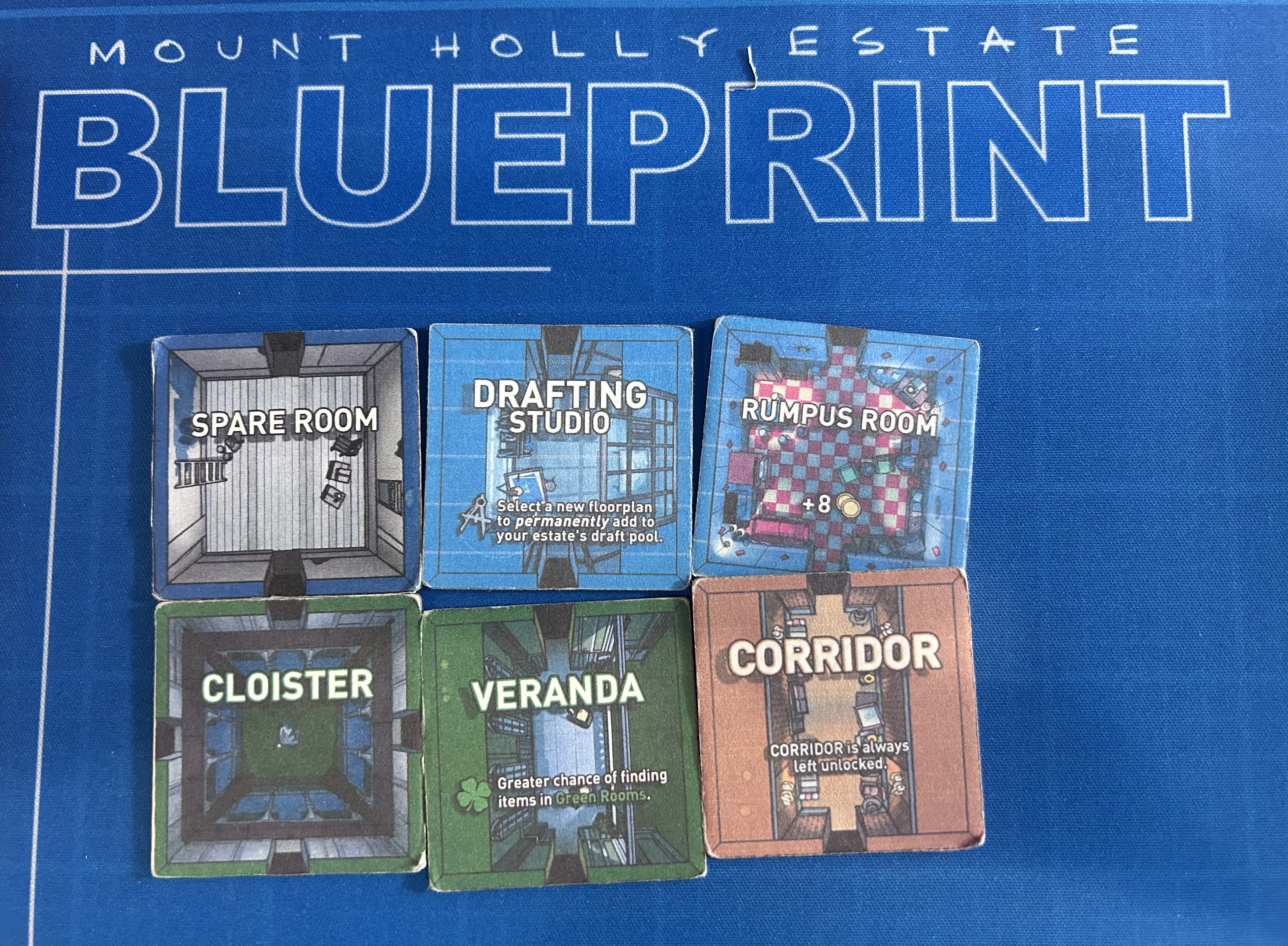
I have an L-shaped room. It has caused me more grief than any other object in this project, and it isn't close.
Here's why. When you draft a room in this game, you place a tile, and the tile has to face a direction. Most shapes don't care which. A straight hallway is a straight hallway however you spin it. A four-way opens on all sides, so rotation means nothing. A dead end has one door and nothing to argue about. Only two shapes ever make you decide — the L, two doors meeting at a bent corner, and its cousin the T, with three. Those are the only rooms that ever ask which way?
So when I tell you I spent the better part of two weeks and three broken models on tile orientation, understand that I really spent it on one stubborn shape and the question it would not stop asking. This is the story of getting that question wrong, repeatedly, in the open, on the way to an answer that — I'll spoil it now — fits in a single sentence.
Yes, the title is a joke only I will laugh at. Let me have it.
(As ever: the AI I worked through this with, I call Maude. Naming the actual product would read like an endorsement, and "Maude" is funnier.)
Before I walk you through them, a habit I dragged in from my day job. When my team is working a hard interaction problem, we don't solve it once — we build two or three models of it, usually low-fidelity wireframes, clickable, just enough to feel the behavior with none of the visual noise. And we never call them Concept 1, Concept 2, Concept 3. We give each one a name.
It sounds precious until you've watched it work a room. A named model grows an identity — it stops being an interchangeable line item and becomes a character, with its own logic and its own way of being wrong. And it hands everyone a word to point with. "I want the freedom of this one with the guardrails of that one" is a sentence a stakeholder can say and still remember after the meeting; "I liked Concept 2, or was it 3?" evaporates on the walk back to their desk. The names are scaffolding for the conversation.
So of course I named the orientation models. Three of them. We beat all three to death, and each died of something specific. In the order I broke them:
Draft One · True North
The version where the rooms could only be read one way
The first model I named True North, and the name was generous. Maude's instinct — and, briefly, mine — was the tidy one: lock every tile so the room's name always reads upright, and let the house grow in a single direction. North, away from you, deeper in. Clean. Legible. A board you could read like a page.
It lasted about a day. Because a board you read like a page is a board that only goes one way, and this game does not go one way. You draft sideways. You push west into a wing and east into another; you build laterally as much as you build forward. The whole feel of exploration — the sense that the house is sprawling around you, not just ahead of you — lives in those side doors. Lock the tiles upright and you amputate it.
I caught this one fast, which felt like skill at the time and looks, in hindsight, like beginner's luck. The lesson it left was the first plank of the real rule, though I didn't know that yet: whatever orientation system I land on, it cannot cost me lateral movement. Drafting east and west isn't a feature to preserve. It's the verb the whole game is built on.
Draft Two · Lazy Susan
The version where the game turned the corner for you
So orientation had to allow sideways growth. Fine. The next model I named Lazy Susan, after the spinning tray on a dinner table — because that is exactly what it did: rotate itself so you wouldn't have to. A tile enters through one fixed door, the one facing the room you came from, and then it simply turns to meet your approach. The bend lands wherever the geometry puts it. You don't choose. You connect, and the corner takes care of itself.
I liked it. It felt faithful, like I was honoring how the video game does it, and it was tidy, which I have a weakness for. Both feelings were wrong.
It wasn't faithful, because I'd misread how the video game actually orients a room — built a confident model on a glance. And it was the wrong kind of tidy, because the tidiness came entirely from deleting a decision. At the table, a corner that turns itself feels like the game playing without you. The instant you draft an L, your hand wants to decide which way it bends — toward the unopened door on the left, or the corridor on the right. That instinct isn't noise to engineer away. It's the player reaching for agency in the exact spot the game should be handing it over.
Draft Two's lesson, plank two: the bend is the player's decision, not the system's. I'd now learned, the hard way, two things the rule had to protect. I had not yet learned the thing that would blow up next.
Draft Three · The Bouncer
The version where I invented a problem the game doesn't have
Here's the one I'm least proud of and most glad I wrote down.
Once orientation was a real choice, a worry crept in. We draft from a blind bag. What happens when you pull a tile that — no matter how you turn it — throws a door off the edge of the board? A four-way pressed against the rim. A straight aimed at the wall. A T jammed into a corner with nowhere for its third door to go. A tile you simply cannot place legally.
So Maude and I built a bouncer for the door. That's what I called the model — The Bouncer — the one that cards every tile and turns away any that can't be placed legally. We even named what it was rejecting: the illegal draft. Redraw it? Skip it? Charge the player something to make it go away? I wrote rules. I logged a deviation. I sketched a whole little subsystem around the tile that can't come in.
Then a player's datamine of the actual game landed in my lap, and it quietly pulled the floor out from under all of it.
The game never refuses a room. When it genuinely can't orient a tile without sending a door into the wall, it doesn't redraw and it doesn't apologize. It places the tile anyway and lets that door dead-end against the edge of the house. A sealed exit. A door to nowhere. The game shrugs and keeps going.
Read that twice, because it's the part that undid me: the failure state I'd spent days designing around does not exist in the source. The "illegality" was never in the game. It was in my model — a side effect of Draft Two's forced rotation, which could paint a tile into a corner the real game never gets stuck in, because the real game is perfectly happy to nail a door shut and move on.
The Bouncer was working a door with no velvet rope. The real game turns no tile away — it waves the misfits in too, dead door and all — so there was never anything to bounce. I had built a fix for a problem I personally introduced two drafts earlier. That's the most honest sentence in this post.
The Spreadsheet
The part where the numbers nearly won
I should tell you what state I was in when that datamine arrived, because it explains the panic.
I'd just been staring at the game's real rotation tables — the actual numbers a player had pulled out of the code. Orientation in there isn't a coin flip. It's weighted. Rooms lean toward opening south, away from north. The weights shift on day three, shift again on day twenty-one. One item rewrites the odds wholesale. There are columns and percentages and exceptions nested inside the exceptions.
I looked at all that and felt the floor tilt, because I cannot put that on a table. Nobody is going to consult a weighted probability chart that re-weights itself on a schedule before they place a hallway. I had a genuine moment of: this is the part that doesn't translate. This is where the board game quietly fails to be the video game, and everyone at the table feels the seam.
What I'd missed — what the datamine actually showed, once I stopped panicking and read it — is that all that machinery sits on top of something tiny. Strip away the weights, the day-three nudges, the item that flips everything, and underneath is one rule, and that one rule is the only part that ever touches the board:
That's the load-bearing wall. Everything else in those tables is the video game deciding, at random and on your behalf, which of the legal orientations you get — a thing it does because a computer can roll invisible dice a hundred times a session and you'd never want to do that by hand. At a table you don't need the dice. You look at the tile, look at the board, and turn it a legal way. The weighting was never the rule. It was a machine standing in for a pair of human eyes — and at the table, I have the eyes.
What the rule turned out to be
So here's where three broken drafts and one humbling datamine actually landed. The whole of tile orientation, table-ready:
Only the L and the T ever rotate; everyone else places themselves. When you draft one, you turn it so a door meets the room you came from — and then you choose how it bends, among the orientations that keep every door on the board. If more than one is legal, the choice is yours. The table hands you the agency the video game charges an item to give back; that's a deliberate deviation, and an easy one to defend, because choosing is the fun part.
And if no orientation keeps every door on the board — the four-way at the rim, the T wedged in a corner — you place it anyway and let the stranded door dead-end against the wall. No redraw. No apology. An unapologetic dead end, exactly as the game does it. Because there are no illegal drafts.
There is exactly one thing that earns a redraw, and it's the single mercy the video game actually grants: it will never hand you a draft that's all dead ends. So neither will we. If every option in front of you is a dead end — a Dead End Draft — you put them back, reshuffle, and pull again. That's the entire safety net. One guarantee, because it's the only one the source makes.
Everything else stays hard on purpose. You can draw a room that connects to nothing useful — a road-block, a door that opens onto the back of something you already placed. The game permits that, deliberately, and so do we. Getting stuck with a bad option is the tension. The rule protects you from impossibility, never from regret.
Why I'm keeping the wreckage
I could have written this post as one clean sentence — a door may never point off the board, you choose among what's legal, and a stranded door just dies — and pretended I'd known it all along. That would have been a lie, and worse, it would have thrown away the most useful thing I made.
Because the three broken drafts aren't detours around the design. They are the design. Look at what each wrong one left behind. True North, the upright cage, taught me the rule had to protect lateral movement. Lazy Susan, the self-turning corner, taught me it had to protect the player's choice of bend. The Bouncer, guarding a door that needed no guard, taught me it must not invent a failure the source doesn't have. Three planks. The final rule didn't arrive elegant. It got sanded down to elegant, one ugly pass at a time, and every pass stripped away a thing the rule turned out it couldn't afford to lose.
A mentor told me once that the documentation is the design. Here's the corollary I keep relearning: so is the wreckage. The record of what failed, and why, isn't embarrassing throat-clearing before the real answer. It's the rationale. It's the reason the clean rule is shaped the exact way it is. Delete the failures and the survivor looks arbitrary — why this rule and not some tidier one? The tidier ones are all in the graveyard, and the graveyard is the answer.
So I'm keeping the bruises in the file. Every model we tried, and every reason it broke, is going into the deviations log — right beside the one that outlived them, the rule I just call the Edge Rule. Three named failures and one named survivor. Not an apology. An explanation.
I got the answer wrong three times. The fourth time it fit in a sentence — and the only reason I trust the sentence is that I can see the three wrong ones standing behind it.