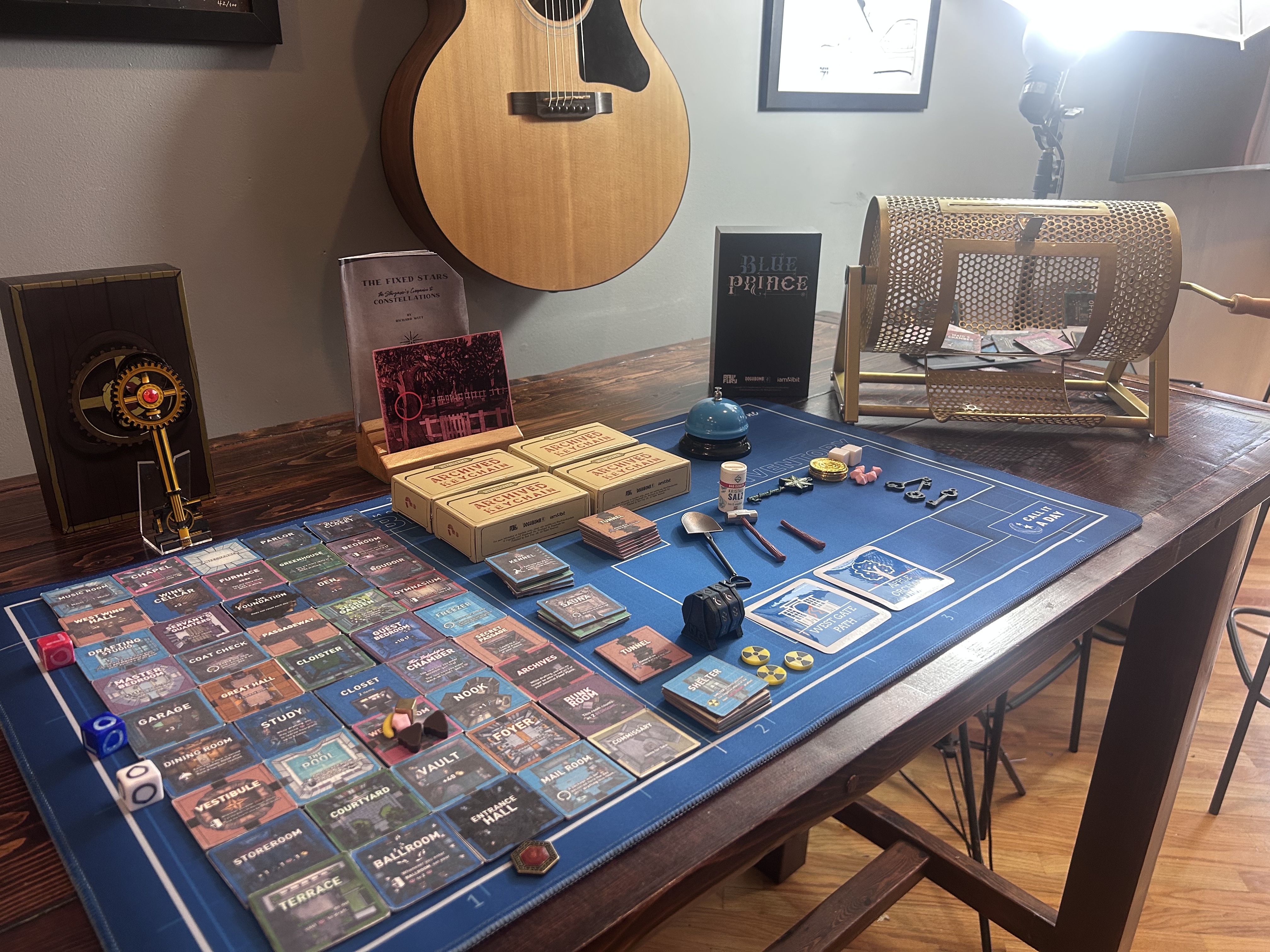
Two months ago I was using an Exacto knife to cut out home-printed mansion rooms and gluing them to cardboard tiles. 110 of them, to be exact. Today is a little more exciting. Recently, something arrives in the mail almost every day — from an indie game shop, from eBay, from Etsy, from iam8bit when they have stock. The game is the same game. The object it's becoming is something else entirely.
For two months I wasn't sure what kind of thing this was supposed to be. A playtesting tool? A proof of concept? Something you'd hand to a stranger and say "try this"? All of those, sort of. But not quite.
It's clearer now. This prototype has one job: become a singular, polished, one-of-a-kind physical object. Not a production run. Not a kit. One instance. The best version of this game I can build, using the best materials I can find.
That clarity matters because of what I do for a living. As a UX designer, every object I've ever made professionally — every interface, every flow, every system — exists only on a screen. You can't hold any of it, and it's redesigned and iterated on constantly, making a shadow of what I may have put into it personally. This is the first thing I've designed that has actual weight. It'll sit on a shelf. You can pick it up. For a career's worth of digital work, that turns out to mean something.
The Sourcing
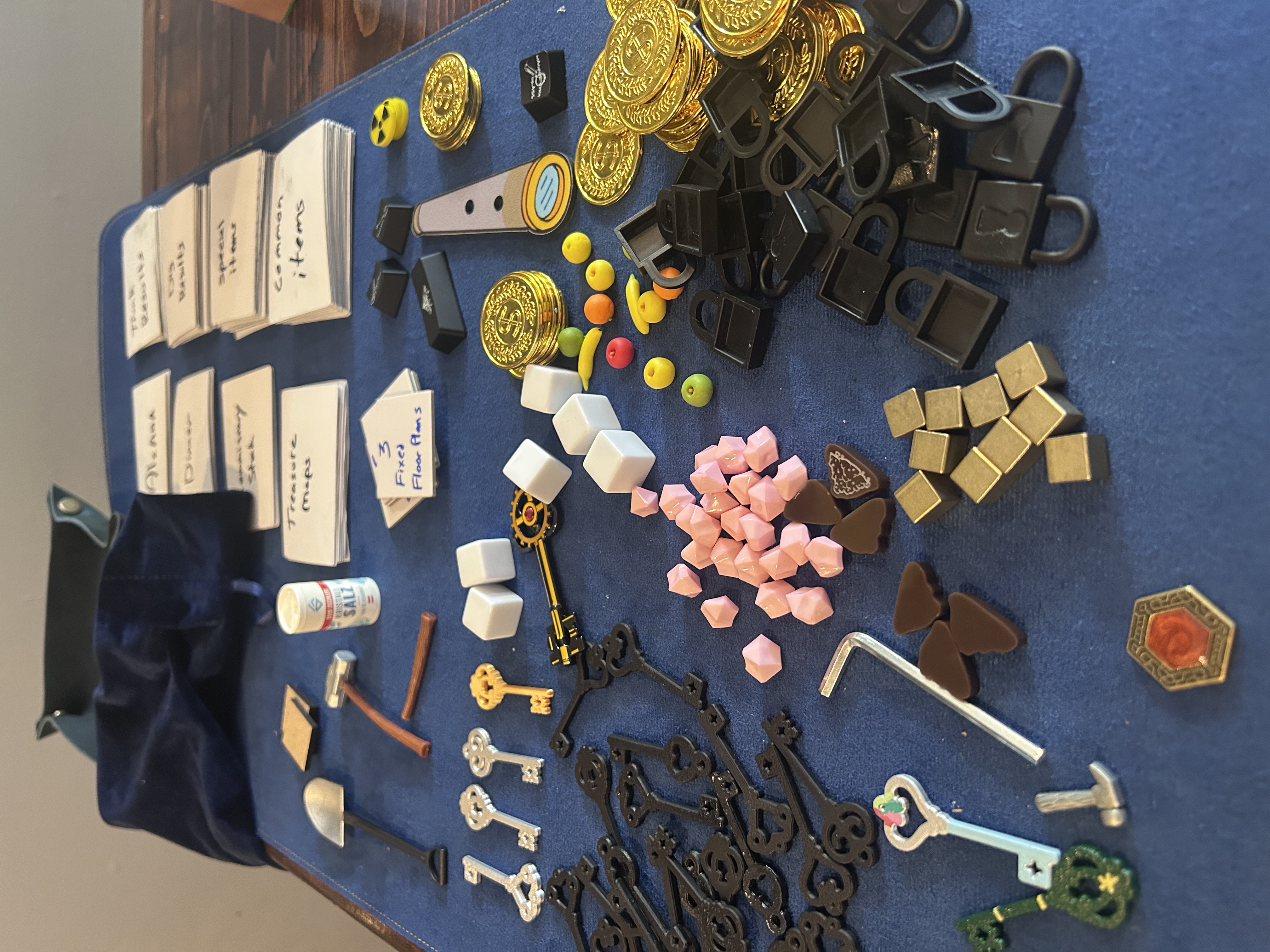
Part of what's made the last two months genuinely fun is discovering that the board game design community is a subculture I knew existed but had never actually entered. People have made striking things. The quality of components in indie games — the tokens, the trays, the custom dice — is something I didn't expect. 3D printing wasn't around when I was a kid playing board games, and the possibilities now are almost unlimited.
I've been cannibalizing other games for parts. Tokens from games I played as a kid, adapted and manipulated into something that fits here. A full list is coming in a future post — there are more sources than I can recall without going back through the emails and receipts.
Almost every day something arrives and there's a small dopamine hit when it does. A new token that might work. A prop that looks right. A component from somewhere unexpected that fits the aesthetic better than anything I could have designed from scratch.
Today's hit came from the lottery spinner.
iam8bit and the Coherence Problem
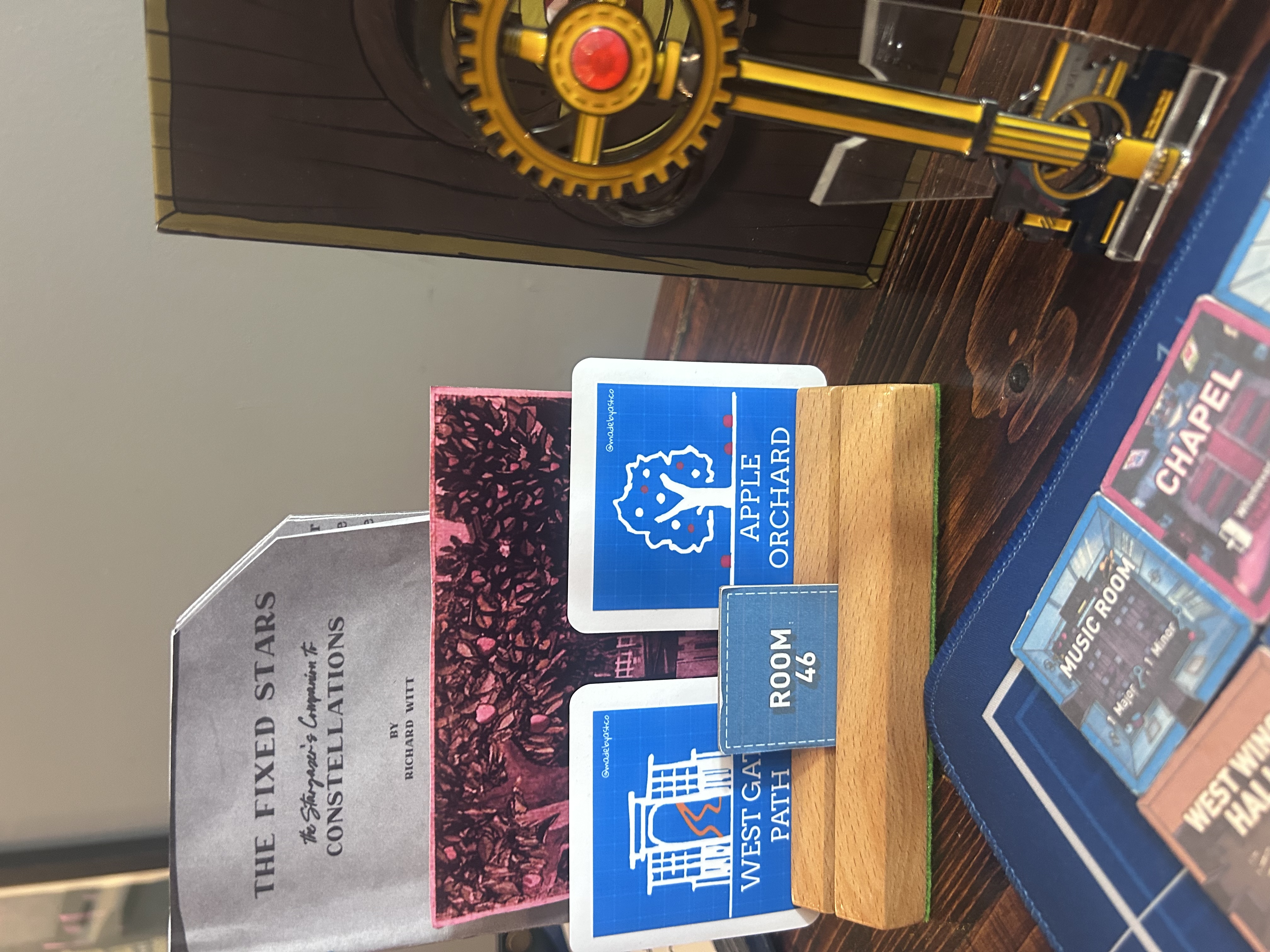
The best pieces in this game didn't come from me. They came from iam8bit.
The Archived Keychain boxes. The Prism Key prop. The iam8bit Blue Prince collector's edition artifacts — beautifully designed, game-accurate, built with real craft. They fit into this prototype almost too well. I've wondered more than once whether iam8bit was thinking about a physical game too. What they've produced could not be more perfect for the table.
The problem is that everything else in the game now has to keep up with them.
Right now the game is a mix: high-quality iam8bit artifacts, solid generic tokens like gems and padlocks, pieces hijacked from other board games and manipulated, and the paper tiles and cards I've printed and cut out myself. The tiles look good. The handmade item cards — the dig results, the common items, the trunk results — look shabby standing next to the iam8bit stuff. The quality gap is visible.
The goal of making a showpiece means closing that gap. The path for the cards is clear: stop handmaking them. Commission a proper print run — one batch, high quality, even if it's expensive. This isn't going to production so a one-time cost isn't the calculation it would otherwise be. The cards just need to look like they belong in the same game as everything else.
The harder problem is the pieces that don't exist yet. The metal detector. A few other items specific to Blue Prince that have no obvious generic stand-in. I'm looking at you, lockpick. The only real path for those is 3D printing — but that's outside my current skillset and the right solution isn't clear yet. That question stays open.
The Long Table
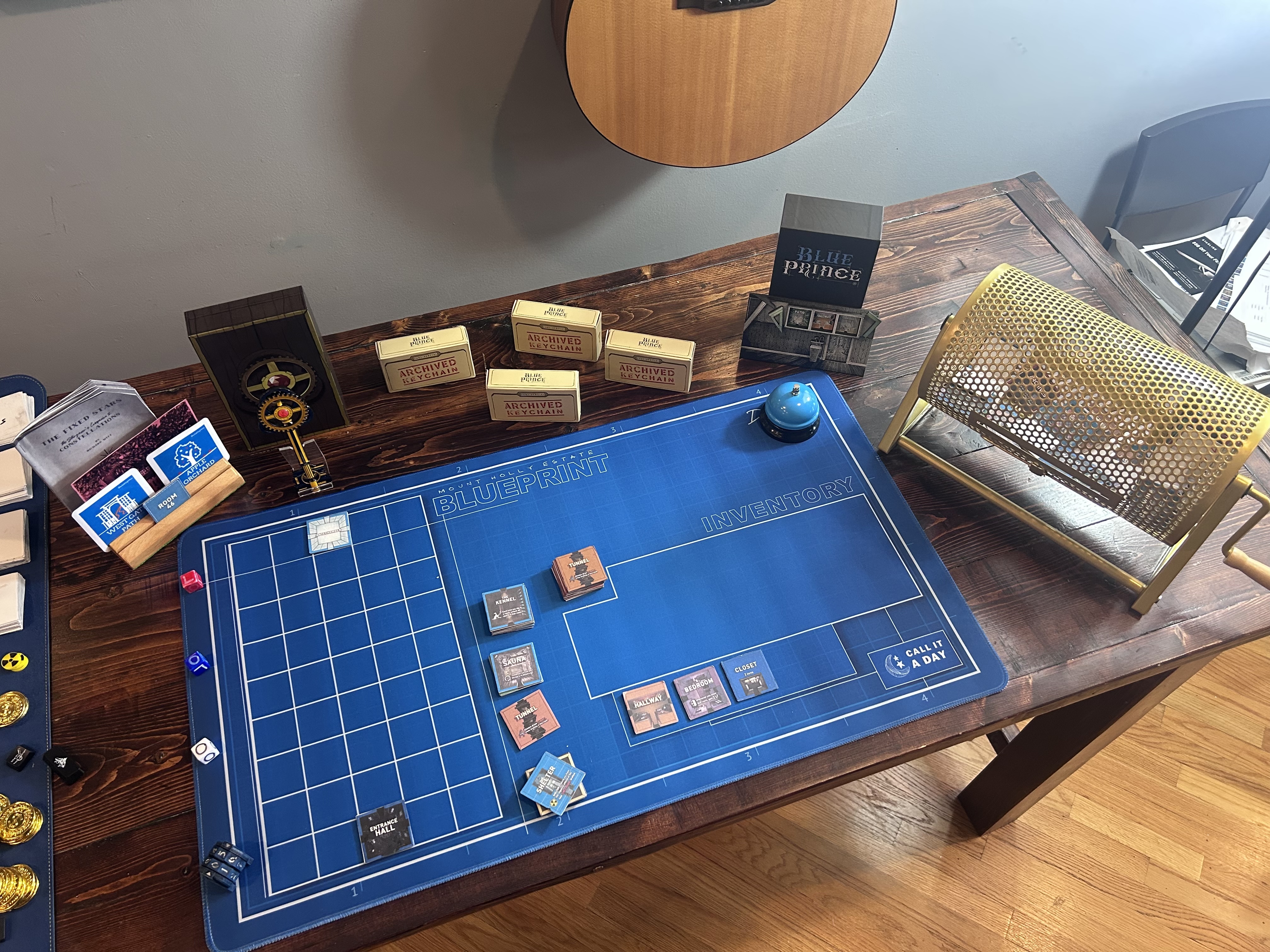
One more thing that's become clear: this game doesn't need to fit in a box.
Not this version. A production game has constraints — manufacturing tolerances, shipping costs, retail shelf sizes. This prototype has none of those. It just needs to be impressive, playable, and fun. So if a component is bigger than what "should" fit, that's fine. The game gets to assert what it needs.
Which brings me to the spinner.
The Hot Date Who Can't Dance
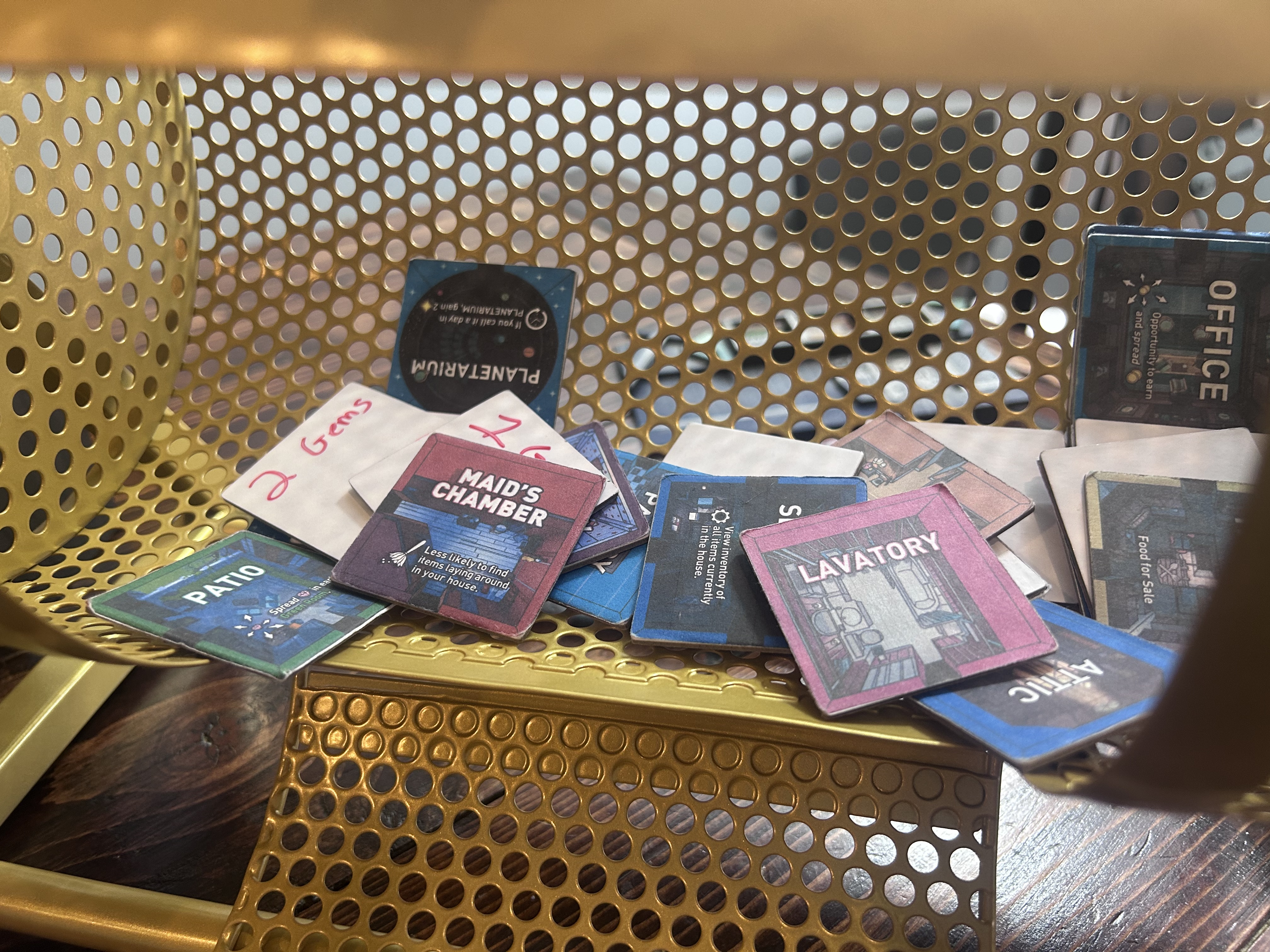
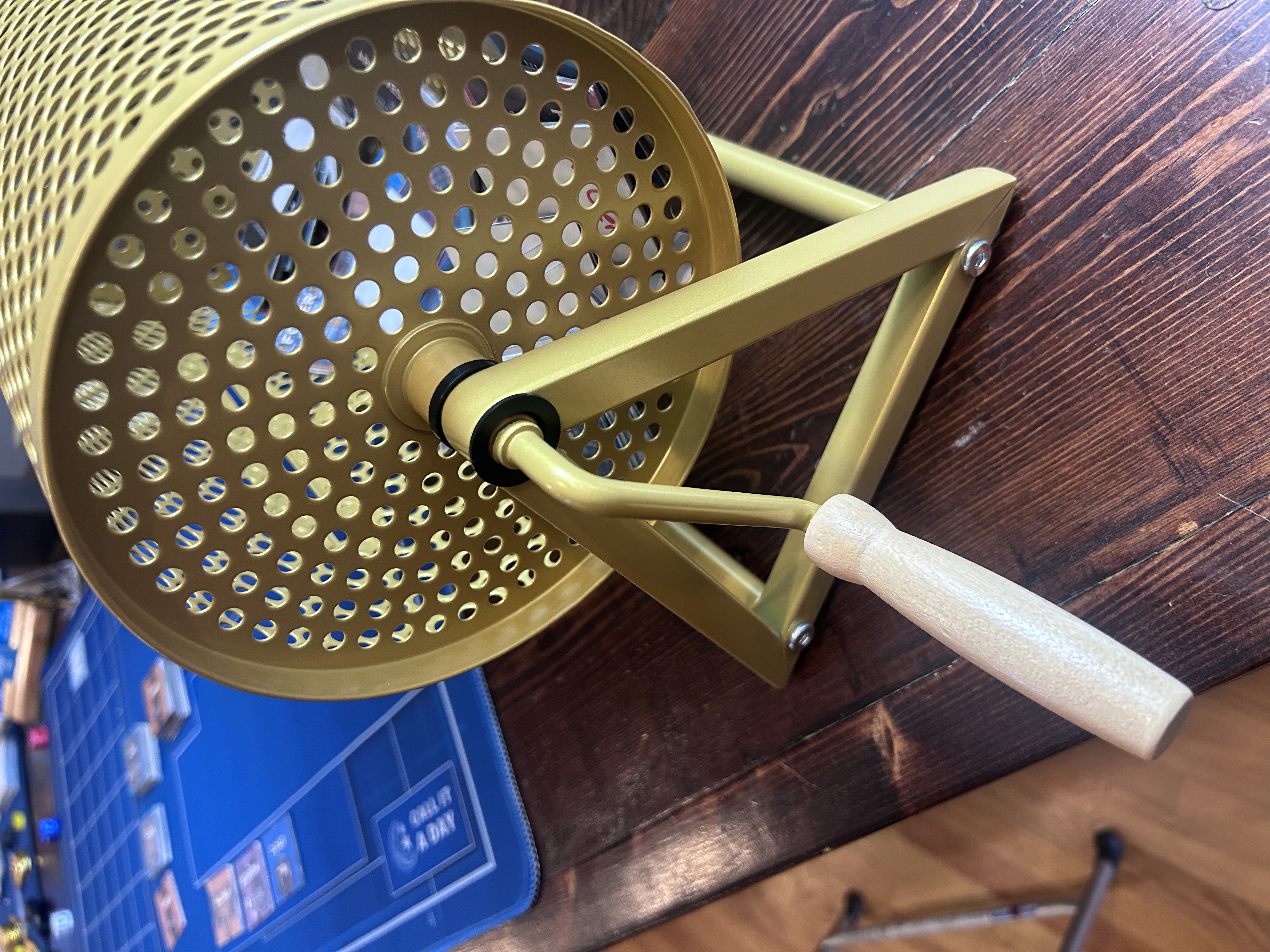
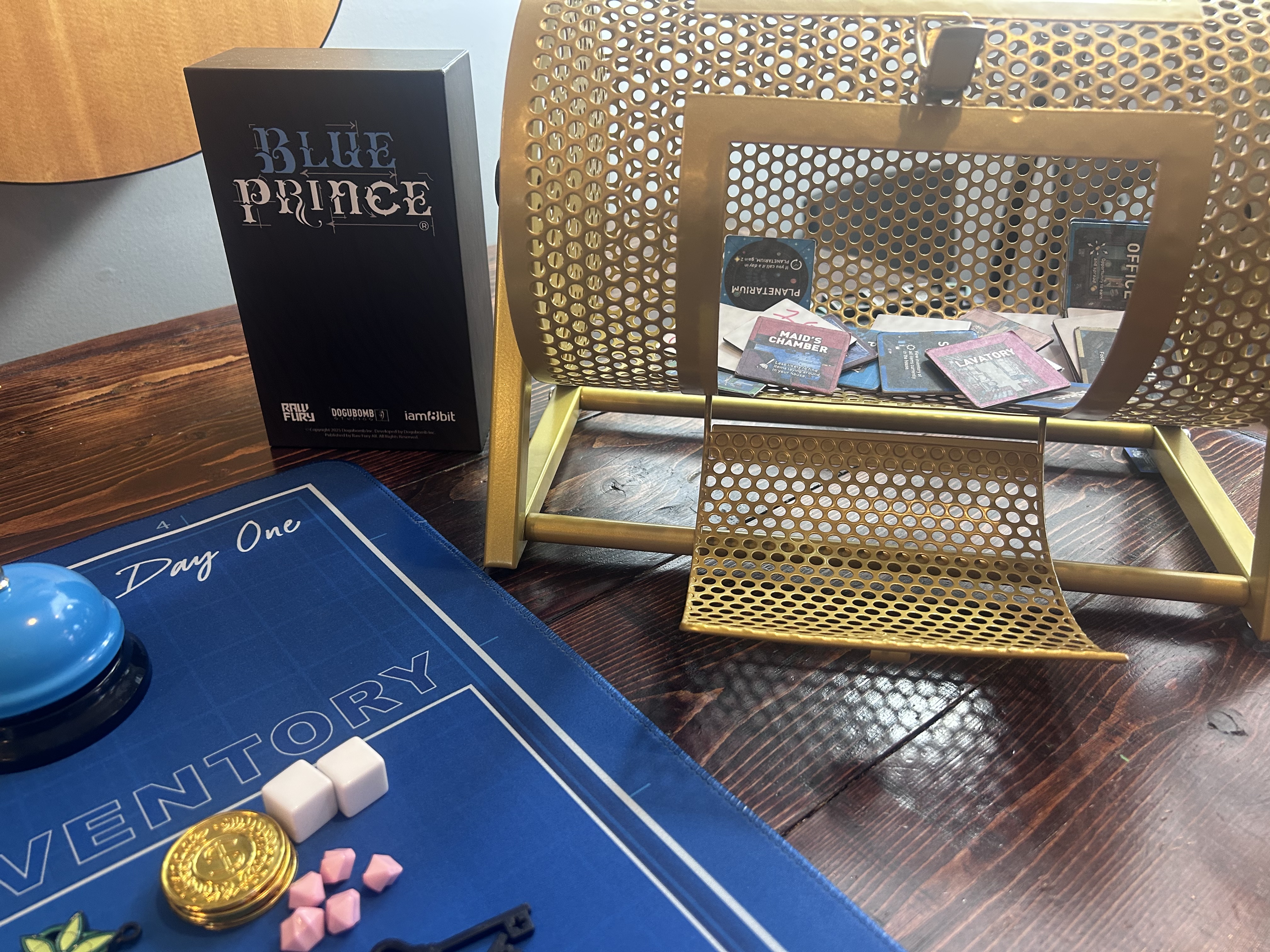
The lottery spinner arrived today. Brass, beautiful, a hand crank on the side. You know exactly what to do with it — spin the crank, take a tile. The mechanical logic is immediate. It looks exactly right at the table and fits nicely into the Blue Prince world.
It doesn't quite work.
The cage is clunky to open. The tiles are heavy enough that they don't shuffle as cleanly as you'd want. The tactile experience that should make this a great piece of table theater is fighting its own mechanism.
I brought a pretty date to the dance, and just found out she's awkward.
Over years of design work you learn to be unemotional about removing what doesn't work — especially when it looks striking. Visuals only get you so far. This is the spinner's problem. It's the best-looking non-iam8bit thing on the table and it has a usability issue. Those two things are equally true and one of them matters more.
I'm not abandoning it yet. But I'm not attached to it either. The bag has been working. The bag will probably keep working. The spinner got a fair trial and the trial exposed a real problem. That's how it goes.
The dopamine from the arrival has already faded. That's fine too.
The Brass Cubes
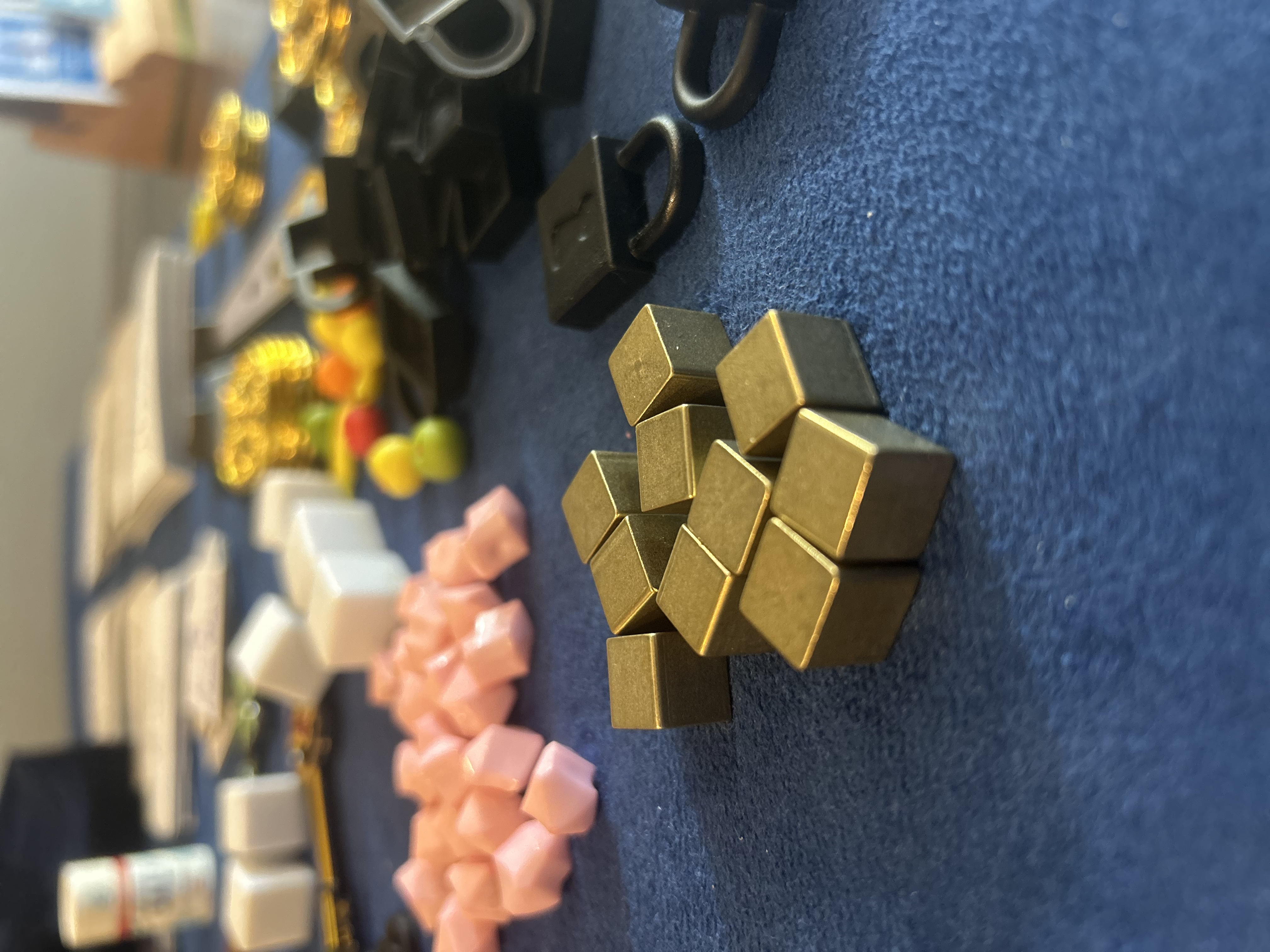
My favorite piece in the game right now is actually the most abstract one. Ten small brass cubes, about a centimeter each. They stand in for trunks. They don't look anything like a trunk in the video game — no lid, no lock, no latch. They're just weighted brass squares.
But they have presence. They're small enough to sit on a tile without crowding it, and heavy enough that when you place one down it feels deliberate. Something about holding one — the weight of it specifically — is what made me narrow down exactly how I want all the materials to feel. Not just look. Feel.
I've been looking at trunk-shaped tokens — things that are closer to what a trunk actually looks like in Blue Prince. I've found some candidates. But here's the problem: something that's close to the original but not quite right often looks more wrong than something that's fully abstract. Your eye knows something is off but can't place what. The brass cube doesn't try to be a trunk. It's just a marker. That might be the right answer.
Which points to a possible design system: anything from iam8bit is an exact replica of a game artifact. Everything else is deliberately abstract. No uncanny valley, no compromises, no "close but not quite." Two distinct material languages, one intentional. Clean.
More thinking needed. But that's what makes it interesting.