The suspicion started in the middle of a playtest. Office came up in the draft and something felt off. In the video game, Office costs 2 gems to draft. On the board game tile, the back said 0. That one tile being wrong wasn't the problem. The problem was that if one was wrong, others might be too — and every playtest conclusion drawn from those wrong costs was suspect.
So we did the audit. Not a spot check, a real one. Every room in the glossary, cross-referenced against the video game's authoritative source — the Rooms by Drafting Cost category pages on the official wiki, the only place where a room's cost is definitively catalogued by the game itself rather than by a secondary guide's best guess.
Seven errors. Six rooms that the board game was letting players draft for free when the video game charges gems for them. One going the other way — the Kennel, which had been costing 1 gem in the board game but is actually free in the video game.
| Room | Board game had | Video game says |
|---|---|---|
| Office | 0 gems | 2 gems |
| Walk-in Closet | 0 gems | 1 gem |
| Ballroom | 0 gems | 2 gems |
| Foyer | 0 gems | 2 gems |
| Master Bedroom | 0 gems | 2 gems |
| Vestibule | 0 gems | 2 gems |
| Kennel | 1 gem | 0 gems |
The trap we walked into
Here's the pattern worth naming, because it's the kind of thing any long-running design project can fall into without noticing. The glossary document became the source of truth for the prototype — tile backs were produced from it, playtest decisions were calibrated against it, rule text quoted from it. But the glossary was a working document. It was authored from memory, best-guess lookups, and secondary guides. It was never actually verified against the game.
This is a subtle kind of drift. Nothing in the glossary was obviously wrong. Every entry looked plausible. Office at 0 gems feels reasonable — it's a spread-coins room, and free-to-draft spread rooms exist. Foyer at 0 gems feels reasonable — it's a Hallway, and most Hallways are free. Master Bedroom at 0 gems feels reasonable — it's a Bedroom, and Bedrooms are usually free. Six out of seven errors survived because each one, on its own, was plausible.
What caught them wasn't careful review. It was accidentally looking at the right reference and having a number not match.
The part where paper prototyping shines
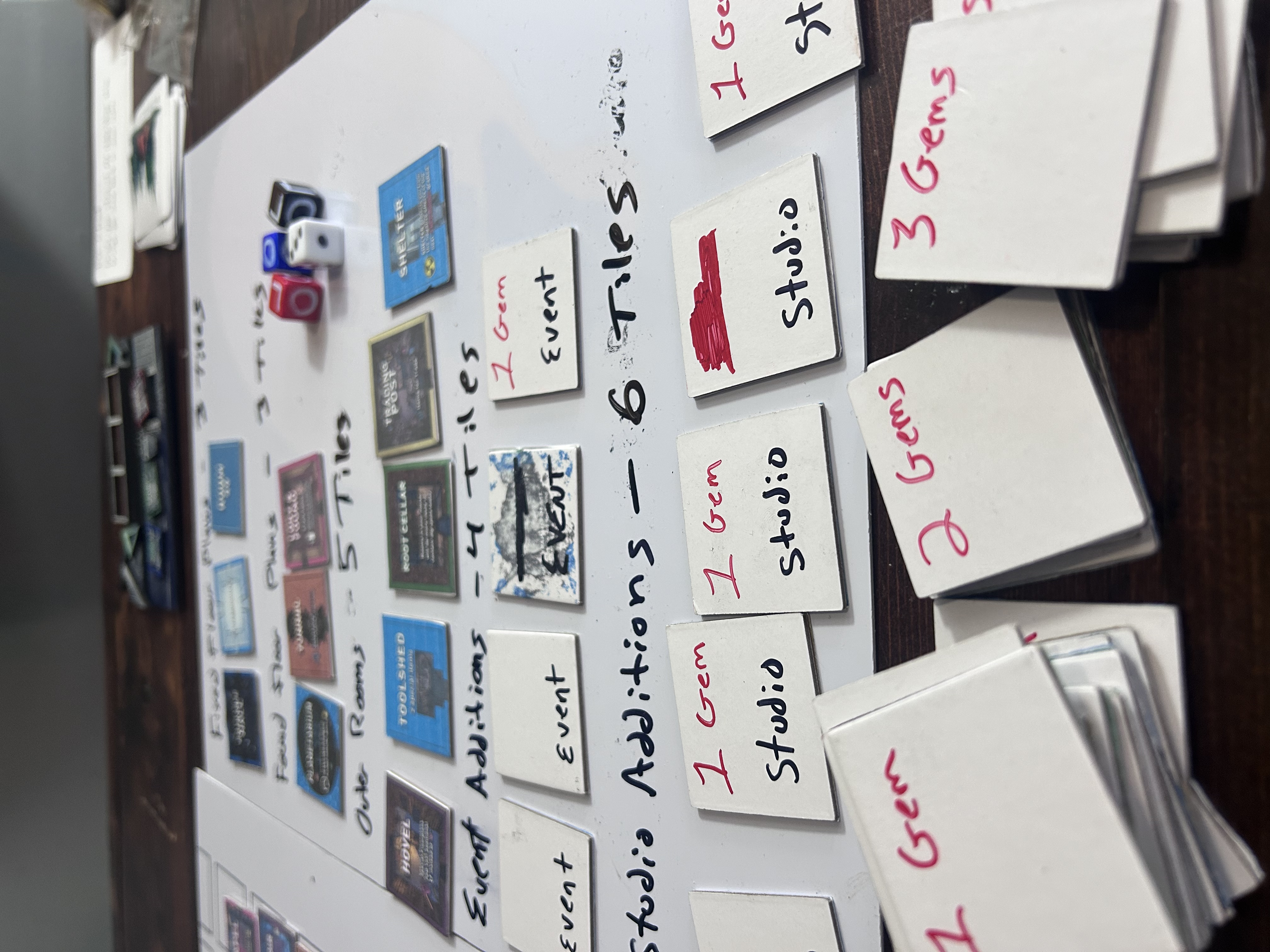
If the tiles had been professionally printed with embossed gem icons on the backs, seven tiles being wrong would be a problem measured in weeks. Send the corrected file to the printer. Wait for the reprint. Swap the physical components. Update the inventory lists. Re-verify the print quality.
Because these are paper prototypes — hand-labeled in red Sharpie for gem costs and black Sharpie for category tags, on white cardstock backs — the seven tiles took about ten minutes to fix. Find the wrong tile. Scribble out the old gem cost with the red marker. Write the correct cost above or beside it. Move the tile into the correct sorting stack at the bottom of the side board — the one labeled "2 Gems" in red, or "0 Gems" for the free stack — so next setup pulls it from the right pile.
The photo above captures the moment mid-fix. The Studio Addition tile with the thick red scribble is the Kennel, which was costing 1 gem yesterday and is free today. The EVENT tile with the black bar across the previous label is a tile whose category changed at the same time — a separate pass we were making on the type system, which will be its own post. Both edits happened while the board was still set up from the playtest.
The economic shadow the error was casting
Seven wrong costs sounds small. In practice, six of the seven were pricing upward — the board game was letting players draft rooms for free that should have cost 2 gems. That's eleven gems of missing cost across six rooms, most of which are common mid-run drafts. The Office coin-spread effect, evaluated as a free draft, is generous. Evaluated as a 2-gem draft, it's a real economic decision — spend the gems now, or save them for something else and skip the coin pile.
Every "Office feels generous" note across three campaigns of playtesting was partially explained by this. So were the "Foyer felt like free value" moments. So was at least some of the gem-desert symptom — because downstream systems that depend on gems (dig rooms, items, the whole mid-game item economy) were being reached more easily than they should have been, which in turn masked what a correctly priced gem economy would actually feel like.
This is the hard part of catching an error like this mid-project. The fix isn't just the seven tiles. It's recalibrating the mental model of every prior playtest. Runs that felt like confirmation of a balanced economy were partly runs against a looser economy. That doesn't invalidate the observations — the Foyer-plus-Great-Hall moment from the last post was still a real emotional beat. But it means the pricing of that beat was soft, and tightening it might change how it plays next time.
What's going on the list
The glossary is fixed. The seven tile backs are fixed. The rules document still references Foyer as "Free to draft" in one place, which now needs a rewrite — that's the next pass. Other documents likely have trailing mentions of these costs in example text or rule prose; those go on the punch list for sweep.
The broader principle from this is going straight into the Design Deviations document, which is the permanent reference for any place where the board game intentionally departs from the video game. Before today, that list was about design choices — things we changed on purpose. After today, it needs a smaller sibling list: verified alignments — places where the board game now matches the video game, with a source-of-truth citation and a date. That list will be boring and useful. Every time someone asks "wait, should this room really cost that much?", the answer will be there with a reference.
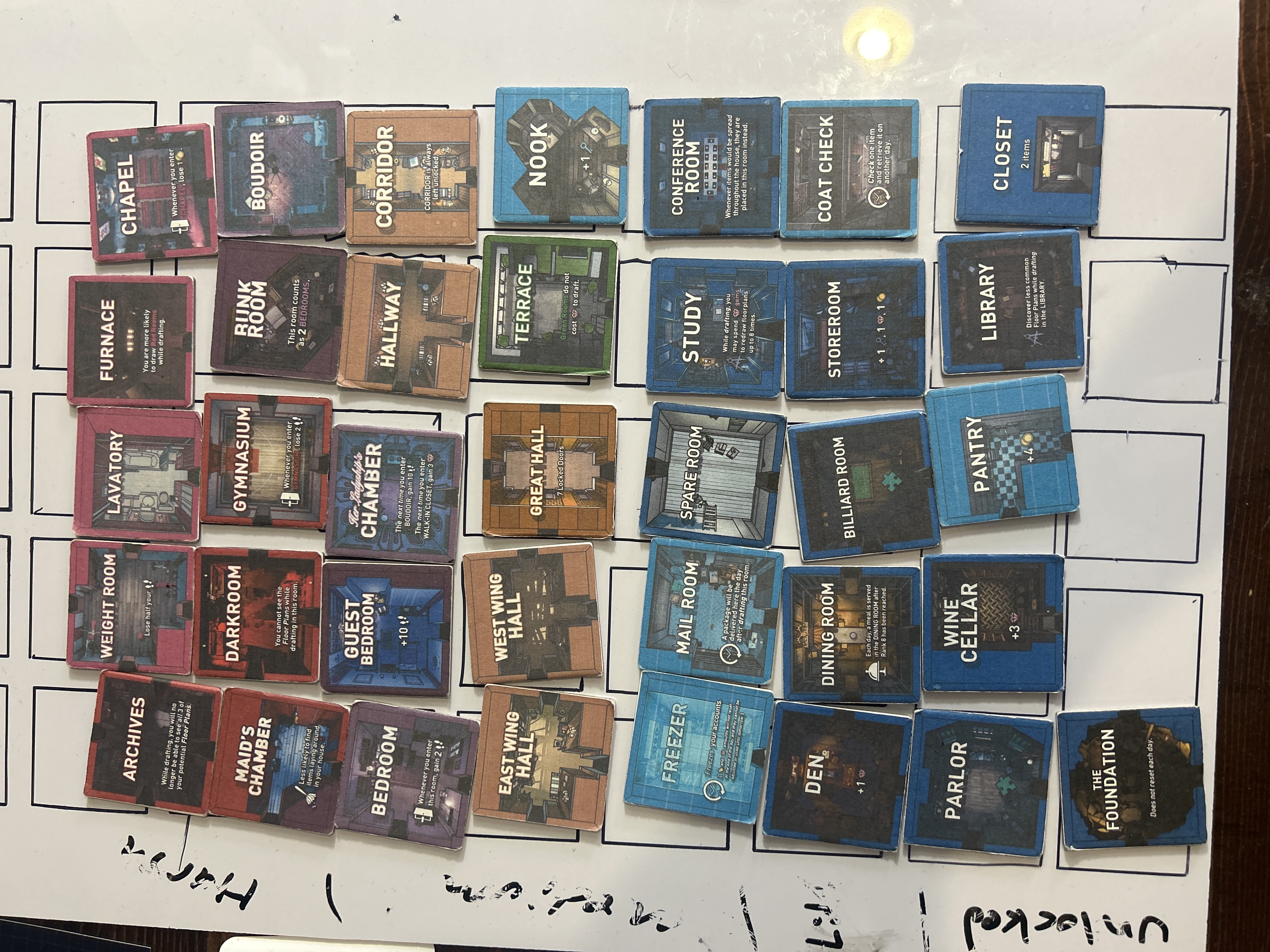
One last thing worth noting, looking at the photos. The cardstock is starting to look a little beat up. Edges fraying in places, ink bleed on a few backs, a visible history of erasures on the side board. That's the right kind of wear. A prototype that sits on a shelf looking pristine isn't doing its job. This one is getting used — drafted, placed, shuffled, sorted, re-sorted, scribbled on — which is exactly what it's built for. Every scuff is a playtest that happened.
A working document is not a reference document. The glossary was working, so we trusted it. The wiki category pages were authoritative, so we should have been checking against them all along. The paper prototype made the correction cheap. The principle — verify against the actual source, not the document you wrote about the source — would apply no matter what medium this game was in.