The handwritten notes are the most honest document in this project. The rules can be edited. The blog posts can be shaped into a narrative. But a notebook filled mid-session doesn't lie — it's just the game talking back at you in real time, unfiltered.
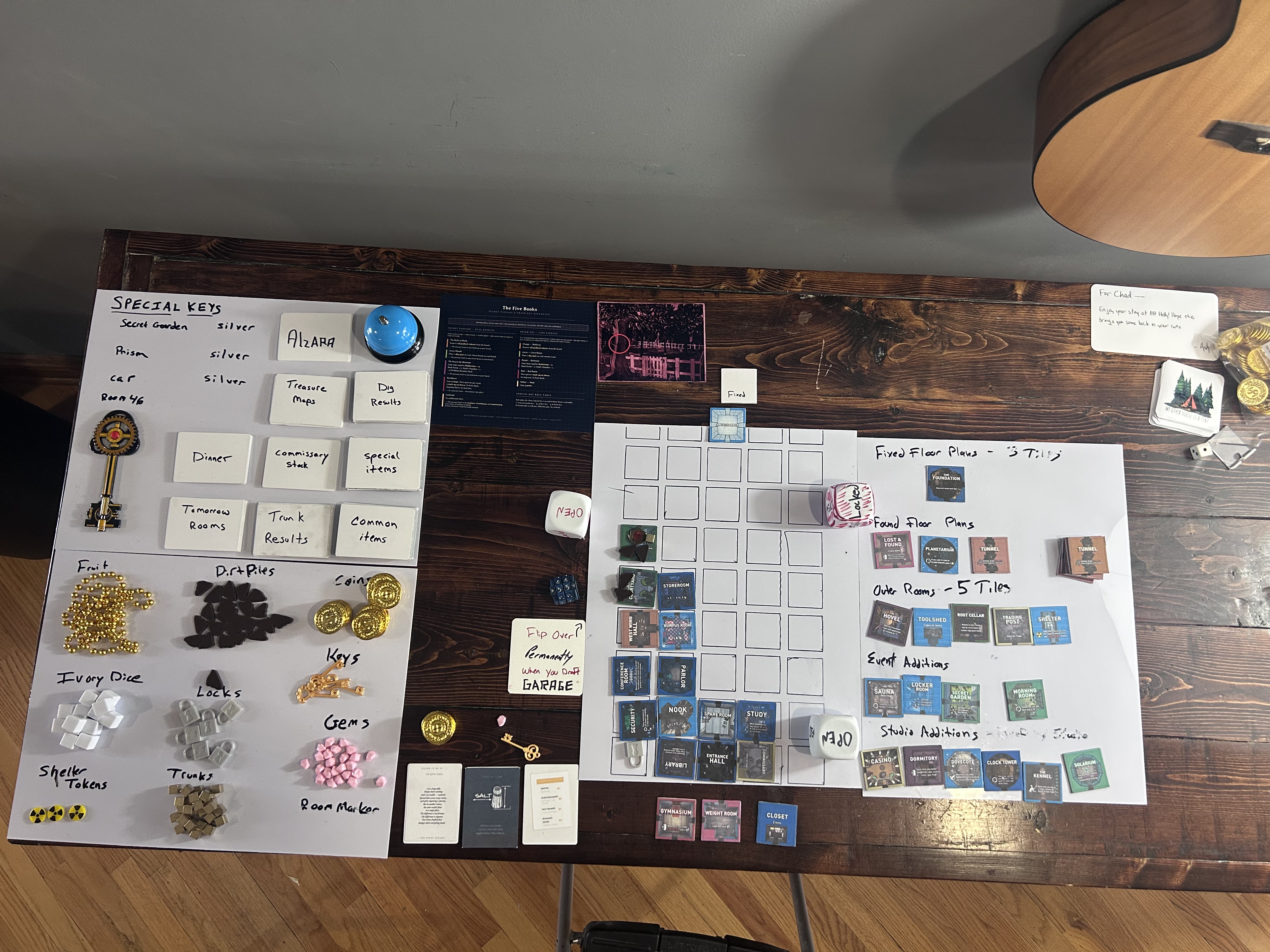
Campaign 4 is the current one. It started the way most days in this game start — bag shuffle, deep breath, the question of what the manor is going to decide to be today. After 45 minutes of on-and-off play, there were 10 rooms placed at Rank 4. The note reads ONWARD in capital letters, boxed and underlined, with arrows pointing down. That's the energy.
What the notes actually say
Before telling the story, here's the raw feed — not cleaned up, not retrospective. This is what was written mid-session.
The first thing that catches the eye across all six pages is written in red marker: This felt brutal. That's the Music Room. Drafted it, used the freshly updated glossary, collected the guaranteed Key — then rolled the standard die for the bonus. A 2. Nothing extra. After 45 minutes with no gems and a run already feeling thin, rolling a 2 on a 2-gem room with real upside felt like the manor had a sense of humor about it. The frustration was noted immediately, in red, underlined twice.
That reaction is useful. The Music Room is working correctly — the roll is supposed to feel high-stakes. A 4 or 5 would have been a Secret Garden Key. A 6 would have been a second Key. A 2 is the floor. The problem isn't the result. The problem is what surrounds it: when every other system in the run has also come up empty, a 2 doesn't feel unlucky. It feels like confirmation.
0 gems — entire session so far
Music Room — took 1 guaranteed Key
→ Rolled standard die → 2 → nothing extra. "THIS FELT BRUTAL"
Vault drafted early — 40 coins, nowhere to spend them yet
Foyer at Rank 5 — all Hallway padlocks removed
Secret Garden Key acquired from Locksmith — felt like an event
Run ongoing · Board still set up
The Vault problem
The Vault came up early again. This is a pattern now across multiple campaigns. 40 coins land in your lap before there is anywhere useful to spend them — the Locksmith, Kitchen, and Commissary are all 1-gem rooms, and without gems you cannot draft them. So you sit on a small fortune with a closed market.
The note flags it: kinda blows up the coin economy. Accurate. The Vault is designed to feel like a windfall, but early in a run a windfall into a closed market is just noise. The design question — whether to add a minimum rank restriction, reduce the payout, or accept that some runs have this awkward surplus — stays open. It needs more playtests before making a call.
The glossary at the table
Something worth noting that didn't go wrong: the Music Room played clean. The recently updated glossary entry walked through the guaranteed Key, then the three roll outcomes, then the full Special Key sub-roll inline. No rulebook needed. The player followed it without stopping.
Same with the Locksmith. The Secret Garden Key purchase — 8 coins, die roll, specific key with a specific use — resolved entirely from the glossary card. The whole chain of causality was visible from one entry. That's what the glossary is supposed to do, and it worked.
The notes call the Secret Garden Key acquisition out specifically as feeling like an event. That four-part structure — cost, chance, named reward, clear purpose — is worth identifying as a template. It's the same structure that makes a good item feel good. It's also, not coincidentally, what was missing from the Apple Orchard.
The Apple Orchard, and what the table wasn't ready for
This happened in an earlier run, not Campaign 4 Day 1. But it's the thing worth stopping on.
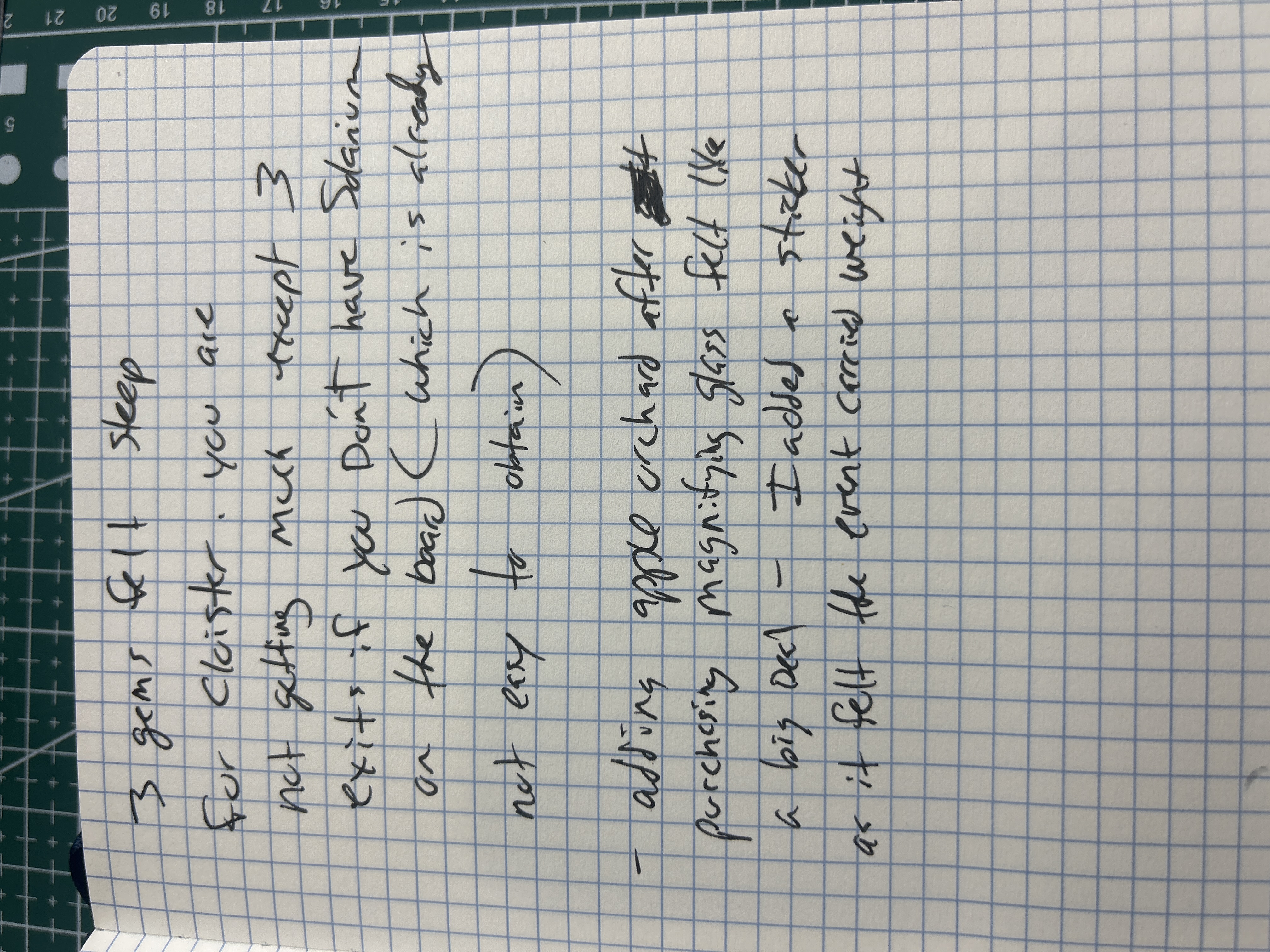
The Magnifying Glass came into play. The Photo card — collected from the Darkroom — had been sitting in hand. Holding the glass to the fine print on the photo revealed a gate code. That code, entered at the Entrance Hall, permanently unlocked the Apple Orchard. Starting steps increased from 50 to 70 for every future run, forever.
It should have been a moment. It was a moment — campaign-level, permanent, irreversible. And there was nothing at the table to hold it.
The problem with permanent unlocks
The Apple Orchard unlock is one of the most significant events in a Blue Prince campaign. It changes your base starting resources for every future run. In the video game there's an animation, a sound, a visual confirmation that the world has changed. At a physical table there's a checkbox on a sheet of paper. The gap between those two experiences is where game feel lives — and right now the physical version is losing that gap entirely.
The instinct in the moment was to reach for something. Some physical object to mark the occasion. As it happened, a set of Blue Prince fan stickers had just arrived in the mail — ordered from another player in the community. One went on the Campaign Sheet next to the Apple Orchard checkbox. Unplanned. Just a spontaneous grab for ceremony.
It helped more than expected.
The sticker worked because it turned a checkbox into an artifact — something with texture and weight that said this happened, and it stays happened. Every future run that Campaign Sheet comes out of the box with that sticker already there, already declaring itself. The Apple Orchard is unlocked. Was unlocked. Will be unlocked.
That reaction is a design note the game needs to answer. Not with stickers specifically, but with intent. The working idea: a small set of "Manor Cards" — one per major permanent unlock — that live in a labeled envelope inside the box. Apple Orchard unlocked: take the card out, place it face-up beside your Campaign Sheet. It stays there every run going forward. The West Gate discovery gets one. The Foundation becoming permanent gets one. The Planetarium gets one.
Over a full campaign those cards accumulate. By the time you're closing in on Room 46 you have four or five of them face-up beside the board, each one a permanent record of something you found and kept. The manor has a memory and the table shows it.
The sticker was a prototype of that idea. It worked well enough to become a design direction.
What the notes flagged that didn't make it into a rule change (yet)
A few things from the six pages of notes that are still questions, not answers:
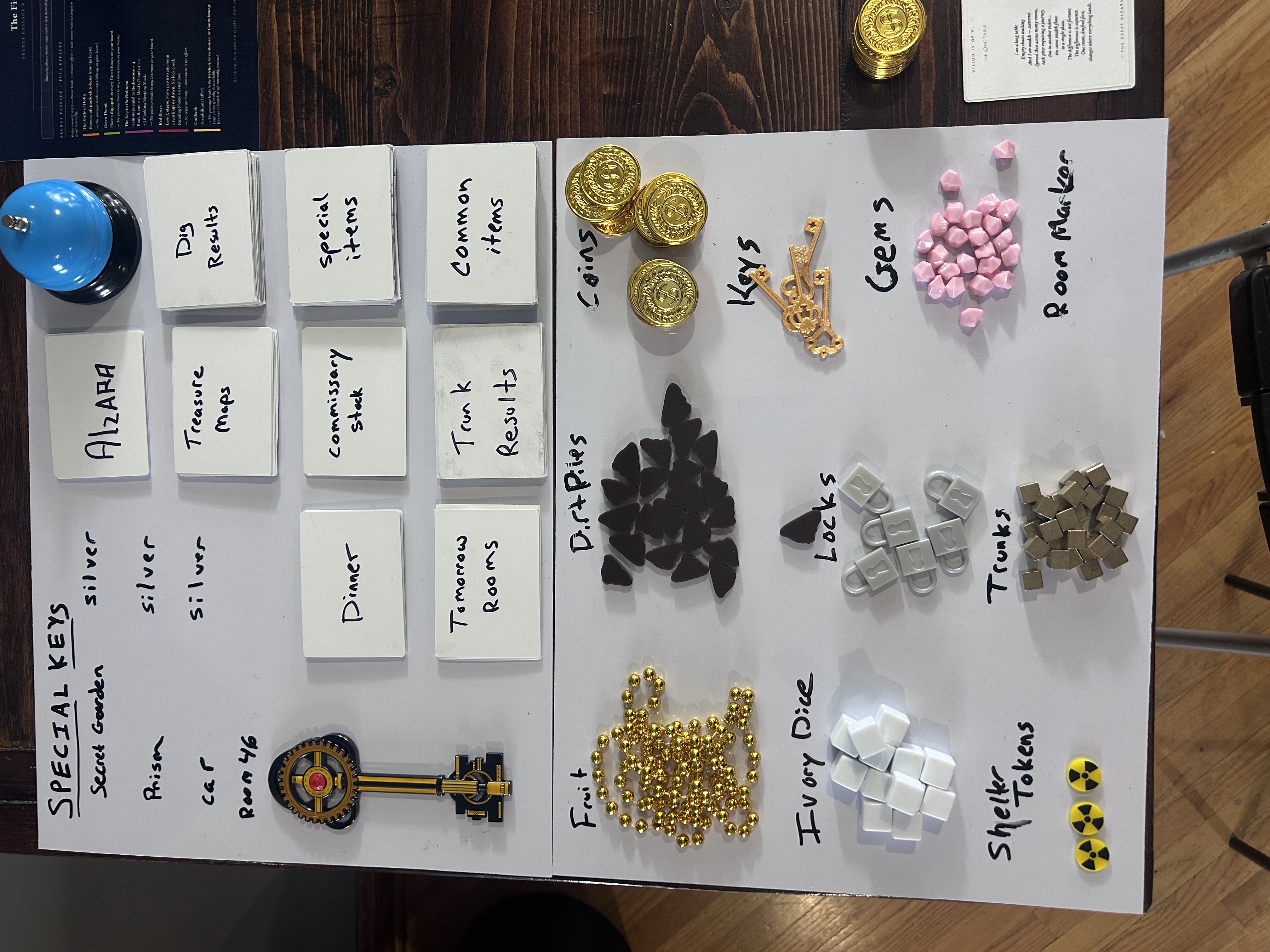
The items almost never showed up. Shovel, Magnifying Glass, Metal Detector — no appearance across the session. Only the Salt Shaker came into play. Fruit didn't factor in at all. The card piles barely moved. This is downstream of the gem desert — no gems means no dig rooms, no dig rooms means no dig spots, no dig spots means the Shovel is irrelevant. Entire systems go dark when the early economy doesn't open. That's something to watch across more runs.
The notes ask whether safe rooms like Boudoir and Drawing Room should give a gem every run rather than only on first campaign entry. It's a real economy question. A small reliable gem trickle from safe rooms might be exactly what breaks the gem desert pattern without solving it all at once. Holding for playtesting.
The notes also flag tile texture — the feel difference between the front and back of a tile. The suggestion is to add a texture to one side so the fingers know which way a tile is facing before the eyes see it. That's a production note for later, but it's the kind of detail that separates a prototype from a game.
Still playing
Campaign 4, Day 1 is still in progress. The board has more rooms than any previous run at the same session length. The Secret Garden Key is in hand. The gem situation is still dire but the path north is clearer than it's been.
The notes will keep coming.
Does the Vault need a minimum rank restriction? Is the gem desert a probability problem or an economy design problem? What physical objects should mark the Apple Orchard, the West Gate, the Foundation? How do you design for a feeling at a table when you can't control what the player reaches for?