Run 1 ended in four turns with 43 coins and nowhere to spend them. Run 2 lasted about 30 minutes, built eight rooms, and ended with 42 steps still in the tank. Both runs failed. But they failed differently — and the difference is where the design work lives.
The run
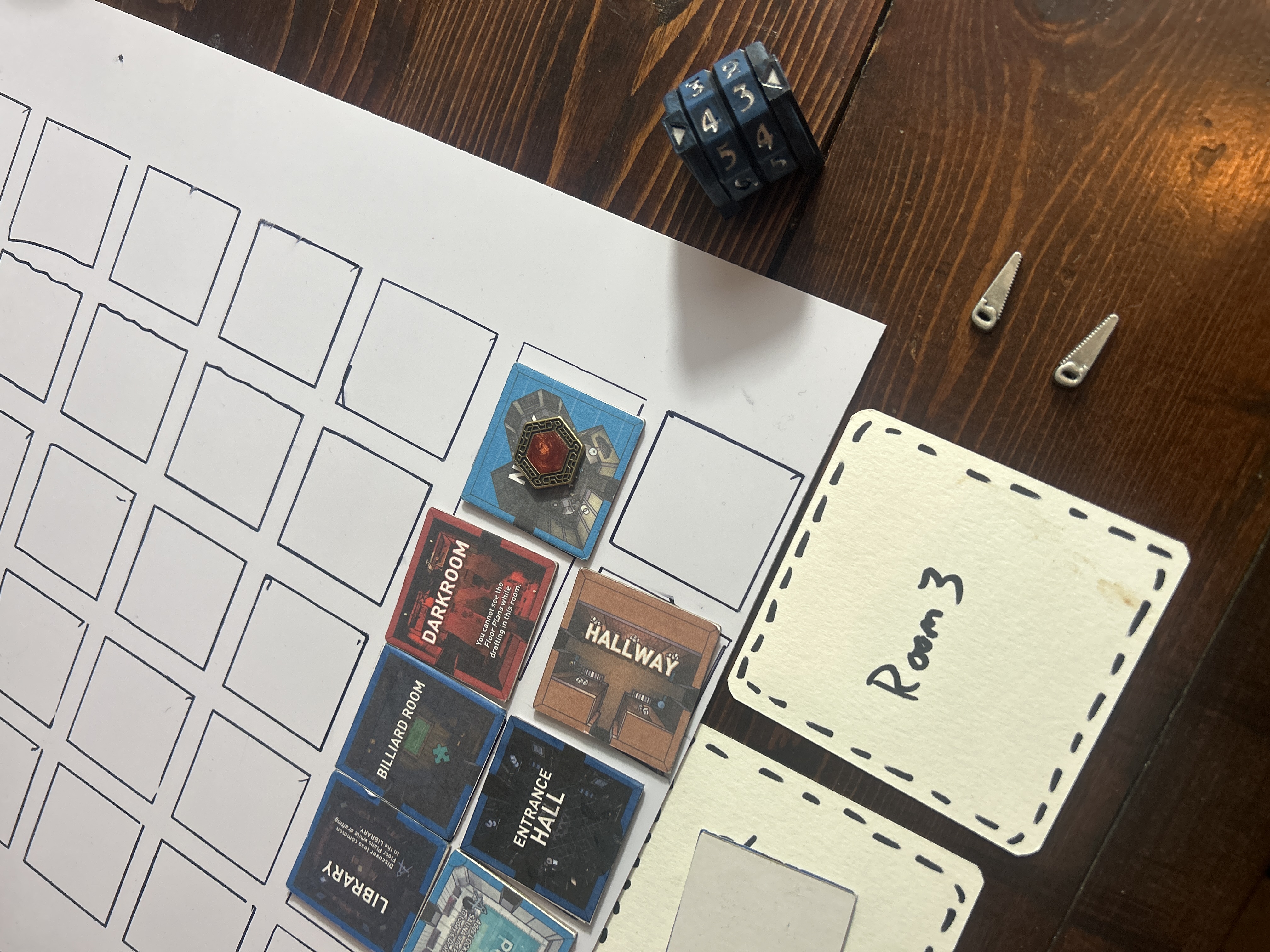
Proper shuffle this time. First draft from Entrance Hall: Library, Kitchen, Billiard Room. Door unlocked. No padlock to deal with. The Billiard Room went down at Rank 2 — free, puzzle room, and on entry the standard d6 rolled a 2 giving 2 keys. Economy open immediately.

From the Billiard Room, Library went down next — free, and gives 4 tiles on its single draft exit. The Library draw produced Hallway, The Pool, and Office. The Pool costs 1 gem, which wasn't available. But it was drafted anyway at some point — a rules error that went unchallenged in the moment. The Pool being on the board added Sauna and Locker Room to the bag, which was a meaningful state change even if the payment wasn't properly resolved.
Coat Check came down off the Pool. Then a Hallway east of Entrance Hall, spending the first key on a locked door. Darkroom north of Billiard Room — free, Red Room, Photo card collected, Lost & Found permanently added to the Active Bag. Nook placed off the Darkroom blind draft — Darkroom hides one of your three tiles, so you're choosing with imperfect information. Nook's guaranteed key retrieved on entry.
Final room: Lavatory. Dead end, no effect, no items. The last tile that fit the space and the budget.
Billiard Room → rolled 2 → +2 keys
Library → Pool drafting error (Pool costs 1 gem, 0 gems held)
Locked door (east of Entrance Hall) → spent 1 key
Nook entry → +1 key
Darkroom → Photo card collected · Lost & Found added to bag
End: 42 steps · 0 gems · 1 key · 5 coins
8 rooms placed · ~30 minutes · voluntary end
Steps are not the problem
42 steps remaining at run end. The board wasn't cleared by step exhaustion — it was cleared by dead ends. Eight rooms placed, multiple open doors available, but nothing useful to draft into them. No steps were ever the constraint.
This is worth stating clearly because the step economy was the design concern going into playtesting. The assumption was that 50 starting steps might be too few — that players would run out of time before running out of board. Run 2 says otherwise. With reasonable routing you barely dent the step count in a failed run. The real constraint is gems.
Zero gems, entire run
The Active Bag contains 20 one-gem rooms out of 63 core tiles — roughly 32% of the bag. You should see them constantly, and you do. Kitchen appeared twice. The Pool appeared. Terrace appeared — a dead end that removes all Green Room gem costs, which would have been the indirect solution. Servant's Quarters, Drafting Studio, Courtyard all surfaced at points. Every one was unaffordable.
The bag is full of useful rooms with a 1-gem entry fee. Without a gem source early, they all become scenery. You watch them come up, note them, return them to the bag.
The guaranteed gem sources in the base game are: Den (+1 on entry), Walk-in Closet (+1 guaranteed plus draws), Wine Cellar (+3 on entry), Storeroom (+1 guaranteed). All four are 0-gem rooms in the Active Bag. Neither appeared in a draft all run. With 63 tiles and roughly 8 drafts, you see maybe 24 tiles total — 38% of the bag. Seeing none of the four zero-cost gem rooms in 8 drafts is unlikely but entirely possible.
This is a flat probability problem. The VG tilts early draws toward common rooms — Den and Storeroom are Commonplace rarity, the most frequent tier. In the base game bag they're equal weight to everything else. The gem desert is a direct consequence of removing rarity weighting.
The Pool error
The Pool was drafted with 0 gems in hand. It costs 1 gem. This went unnoticed in the moment — the game was flowing and the back of the tile wasn't checked before committing. This is exactly the placement error the tile back marking system was designed to prevent, and it still happened.
Two things to address: the rules need a clearer prompt to check the back before committing to a draft, and the gem cost needs to be more visible during the draft decision — not just on the back of the tile, but as part of the draft mat layout.
The Pool drafted with 0 gems in hand. Gem cost check missed mid-run. Rules need a stronger prompt at the draft decision point — not just on tile backs. Consider a gem cost reminder on the draft mat itself.
The lock die skip
One door draft happened without rolling the lock die first — caught mid-turn and noted. Same failure mode as above: when the game is flowing, the pre-draft roll is easy to skip. The roll needs to feel mandatory, not optional. In the VG the lock result appears automatically — there's no way to forget it. At the table it requires deliberate habit.
This is a first-run problem that should self-correct. But it's worth noting that two procedural errors happened in 30 minutes of play on a game the designer built. New players will make more.
Physical notes
Thirty minutes felt right for a failed run. A successful run pushing to Rank 9 will run longer — probably 45–55 minutes. The target holds.
The bag is too large. Reaching in repeatedly over 30 minutes caused arm fatigue. A smaller bag, or a different draw method, is worth testing before the next session. The tiles are small and flat — they stack and clump at the bottom of a large bag rather than mixing freely. The shuffle between drafts is critical and currently unreliable.
The draft mat worked well. Three slots clearly separated, gem cost visible on the back before the flip. The "No Gem Cost" label on Slot 1 was read naturally every draft. That system is doing its job.
What it felt like
Better than Run 1. Meaningfully better. The decisions were real — Billiard Room vs Library vs Kitchen on the first flip was a genuine choice with tradeoffs. The locked door required a key commitment. The Darkroom blind draft added tension. By the end of 30 minutes there was a recognizable shape on the board, a sense of what went wrong, and a clear instinct about what to do differently on Day 3.
That last part is the campaign loop working. The board wants to stay set up. Day 3 has a specific problem to solve — find a gem source early — and enough remaining steps to make it feel achievable. That's the right emotional state to end a run on.
Gem scarcity — is this consistent or was Run 2 unlucky? Does the Nook key on entry feel satisfying or expected? Does 42 remaining steps suggest starting steps could be reduced, or is that padding needed for successful runs? How does step economy change when you actually reach Rank 6–7?