There's a certain kind of design session where you spend less time building and more time correcting your assumptions about what you're building. This was one of those. Cards were printing in the background. Tokens were laid out on the mat. And one by one, things we thought we had settled turned out to be slightly wrong — or right for the wrong reasons. Which is fine. That's what this phase is for.
The fruit problem
It started with a screenshot. Someone in a Reddit thread about Blue Prince posted a photo of their Pantry — every counter covered in bananas, a pile of oranges in the corner — and asked how they'd managed it. I didn't know. I'd assumed the Pantry gave you one fruit per entry and that was that.
The answer turned out to be a post-game experiment system — trigger combinations that create loops. "Every time you eat an apple" plus "fill the Pantry with fruit" is, apparently, how you turn yourself into jam. Nothing we need to implement. But it sent me to the VG wiki to nail down exactly how fruit works in the base game, and what I found changed how we handle it.
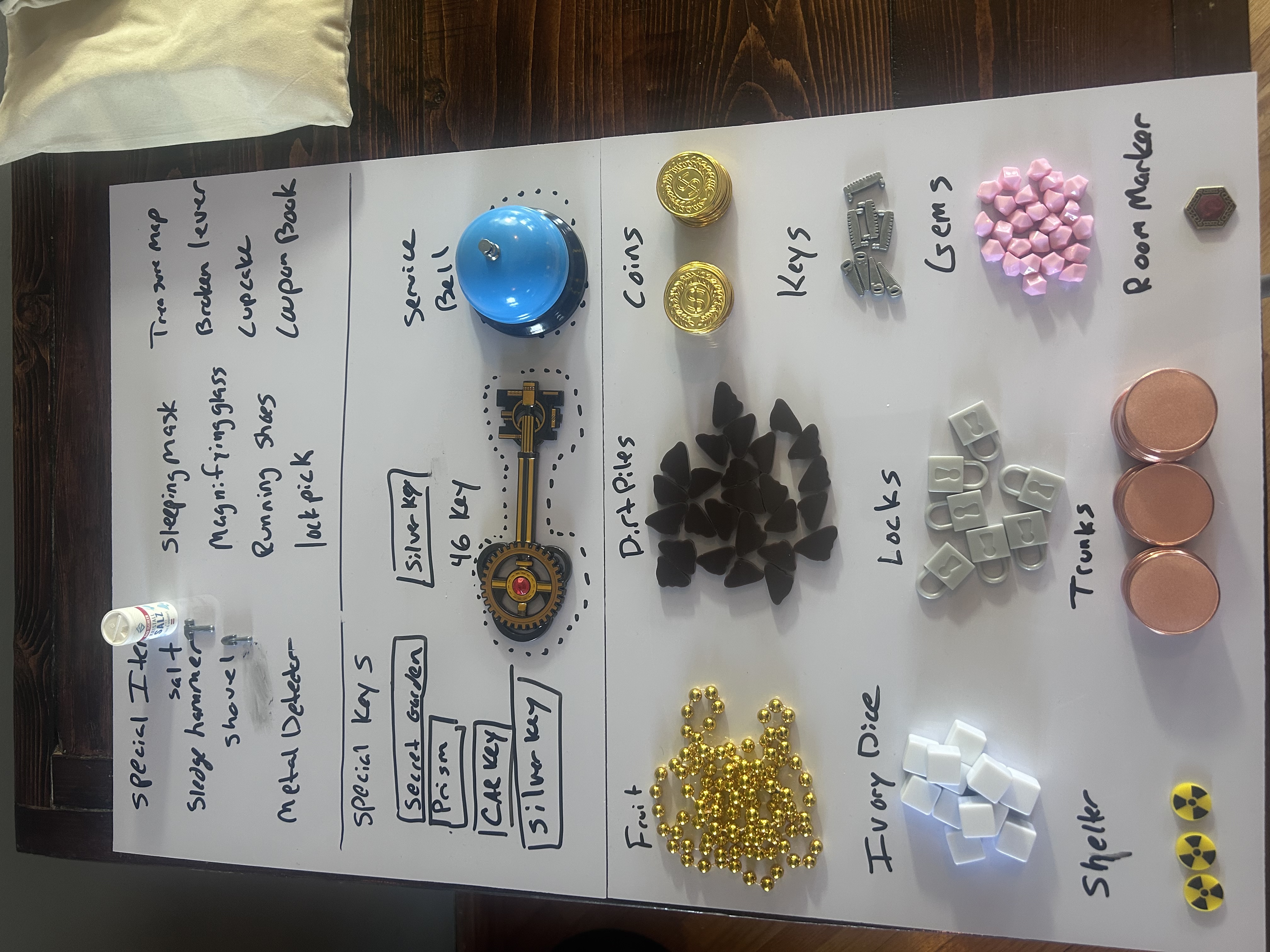
Fruit — apples, bananas, oranges — can randomly spawn in quite a few rooms in the VG. Bedrooms, Parlors, the Library, the Drawing Room. Most require high luck, but they're legitimate random room spawns. That meant our decision to put fruit in the Common Items deck was actually correct, though I'd been second-guessing it. The deck is drawn from room item spawns, and fruit is a room item spawn. The proportions reflect the rarity hierarchy: Apple ×3, Banana ×2, Orange ×1.
We also fixed a quiet inconsistency in the Pantry rule. Two different sections of the rules doc said two different things about whether it resets each entry. The VG is clear: once per run. 4 coins and 1 fruit token on first entry only. The fruit token is placed on the tile when drafted — nothing respawns. That's now consistent across every document that mentions it.
On draft, place 1 random fruit token on the Pantry tile. On first entry: collect 4 coins and the fruit token. Once per run — neither the coins nor the fruit respawn on subsequent entries.
The card is the item
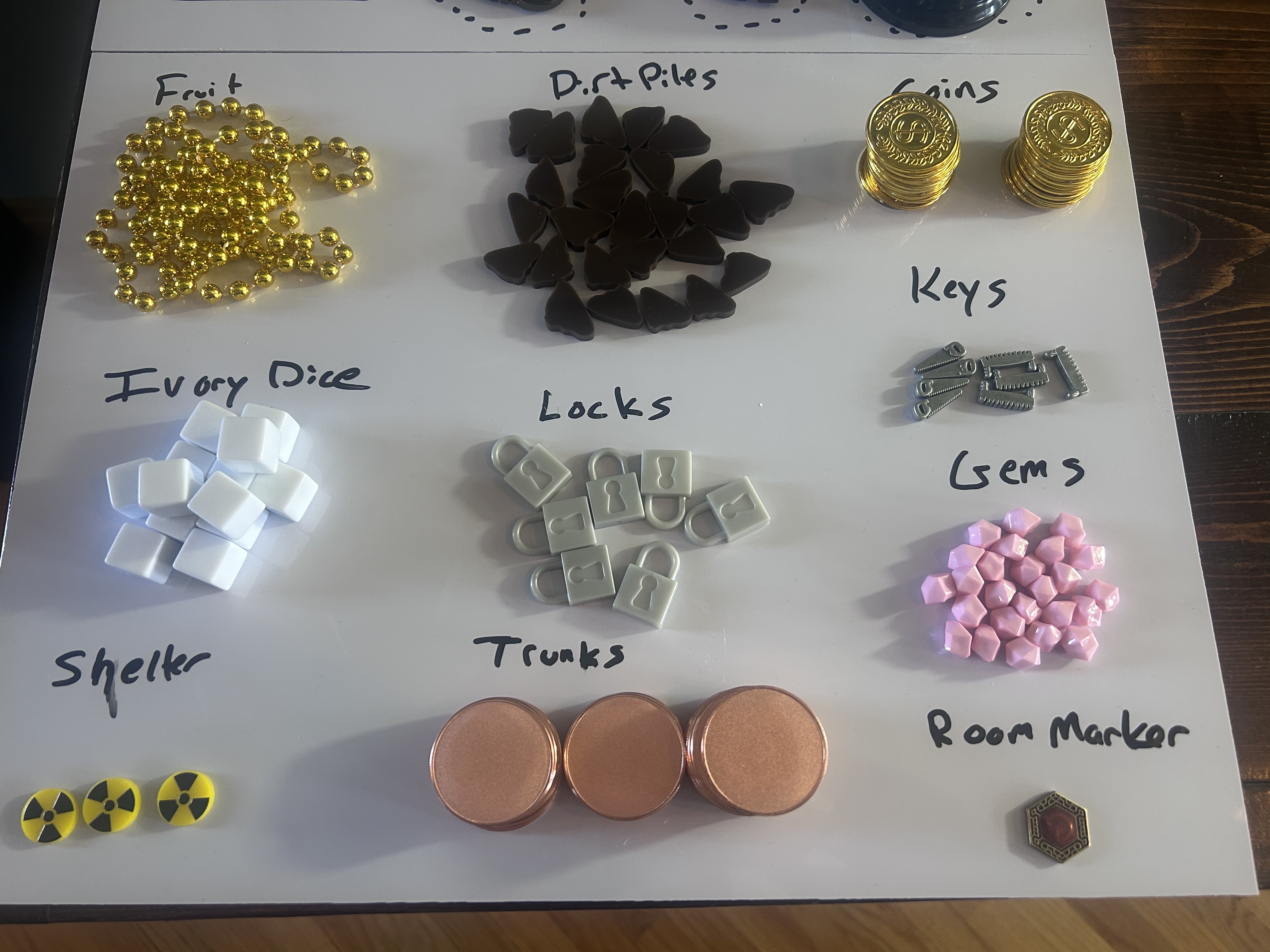
Setting up the token mat for playtesting forced a question I'd been quietly avoiding: what do you actually hold in your hand during play? The Special Items deck gives you a card that tells you what to find. But then what? Do you take a physical token? Do you keep the card?
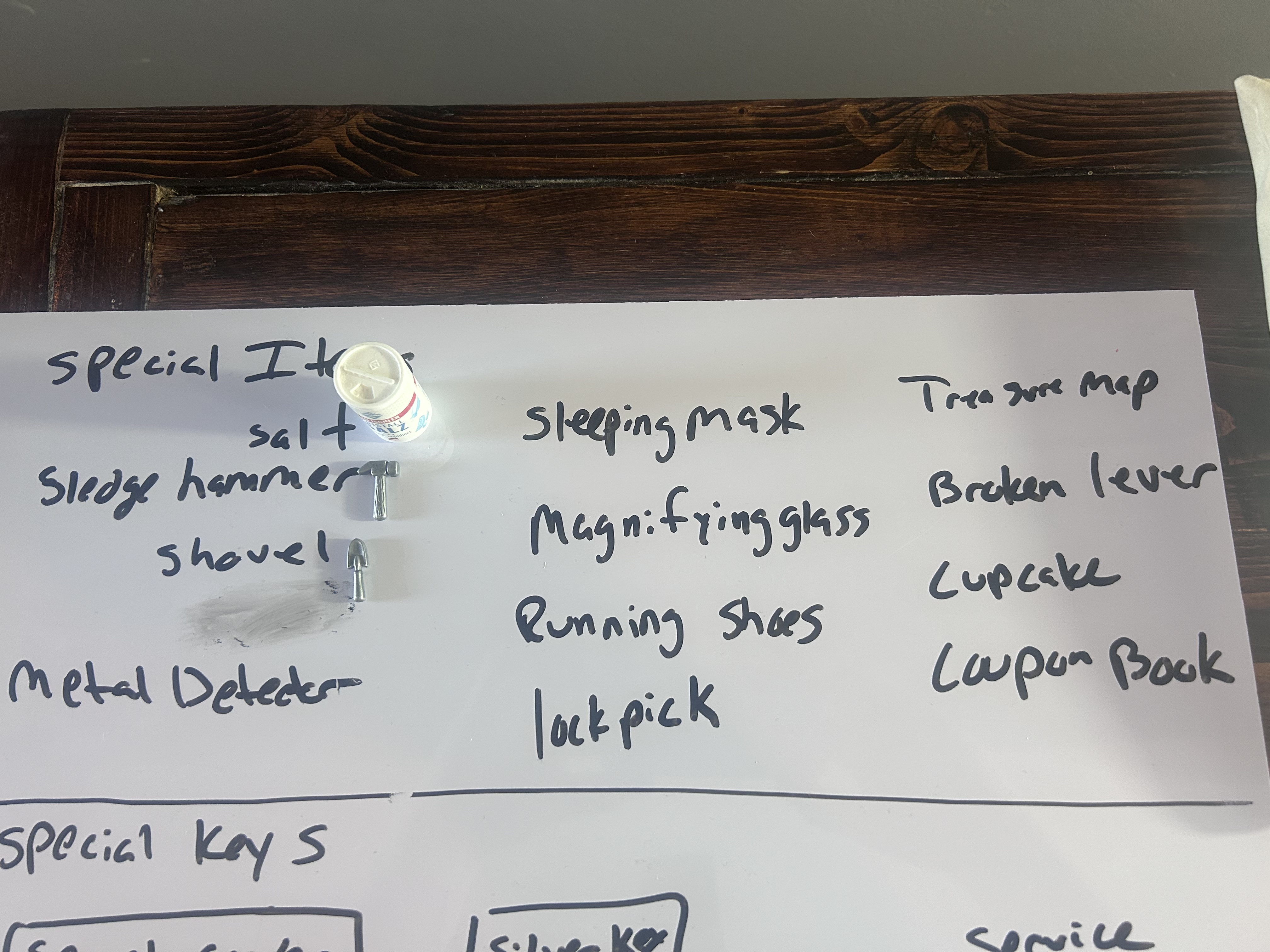
The answer, when I thought about it clearly, was obvious. The card is the item. You hold it in your hand. When you use the Shovel you flip it over or discard it. The Salt Shaker sits in your play area reminding you that your fruit is worth +1 extra step. The Magnifying Glass is there when you need it. There's no separate token system, no secondary representation. The card does both jobs — it's the draw result and the held object.
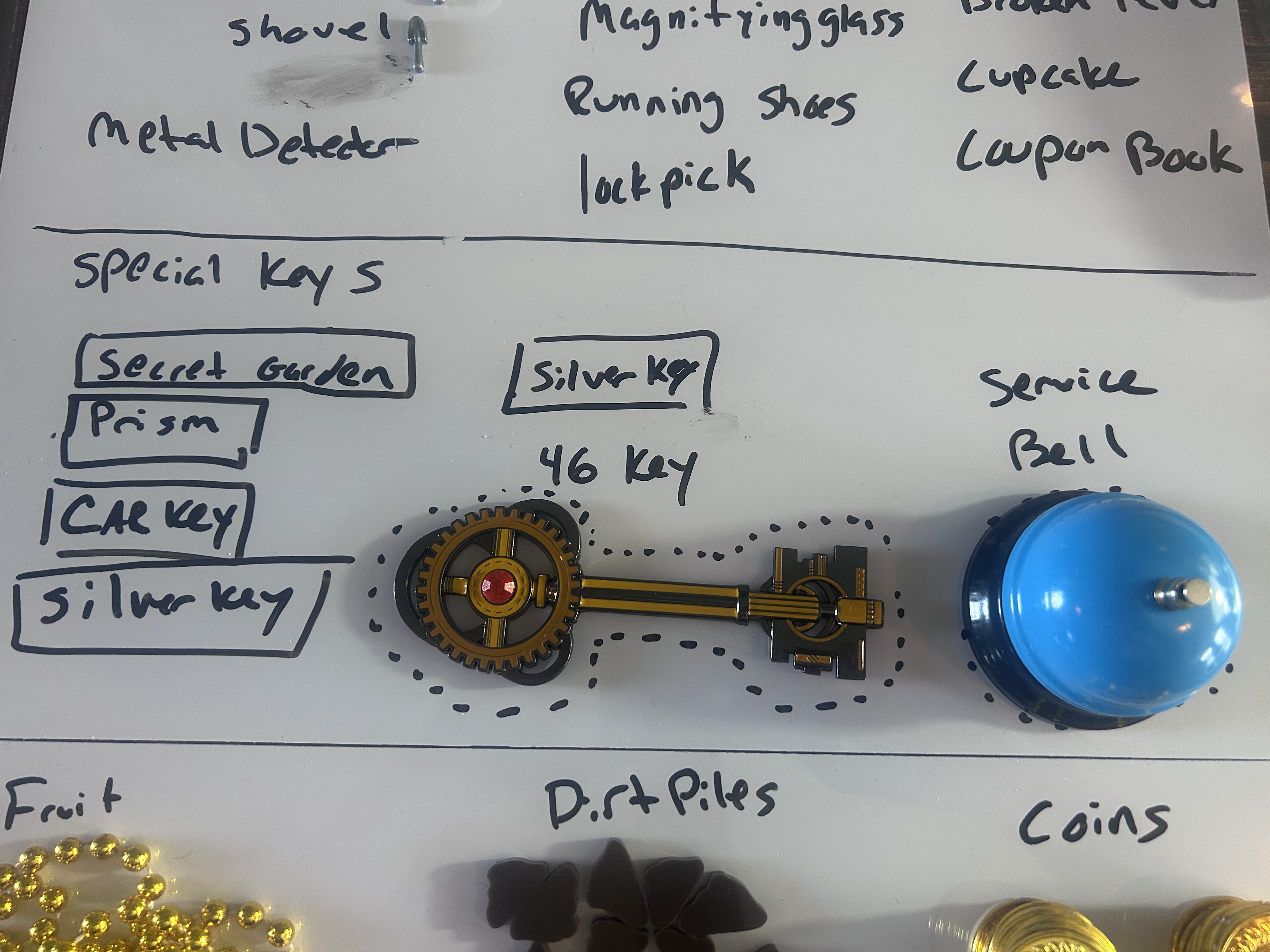
The exceptions are things that need physical presence on tiles or in supply. Ivory Dice sit in your play area as white cube tokens until you spend them at the Casino. Fruit tokens go on room tiles. Special Keys need distinct physical tokens because they're used on specific doors. But Shovel, Sledgehammer, Magnifying Glass, Running Shoes, Lockpick Kit — every one of those is just the card. This collapses a whole category of custom token production that I was dreading.
The Showroom question
The Showroom sells three items: Silver Spoon, Moon Pendant, Chronograph. All three require specific design work. The Moon Pendant needs a carry mechanic. The Chronograph needs a draft-rewind mechanic and something to represent "Tomorrow Rooms become more likely." Silver Spoon is the simplest — it doubles food steps — but it also appears in every food table as a column and a modifier throughout the rules.
The Showroom costs 2 gems to draft. Its items cost 20–30 coins. There's no discount path — The Sail constellation explicitly doesn't apply here. I thought about how often that sequence would realistically fire in a 45-minute prototype run, and the answer was: rarely, if ever. You'd need the gem surplus to draft it and the coin surplus to buy from it in the same run, without that investment crowding out other priorities.
Showroom deferred to expansion. All three items — Silver Spoon, Moon Pendant, Chronograph — move to the expansion list. If playtesting reveals a step deficit or food value problem, Silver Spoon is the first candidate for reintroduction, likely through a different source room.
This was the right call. Silver Spoon is woven through every food table in the rules — there's a "with Silver Spoon" column in the fruit step table — so I left those columns in place but marked them as expansion content. The framework is there if we need it. The complexity isn't.
The Telescope wasn't where I thought
The rules had been saying for weeks that the Telescope is found exclusively in Her Ladyship's Chamber. I'd written it that way, the rules doc said it, the item reference table said it. Then I uploaded a VG wiki screenshot and the possible locations list showed seven sources. Including the Walk-in Closet. Which is exactly what I'd suspected but been told wasn't true.
Some of those sources involve upgrade spoilers and expansion content — Cloister of Mila interactions, room upgrades — so they don't apply to base game. But Her Ladyship's Chamber, the Walk-in Closet, the Lost & Found, and the Trading Post are all base game rooms. The Telescope can legitimately surface through multiple paths.
The solution was simple: one Telescope card exists in the game. It's placed on Her Ladyship's Chamber when drafted — her room always contains it. It's also in the Special Items deck at ×1, so it can turn up through the Walk-in Closet, Attic, or a Trading Post trade. If you already have the Telescope when Her Ladyship's Chamber is drafted, no second copy appears. The scarcity is self-enforcing because there's literally only one card.
What we verified, what we locked
The session produced a design deviations tracker — a document I should have built much earlier, covering every place the board game intentionally or necessarily differs from the video game. Thirty-five items rated by severity and status. Some are accurate translations. Some are deliberate design decisions. A few are simplifications that might need revisiting after playtesting.
The Trunk Results deck got verified and documented: 12 cards, no empty results, every draw is positive. The Car Trunk in the Garage uses the same deck — draw 2 cards instead of 1. That was a deliberate simplification we'd made in an earlier session, and it held up. Having one unified trunk mechanic is cleaner than a separate car-trunk loot table.
All card sheets were rebuilt for A5 paper — the format my printer actually supports. 4 cards per sheet in a 2×2 grid, 34 sheets total across 9 decks. Trunk Results prints first. The rest follows as the run develops and we see what we actually need at the table.
Photo card — design using actual in-game screenshot of the Apple Orchard photograph. Poker sized (2.5" × 3.5"), sepia tones, 11-28 visible in the heart carving. One physical card, lives outside all decks, found in the Darkroom.
The next session is a full playtest run. Trunk Results cards are printed and cut. Tokens are on the mat. The board is ready. Everything that's been decided on paper is about to meet actual play, and some of it will probably be wrong in ways we haven't anticipated yet. That's fine. That's what the table is for.