The editorial above was written five days ago, before anyone had actually sat down and played this thing from a cold start. Today that changed. The table had notes.
Problem 1 — The Stack
The first thing that went wrong before a single tile was placed: the active deck. Sixty-three tiles printed on 110lb cardstock stack to a height that is genuinely precarious. It wobbled. It threatened to fall. Shuffling it felt like defusing something.
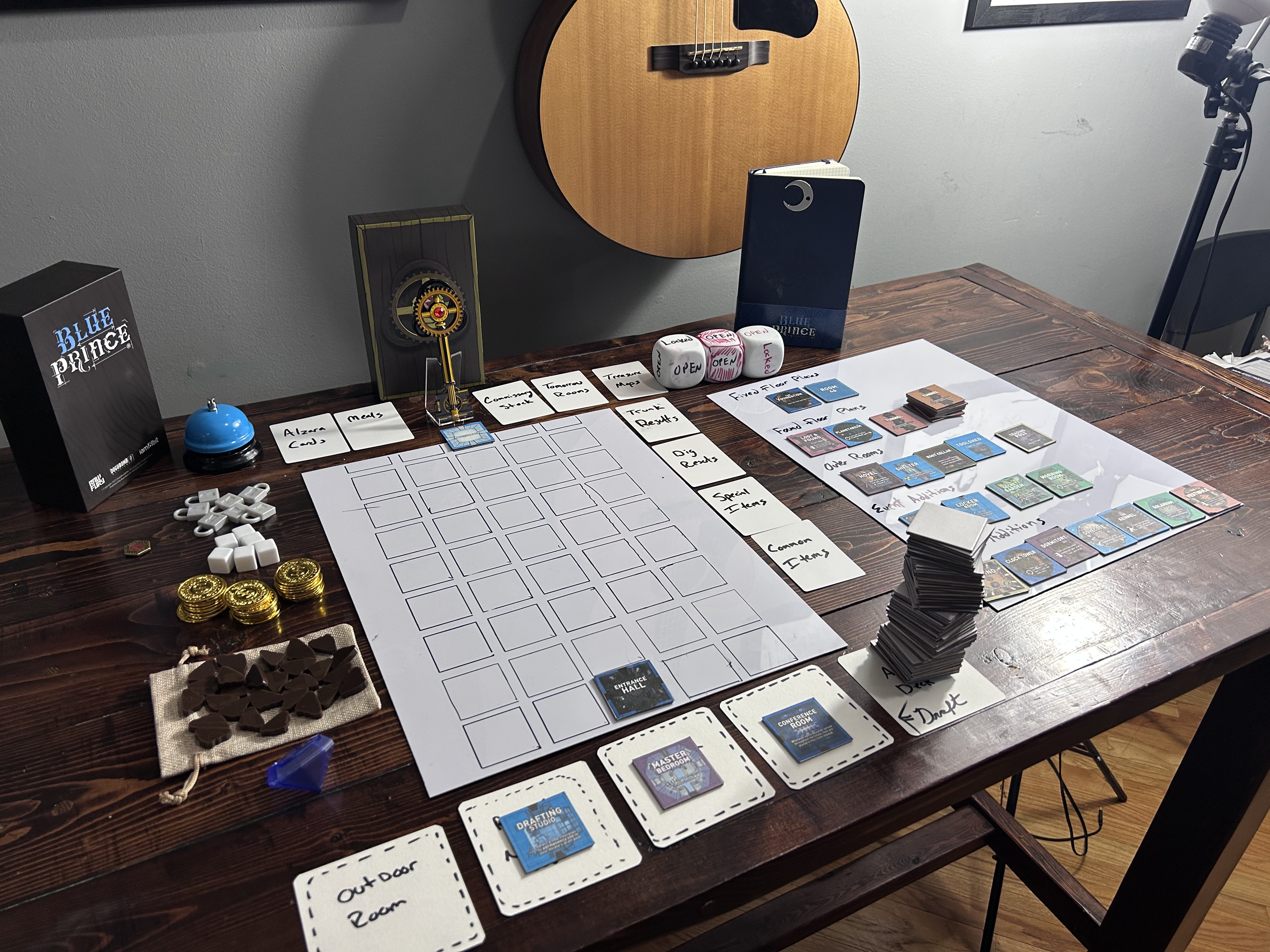
The fix was immediate and came from outside the project entirely — a large felt drawstring bag borrowed from another board game. The tiles went in. A shake randomized them. Drawing three blind felt, if anything, more satisfying than drawing from a stack. A second question: where do unchosen tiles go?
Turns out the answer is the same bag. Research into the video game's mechanics confirmed that unchosen tiles in the VG go straight back into the draft pool — they can reappear on the very next draft. One bag. Shake to randomize. Unchosen tiles return immediately. The stack is gone.
All Core Room tiles live in a single drawstring Active Bag. Unchosen tiles return to the bag after each draft. Drafted tiles (placed on the board) are the only tiles that leave the pool. Redraws: set the 3 current tiles aside face-down, draw 3 new ones, return set-asides to the bag after drafting.
Problem 2 — Tile Size
The original prototype tiles measured roughly 1.875" square. At that size, a single token covers nearly half the tile face. Text is readable but only just. The board felt cramped and busy.
A second set was printed at 3.25" square. The difference is not subtle. Artwork breathes. Room names read from across the table. Tokens sit on tiles without obscuring anything critical. 3.25" square is now the confirmed target size.
Problem 3 — The Pawn
Movement was the biggest design surprise of the session. The rules called for moving the pawn one room at a time, deducting a step on each move. In practice, this felt like administrative overhead. The mental math was already happening — the pawn was just a physical confirmation of work already done in the head.
Halfway through the first run, the pawn stopped being moved step by step entirely. This wasn't a failure of discipline. It was useful information.
The pawn is replaced by a flat room marker — a coin or disk. To move, declare your destination. Count the rooms along your path. Deduct that many steps in one action. Place the marker on the destination. Transit rooms trigger nothing — you only collect resources at your declared destination.
Problem 4 — First Run Clarity
The existing tutorial walked through the draft sequence clearly. What it didn't cover was the moment after you've placed a tile and moved into a room. What do you actually do now?
After entering the Wine Cellar, taking gems, and returning to the Entrance Hall — the question became: did that cost a step? Do I roll? When does the Kitchen do something? The manor has a logic to it but none of that was surfaced at the right moment.
The tutorial is being expanded to cover the full room entry sequence — what triggers on arrival, how to acquire the Shovel, how shops work, how transit movement is calculated. The goal is a document you can follow for an entire first run without touching the rulebook.