Saturday, May 9th. Mike stops by unannounced with a coffee. I have the prototype set up on the table. He becomes my test subject.
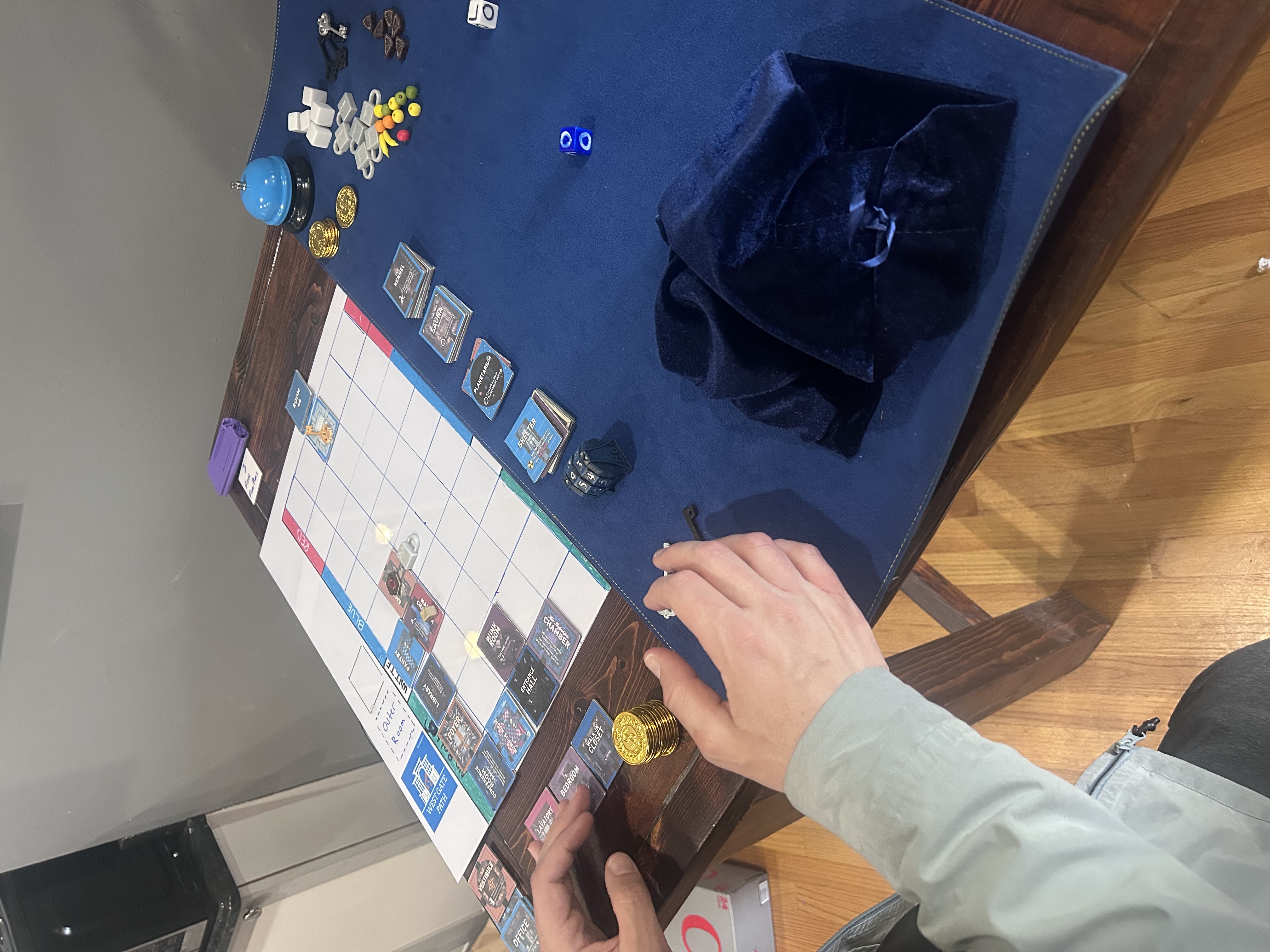
This was not a planned session. There was no briefing, no warm-up, no context-setting beyond the basic pitch: you're exploring a manor, you draft rooms, you're trying to reach the Antechamber. Go. That's roughly how most people would encounter this game — cold, from a box, without someone who built it sitting across from them explaining things. So I tried to stay quiet and watch.
What happened
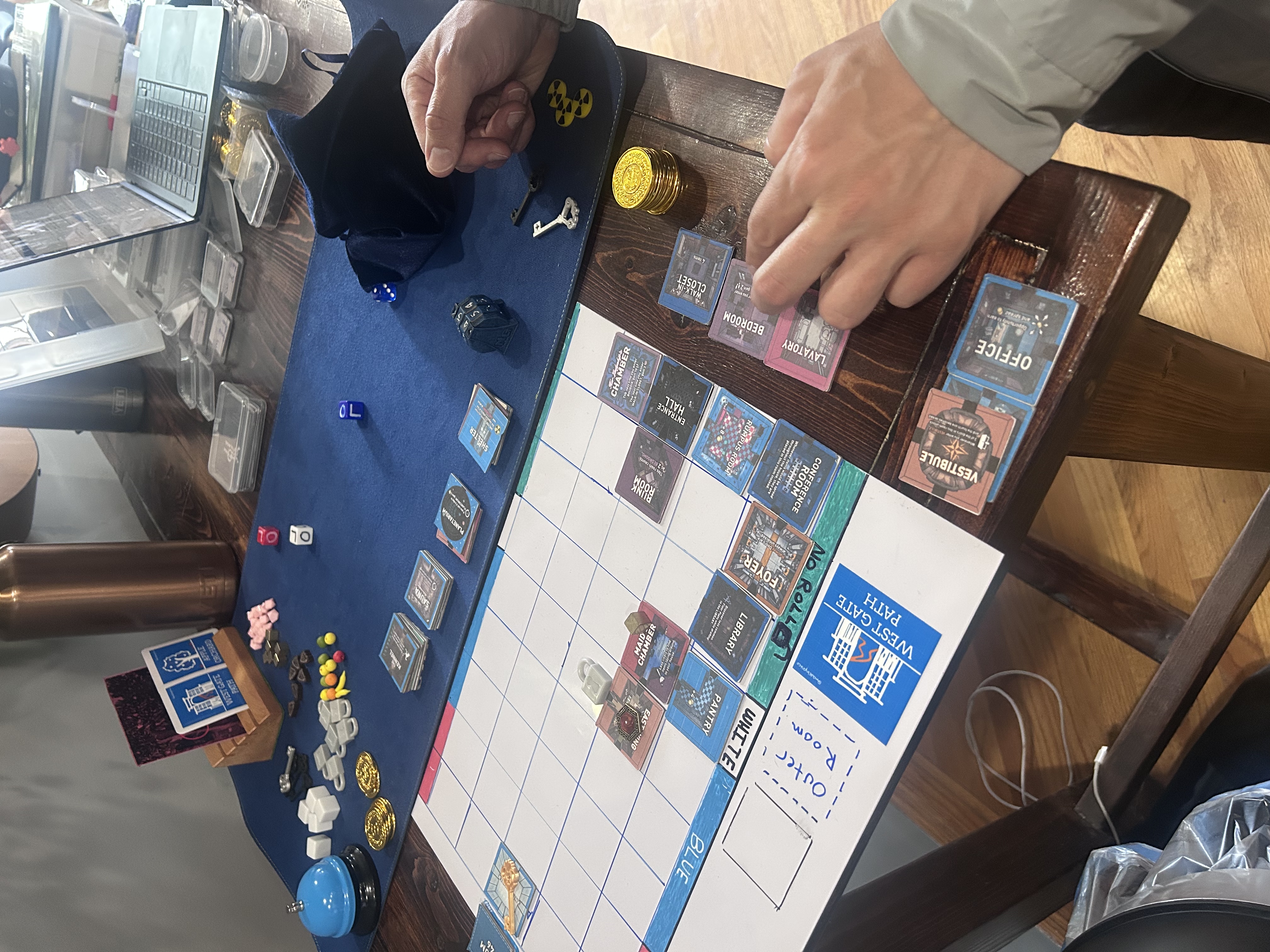
He got through it. That's the first thing worth saying. He completed a full game in about 40 minutes, won via a Secret Garden draft on the West Wing, and reached the Antechamber. The red room Archive effect fired correctly and he understood what it did. The basic loop — draft, place, enter, spend steps, manage resources — clicked without much friction.
Mike has never played the video game. That matters more than it might seem. Most of my own testing has been done with the VG fresh in my head, which means I carry a lot of invisible scaffolding into every session. I know what the Vault does without reading the tile. I know the Secret Garden requires an edge door. Mike had none of that. He was reading everything cold.
What he noticed
A few things came up that I'd stopped seeing.
The first was the lock die. He needed a reminder to roll it when he hit a locked door. The rule is in the rulebook and it's covered in the tutorial, but in the moment of play it didn't fire automatically for him. This is a prompt design problem — the action needs to be more obvious at the point of encounter, not just documented somewhere he read twenty minutes earlier.
The second was the Music Room. He drafted it, I awarded him the Secret Garden Key, and he was confused about how that happened. The Music Room has a two-step roll sequence: first roll to see if a Special Key is granted at all, then a second roll to determine which key. From where he was sitting, it looked like I'd just handed him something without a clear reason. The tile and the rules don't make that sequence legible enough in the moment. This one I want to fix — it's a clarity issue, not a design issue.
The Observatory felt clunky, though that's largely resolved now. The constellation booklet I've since printed gives him a physical reference at the table instead of a screen lookup. The remaining issue is the Telescope — what it does in the context of the Observatory d6 roll isn't obvious from the item card alone. That needs a clearer written entry.
He mentioned the Shovel exactly once, near the end: "Shovel seems irrelevant." It never appeared in the run. I'm not reading that as a balance problem yet — it's one session and the bag has a lot of tiles. But it's worth tracking across future playtests to see if the Shovel consistently fails to show up or consistently fails to matter when it does.
On gems: he expected to find them more often. "Every few rooms or so" was how he put it. The current cadence doesn't match that expectation. Whether the expectation needs adjusting or the cadence does is a question I'm leaving open until I have more data.
The ideas he brought
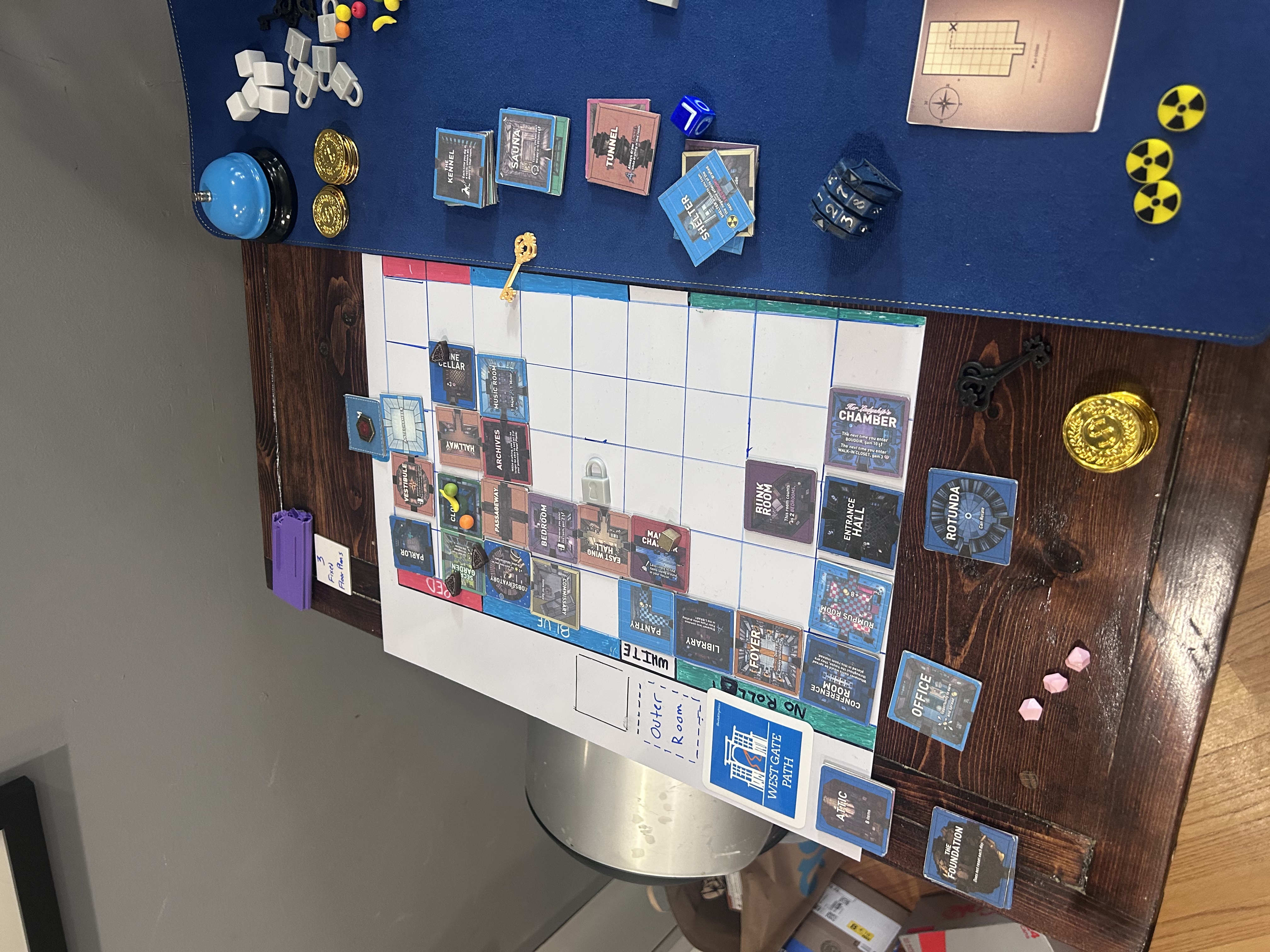
The most interesting part of the session wasn't the rules issues. It was the suggestions he made without being asked — the things a first-time player volunteers, unprompted, because something about the physical experience prompted them.
He kept coming back to the drafting bag. A few times throughout the session he gestured at it and suggested something like a spinning container — a lottery ball cage, the kind you turn a handle on and a ball drops out. He wanted the tile draw to feel more like a lottery moment. This is cosmetic rather than mechanical, but it's worth noting because he mentioned it multiple times. The draw experience matters to players in a way I'd underweighted.
When he picked up an item card, his first instinct was to hold something physical. The card felt like a receipt rather than a possession. He didn't articulate it exactly that way, but that's what I observed — he looked at the card and then looked around the table as if expecting a token to go with it. This opens a real question about the item component design: should high-frequency items like the Shovel, Telescope, and Lantern be physical tokens rather than cards? It would reduce the card footprint and make the inventory feel more tangible. Filed as a design idea, not a decision.
The laptop comment was direct: going to a computer to look up room rules mid-game is not realistic for most people. He suggested a QR code on the back of each tile — scan it, pull up the room on your phone. It's a genuinely good idea. The feasibility is real (unique codes per tile, stable hosting, print complexity), but the underlying problem it solves is real too. Room lookup shouldn't require a device that isn't already in your pocket.
And then, unprompted, near the end of the game: "this could be a two-player game. Two boards, one bag, you draw against each other." He said it like it was obvious. I've thought about a co-op mode before, but competitive — racing from the same tile pool — hadn't been on my radar. I want to test it.
What the session cost me
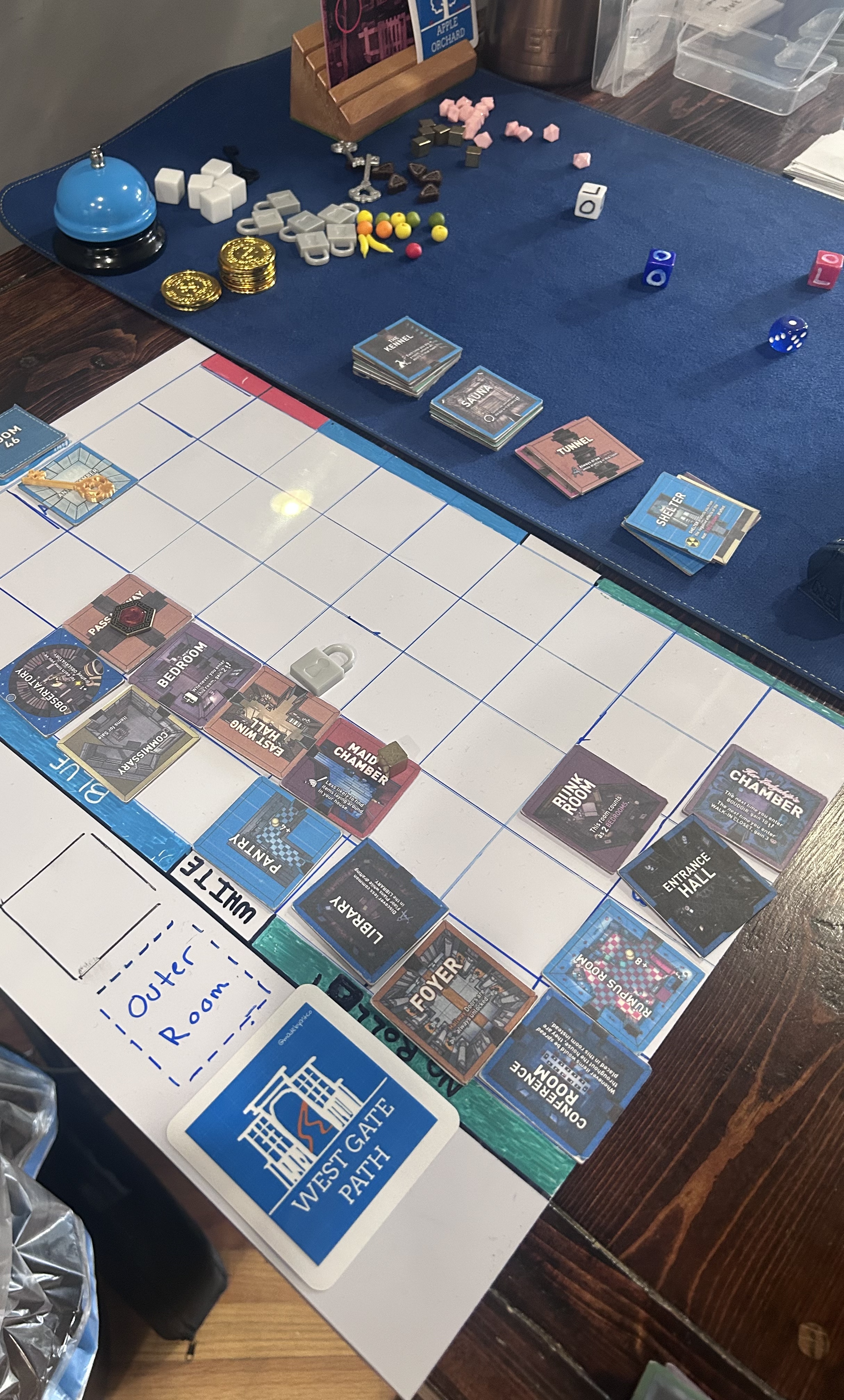
Mostly ego, the useful kind. I'd been playing this game with a map of it already in my head. Mike played it with a blank piece of paper. The places where he got stuck aren't the places I expected, and the things he suggested aren't the things I was looking for. That's exactly what a first external playtest is supposed to do.
None of the issues he hit are fatal. The rules clarity problems are fixable. The component observations are worth sitting with. The 40-minute win from a cold start, by someone who has never seen the video game, is a reasonable proof of concept.
The mat helps, by the way. The navy surface pulled everything together in a way I hadn't fully appreciated until I watched someone else sit down in front of it.