This post is about deletion.
Specifically, it's about deleting a mechanic I'd spent real time on, written rules for, designed a reference card for, and carried forward from session to session with the assumption it would eventually get playtested. Instead, it got cut. The cut happened in a single conversation, but the reason it could happen in a single conversation is that the problem had been quietly there the whole time. I just wasn't looking at it.
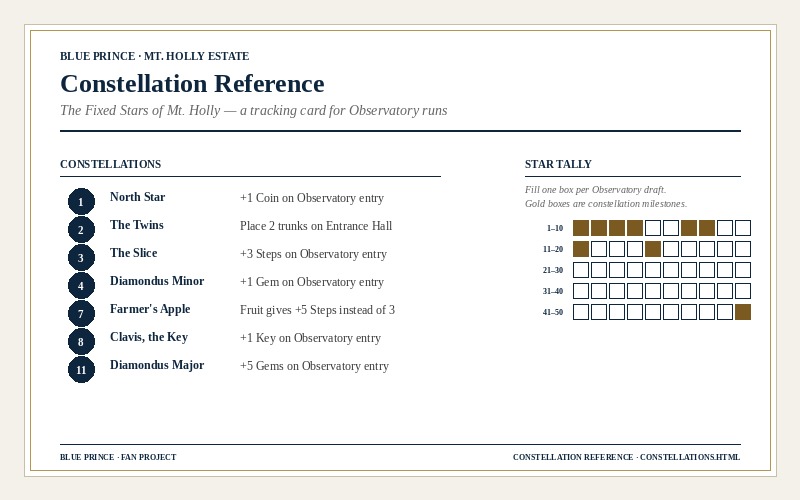
What we had
The Observatory in the board game used to work like this. Every time you drafted the Observatory, you marked a tally on a star track. Stars accumulated permanently across your whole campaign — they never reset. When your tally crossed a milestone (1, 2, 3, 4, 7, 8, 11, 15, 50), the matching constellation activated. A printed reference card listed them — North Star, The Twins, The Slice, Diamondus Minor, Farmer's Apple, Clavis, Diamondus Major, The Sail, and a 50-star "Redraft Unlock" at the top of the ladder. Every constellation you'd reached was cumulatively active from then on.
The campaign sheet had a 50-box tally grid with gold-bordered milestones. The shopping list called for a printed "Fixed Stars" booklet. It looked good. It felt like design.
Except it didn't actually work.
What the video game actually does
I went back to the wiki and read carefully, which is something I should have done a lot sooner. The actual Blue Prince constellation system is this: drafting the Observatory gives you one permanent star. When you use the telescope inside the Observatory, the game generates a night sky. The constellations that appear in that night sky are whichever ones have star values that sum to your current star count. At 6 stars, the sky contains The Twins (2) and Diamondus Minor (4). At 9 stars, it might contain The Slice (3) and Diamondus Minor — or some other combination summing to 9.
You activate each visible constellation individually by interacting with it. Some fire immediately (gain a coin, gain a gem). Others are passive for the rest of the day (The Sail discounts all shops). The night sky locks after the first viewing each day — re-entering the same Observatory doesn't give you a second round of activations. The Telescope item is what grants a second night sky per Observatory.
At 50 stars, a new constellation appears — The Ink Well — which lets you spend stars to redraw rooms during drafting. At 100 stars, the Spiral of Stars.
None of what I'd built reflected any of this.
Three rules, three different mechanics
When I went back and read what I'd written across our own docs, I found the mechanic described three different ways depending on which file you opened.
The reference card said constellations "stack cumulatively with all lower-tier constellations already earned." Reads as: once unlocked, permanent forever. The rules document said constellation effects "apply for the entire run in which the Observatory is drafted." Reads as: per-run, not permanent. The Telescope entry said it lets you "activate one constellation and apply its effect." Reads as: you pick which one, one per visit.
These are three different games. A player who asked a reasonable question — "I reached 8 stars last run, is the Diamondus Minor effect always on now, or only when I draft the Observatory, or do I pick which one to activate each time?" — would get three contradictory answers depending on which document I handed them. I'd been avoiding noticing this. The star system felt sacred because it was in the video game and it felt like meta-progression. It had sat in the docs for months, gradually accumulating mutually incompatible rules, and I hadn't looked it in the face.
The number that made it impossible
I played four campaigns over the last two weeks. Campaign 1 ended on Day 1 Run 1 (we hit a wall immediately and called it off). Campaign 2 made it to Run 2. Campaigns 3 and 4 each won on Day 1. Winning campaigns are supposed to end in four days, in the video game. In the board game, they've been ending in one. I am not a fast player — the runs are routinely 45 minutes or longer — but the way the win condition works, the player is pushing toward Room 46 constantly, and there's no mechanism that forces the campaign to span many runs.
Which means the 50-star milestone on the tally grid was always unreachable. Even if a player somehow drafted the Observatory twice in every run of a 4-run losing campaign, that's 8 stars. Ending each run in the Planetarium gets to maybe 12 or 15. The "50 stars redraft unlock" was a line of text on a card that would never fire.
The 15-star milestone (The Sail) was probably also unreachable in a standard campaign. The 11-star milestone (Diamondus Major, +5 gems) was borderline. Which meant, in practice, the only constellations players would ever see were the first four — North Star, Twins, Slice, Diamondus Minor. The rest was scenery painted on the back wall.
Why I didn't cut it earlier
Because cutting something that's in the video game feels like a failure. That's the real reason.
The board game is a fan adaptation. Fidelity to the source is a design value — if I cut a mechanic, I have to justify it, and justifying it requires admitting that the board game and the video game are not the same thing and can't be. That admission is uncomfortable. There's a version of this project that tries to port every mechanic one-to-one and ends up being unplayable but technically faithful. That's a real trap and I had been quietly walking into it.
The other reason is that the old design looked good. The tally grid with its gold milestone boxes was a satisfying piece of paper. The nine-constellation ladder had the feel of a small book. Subconsciously, I think, I was protecting the art from the math. Art lives on the card; math lives at the table. The math said the art would never be used.
What replaced it
The new mechanic is three sentences long. When you first enter the Observatory this run, roll a d6. Apply the effect from the reference card. If you have the Telescope, roll twice. That's it.
| Roll | Constellation | Effect |
|---|---|---|
| 1 | North Star | Gain 1 coin |
| 2 | The Twins | Place 2 trunks on Entrance Hall |
| 3 | The Slice | Gain 3 steps |
| 4 | Diamondus Minor | Gain 1 gem |
| 5 | Clavis, the Key | Gain 1 key |
| 6 | The Sail | Commissary, Kitchen, Locksmith 50% off rest of run |
Nine constellations collapsed to six. Stars are gone. The tally grid is gone. The 50-star Redraft Unlock is gone. Farmer's Apple and Diamondus Major are out of the base set. The Sail moved to roll 6 — it was the most distinctive constellation and the one I most wanted to keep. The Planetarium now gives a carry-forward benefit (next run rolls twice). The Telescope does the same. Both stack. Her Ladyship's Chamber's end-of-day bonus, which used to give +1 star, now gives +1 key — thematically tied to the Diary Key lore in the video game, which felt like a small win.
What the d6 actually gets right
The central design tension of the video game constellation system is this: you don't control which constellation fires. You look at the night sky and see what's there, and you take what the stars give you. That's the feeling to preserve. In the video game, the mechanism is the star schedule. In the board game, the mechanism is a d6. Different machine, same feeling. The player does not choose their constellation. They enter the Observatory and discover what the night is.
What I lost: cumulative campaign progression. The satisfaction of crossing a milestone. The 50-star payoff. The 100-star late-game content. All of that is real and it's worth naming honestly. What I gained: a mechanic that can be played at the table in four seconds with no lookup, no star count math, no combination-of-additive-partitions logic, no campaign sheet real estate, and no rule-writing gymnastics about what "activate" means. The new rules are precise because they have to describe much less.
A board game is not a video game with physical parts. It's a different medium with different constraints. When you try to port a mechanic that depends on long-horizon meta-progression into a medium where campaigns end in four days, one of two things gives — either the mechanic or the medium. Let the medium win.
What stays on the shelf
One piece of the old system is preserved as a future idea rather than cut. The video game has an in-world artifact called The Fixed Stars — a library book that describes each constellation with flavor text and star-pattern illustrations. It's the kind of object that makes a world feel furnished. For an expansion, I want to produce a saddle-stitched printed booklet that preserves the lore-flavor of that book without re-introducing mechanical complexity. Players would read it at the table for atmosphere; the d6 keeps doing the work. The mechanic and the object can be separated. That's noted in the design-ideas backlog.
What this felt like
Honestly, uneasy. The decision to cut the star system was one conversation, but sitting with it afterward was less clean than that. There's a version of being faithful to a source that becomes a trap — you carry forward complexity that the source can support but your format can't, and the result is worse than either a proper adaptation or a proper original. I'd been in that trap on this mechanic for months without quite knowing it. What it felt like from inside was "I'll figure out the constellation rules later." Every time a session audit surfaced an inconsistency, I'd patch the specific inconsistency and not question the system. It took a playtest pattern — campaigns ending in one day — before the underlying problem became undeniable.
The honest signal, in retrospect: if a mechanic has been in your docs for months and you've never reduced it to a single crisp rule, you probably don't have one. I didn't have a rule. I had three rules that disagreed with each other, a tally grid that would never fill, and a 50-star unlock that would never trigger. None of that was going to survive contact with the table. Cutting it wasn't giving up on the video game's design. It was admitting that the board game had its own design and the two had been allowed to drift.
The card is simpler now. The rules are shorter. The player doesn't have to track anything between runs except the carry-forward note if they ended in the Planetarium. And the Observatory still has what it needs to have — the moment where you enter the room and don't know what the night will give you.